
So stupid it's fun
The guys at Det Norske Teatret are so stupid that it's funny, writes Fiona Åtland (20) in this illustrated review.
After an hour and a half at the “friendship museum” at the old Munch, it sounded like the audience was wearing rubber boots and it was as if they had planned to only clap every other beat. What is the value of putting on such a performance?
The performance You Mean All the Words at the old Munch Museum is a newly written friendship performance, and when I was sent the ticket it said that you could have up to six people on one ticket. On the website, the theater company Leikhus specifies that you should see the play with someone you love, and I therefore brought my mother with me. Earlier in the day I wandered around Tøyen, which in itself is a cultural experience with a range from idyllic surroundings in the botanical garden to the premises of the former Munch Museum. It also occurred to me that the old Oslo district, to which Tøyen belongs, is the district that is affected by the biggest cuts in the Oslo municipality's budget proposal. Among other things, a cut that affects preventive work for children and young people and leisure activities in the district. The performance, on the other hand, repeated a banal message and was far less engaging.
For the occasion, Teater Leikhus had converted a hall in the old Munch Museum into what they call the “friendship museum.” The audience moved between twelve stations with small group tasks, such as sharing a donut in the middle, answering personal questions, or playing Twister with their ticket partner.
In the middle of the room stood a trampoline, a bunk bed and a sofa. The scenography symbolized the life stages of the six performers we follow from childhood to old age. Three generations of actors; children, young adults and older women, played the same pair of friends throughout their entire lives. When the lights in the hall were on, the audience could explore the room freely, but when they were dimmed, the actors took the stage and acted out small everyday tableaux. These were often related to the furniture in the room. In one of the scenes, for example, we observed two little girls playing hide-and-seek around a trampoline.
The play depicts periods of poor communication and growing conflict in a friendship between two girls. The title You Mean All the Words is a phrase they created themselves, which contains all the good things they want to say about each other. The phrase is a reminder that friendship must be nurtured by seeing and affirming the other. Through the ups and downs of life, the characters become increasingly self-centered and forget this special phrase.
Director Eva Rosemarijn has stated on the theatre company's Instagram page that the performance is important because it looks at what we take for granted and take for granted. However, as the scenes unfold, several of the dialogues become repetitive and over-explanatory. Instead of giving everyday life and friendship a symbolic value that could illustrate that we must not take it for granted, everything becomes very literal. Small arguments about overeating and overspending attempt to symbolize the underlying problem of poor communication, but in practice appear as whining. Communication is about more than just words. Behind what is said, there are hidden motives and feelings, and it is these that make everyday dialogue exciting, not the trivial details about things and food that the performance overexposes.
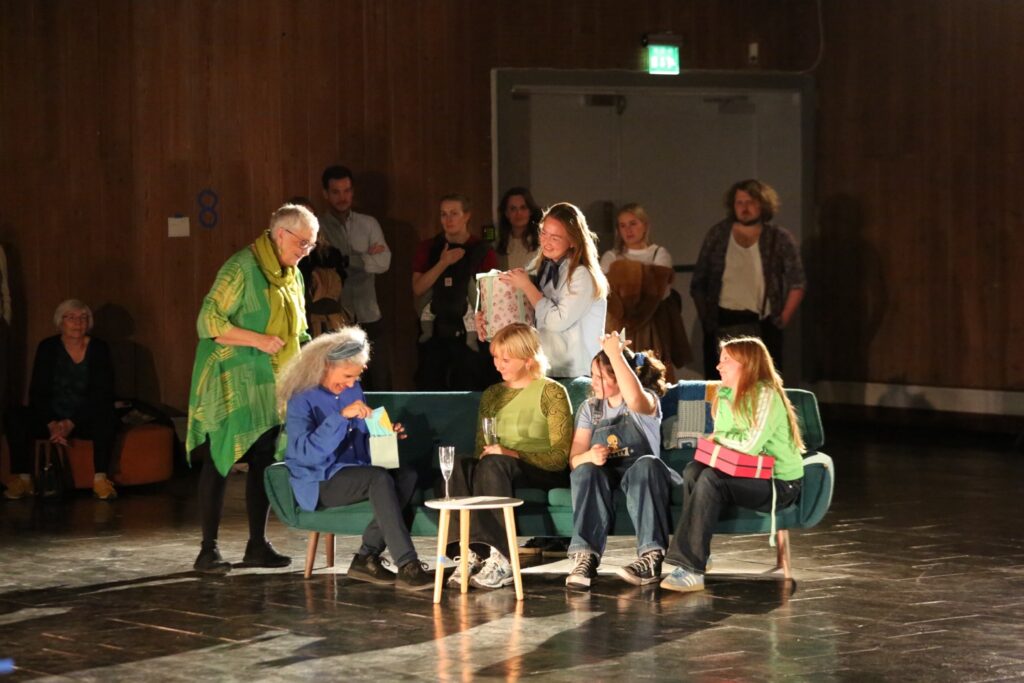
In my first encounter with the performance, I noticed that it was difficult to put aside the ironic distance from the material. At one of the stations, my ticket partner and I were supposed to tell each other about a time when we had felt betrayed by the other. It's cool that they dare, but it's not suitable for everyone, especially when, by virtue of the theater, you have a space where you are free to discuss things in a figurative sense. At the handing out station, I feel that the performance underestimates how demanding it is to answer such a question, while at the same time overestimating the emotional power that lies in asking the audience to answer it. There is clearly a desire for a heartfelt conversation between me and my mother, but I was left with a feeling that it was all too banal.
Despite the fact that the script addresses themes such as grief and hostility, the main character’s friendship problems do not appear to be more challenging than any other relationship. It is perfectly normal to have less contact with your friends at times or experience some form of grief, but when this is one of the main conflicts of the play, the character’s situation is more privileged than problematic. I started thinking about all the other completely ordinary relationships that were burdened by the new budget proposal for the municipality of Oslo. When child welfare services and financial support for single parents are cut, it becomes difficult to understand who will have the time and energy to get involved with this particular pair of friends. The play dwells on a completely ordinary friendship without acknowledging that that is exactly what they are; ordinary. So when the lights turn on and I move on to the item “do you really know each other”, I think it is all a bit petty.
The performance is too self-congratulatory and I miss a touch of self-irony or an overview of the bubble they live in. An example of the opposite can be found in the TV series Exit , when the financier Celine in episode three of season one reacts to her husband's suicide attempt by saying "he shot himself so everyone can see it". The moment is laughably tragicomic because she acknowledges her own self-absorption in a brutal moment. It's a form of self-awareness that makes the scene human and a little unpredictable. It's nice when realistic dialogue centers around natural reactions other than being empathetic.
You mean all the words appears lavish, but fails. Teater Leikus has been given a hall for neighborhood activities in Tøyen, but still does not take into account that they are asking the audience to give themselves up, without being able to create a safe space for it. The question arises: Who is this performance made for?
In that question, there is a feeling that the production is in a bubble. The performance is a project that wants to open up, but becomes too self-referential. The audience is invited to participate, but on the artist's terms.
A similar issue was raised when the artist trio Tani Dibasey and Only Slime (Claudia Cox and Tobi Pheil) took over stage 3 at Det Norske Teatret earlier this year. With Dibasey at the helm, they took the lead in acknowledging the wanking of cultural Norway – a self-reinforcing cycle of networks and self-staging. I was lucky enough to see the final performance of their production Fight . The performance was an endless trip and ended with Dibasey himself having to acknowledge that he felt he had become part of what he had previously criticized. As a result of their success , he believes that he is no longer the voice of those who do not usually see theatre.
I have noticed that I am starting to get to know more and more people in the theatre halls I sit in. There is a lot going on in the people I have seen on the Instagrams of the various theatre institutions, from the theatre and folk high school at the Roman Empire and acting students from Kristiania University College. Many of them have a forward bend in their necks to give their active hands a hold when they talk during the break. I agree that it is important that those interested in theatre also have a meeting place, but if one is going to defend the renovation of the Nationaltheatret for 10 million, the 700 seats in the hall on the main stage at the Nationaltheatret should be filled by more people than those who dream of getting into a theatre school. This generalizing statement is the start of a dark hole growing inside me.
When people are critical of cuts in cultural support, there is a part of me that thinks that it only affects the artist, especially when there are also cuts in preventive work for children and young people. The media highlights that theatre is inaccessible to those named Ahmed or Abdullah, that is not true. It is really not only those with foreign names who do not understand theatre. My name is Fiona and I have friends named Åshild and Marius who experienced that Macbeth on the main stage at the National Theatre did not reach the audience. Good acting performances and a creative set design, but what was the performance really about? These thoughts belong to a utilitarian ideology that usually makes me furious, but which nevertheless supports the hypothesis that the Theatre from the outside can resemble a closed circuit with a bit of incest.
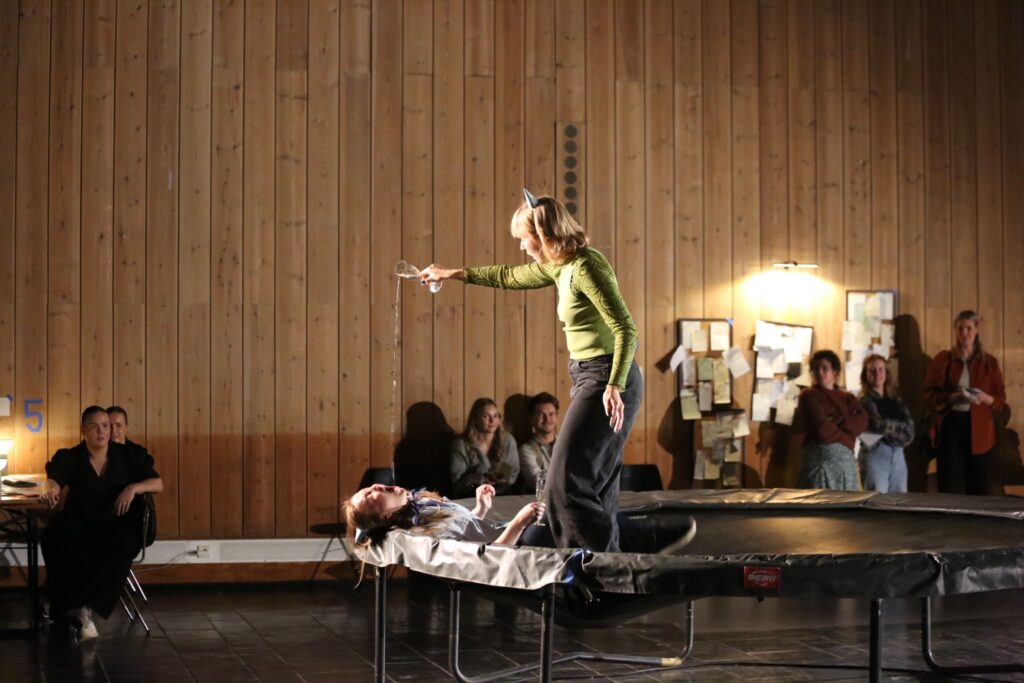
This opens up a larger question: Why is it so difficult to change the system you are a part of? In You Mean All the Words it may be about a desire to stage one's own story. The performance's program shows a photo of the scriptwriter and director, taken when they were about the same age as the child actors in the play. This can be read as an expression of how the project reflects themselves, but that is just speculation. Perhaps the answer lies in the question of who this performance is made for? It is made for those who have made the performance and not those who watch, it seems to me. The performing arts are reduced to the creator's own artistic project with little room for the spectator.
The contrast became clear when a few days later I saw a performance at the Oslo National Academy of the Arts – Folkefiende written by Liv Heløe. It was theatre that included the audience, that did not just reflect itself and that I experienced as more innovative. The text was about, among other things, the cost of taking a stand, and giving a single voice to the compact majority. It was clear that the director Anna Sharko has a thorough respect for what Heløe is trying to convey with her text. The result was a clear and well-thought-out performance that demonstrated how quickly self-criticism can slip into self-righteousness. The performance is innovative because it does not limit the use of the text to tell a story and thus does not repeat the same point.
Sharko transformed the monologue voice into a chorus that seamlessly changes the direction of the story. The first voice is both self-pitying, self-ironical and serious at the same time. The actors were a big amoeba that slithered through different narratives. It was entertaining and thought-provoking. The humor lay in how even small things, like buying fresh bananas at the store, were bad climate responsibility. I think the performances were innovative because they don't repeat the points through text, but explore spacious relationships, the humor behind the words, entering different narratives. Where You Mean All the Words was navel-gazing, Folkefiende turned its gaze outward. In You Mean All the Words, Teater Leikhus didn't need to create a repetitive friend rebus that asked me to “draw my partner” to track down something more existential. In my mother's drawing, I looked like a sausage and that just irritated me.
November 5, 2025
By: Theatre Playhouse
Script: Lise Andrea
Directed by: Eva Rosemarijn
Dramaturgy: Lise Andrea
Scenography: Daniel Vassjø
Video: Eivind Helgeland
Design: David Pedersen
Actors: Irene Nessa Bjørnevik, Pernille Horntvedt, Marie Satyami Vik, Tone Hoemsnes, Maria Taranta-David, Karla Juel Grimsby
Produced by Leikhus
All photos: Leikhus / Daniel Vassjø
Also mentioned in the text:
Enemy of the People – KhiO Theatre Academy
Fight! – Det Norske Teatret / Scene 3. Reviewed by Unge Stemmer here and here .
Macbeth – National Theatre. Reviewed by Unge Stemmer here .