
So stupid it's fun
The guys at Det Norske Teatret are so stupid that it's funny, writes Fiona Åtland (20) in this illustrated review.
Who would Macbeth have been if the events in the play had happened today? The modernization of Macbeth manages to connect the past with the present.
Macbeth premiered at the National Theatre on October 17. The famous royal drama, originally set around the year 1000, has been given a strong modernization in Marius von Mayenburg's version of the play.
In the lead role we have Macbeth (Ola G. Furuseth) who is told that he will become king by three sisters of fate. Macbeth and his wife, Lady Macbeth (Marian Saastad Ottesen), decide to kill the current king so that he himself can become king as predicted. He therefore decides to eliminate everyone who can come between him and the throne. Megalomania and arrogance are central themes in the play and are no less relevant today than when it was written in the 17th century. I think the performance brings out the themes of the play very well, while modernizing it for a modern audience.
On stage is a tower covered in white tiles. It contains two balconies, a narrow staircase, secret doors and a room without a door, but with a plastic curtain. The moving set design helps to make the scene changes seamless and creates a completely different dynamic than what Shakespeare is known for. The play has 32 characters divided between 6 actors, an enormous logistical task that they have managed to carry out impressively. When the Thane of Cawdor is executed, for example, the actor takes off his Cawdor mask and becomes King Duncan's son with the traitor's head in his hands.
The tower is also used as a canvas for 3D mapping throughout the piece. This is a projection method that allows you to bend the images as you wish and therefore cover a 3D figure with images on all sides. You can also mark parts that you do not want the image to cover. This creates a sense of space and gives the audience the opportunity to focus on several things at the same time, such as both the images on the tower and Macbeth standing on one of the balconies.
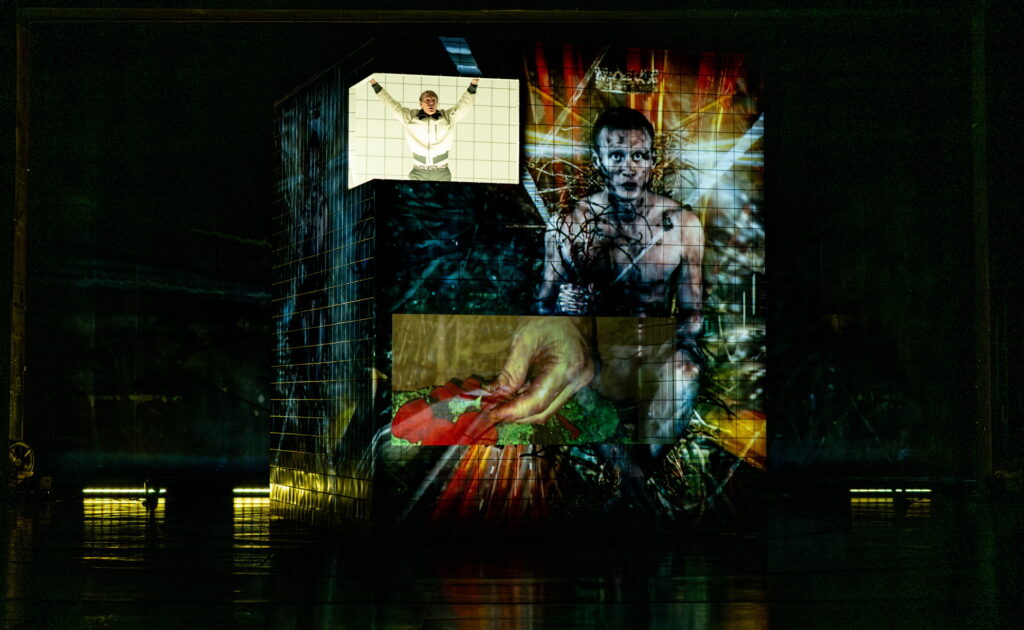
Another element is a transparent stage curtain that is lowered in front of the stage, acting as a screen for projection, while the actors stand behind it. This makes it feel as if the characters are in their surroundings and not in front of the stage as in theater with analog scenography.
The performance has been heavily modernized. Guns and bats are used as weapons, biker suits and cowboy hats as costumes, while drugs and alcohol are props. But the performance still relates to the original. In several places it resembles Morten Krogstad's re-writing, which I read in advance of the play, with some exceptions of a little swearing and a few more modern words here and there. This creates nice contrasts between the old-fashioned and the modern language and makes the dialogue exciting to follow.
The plastic curtain, the white tiles, Macbeth's chainsaw and his oval glasses (which are suspiciously reminiscent of Jeffery Dahmer's) contribute greatly to the serial killer style of the promo images. This gives a modern twist to the king-killer Macbeth.
Jeffery Dahmer is one of the world's most famous serial killers and was convicted of killing 17 people in 1992. In 2022, a Netflix series about him was released, where the poster is reminiscent of the poster for Macbeth, with the yellow light, bangs and glasses. By connecting Macbeth to Dahmer, they connect Shakespeare's work with people we recognize from our own time. The play is not only modernized, but set in our time. Who would Macbeth have been if this had taken place in modern times? What would he have looked like? I think Mayenburg thinks he would have looked like the famous serial killer, if it hadn't been him.
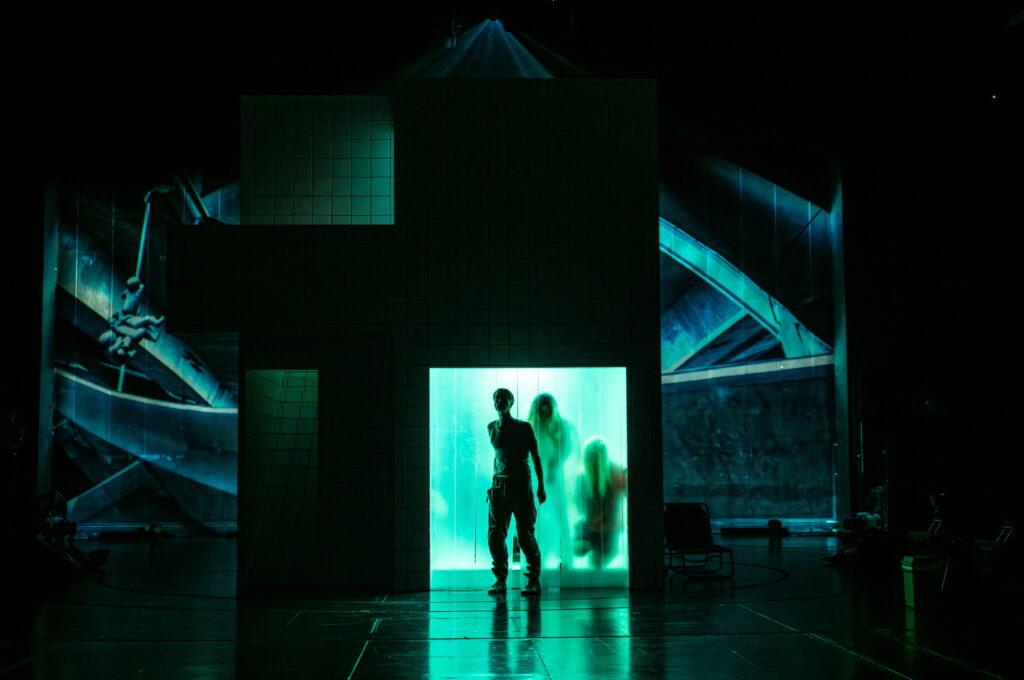
Another example of the modernization of the play is when the king’s son is declared a prince. He stands still for a while and it seems as if everyone is waiting in anticipation for what he will do and how he will react to such power. After a bit of a huff, he shouts “YES!! YESYESYES” and jumps around the stage. I doubt that this is how Shakespeare intended his reaction to be, but it works well as a reflection of today’s less formal standards and behavior. It is a great contrast to the original play and creates a funny and laugh-out-loud scene.
In the original, Malcolm, the king's son, is a humble prince, much better suited to be king than Macbeth. Throughout the play, especially the scene described above, he is portrayed as more self-absorbed. Perhaps we lack role models to create such a character, or would a humble prince of this kind simply not be credible in today's society?
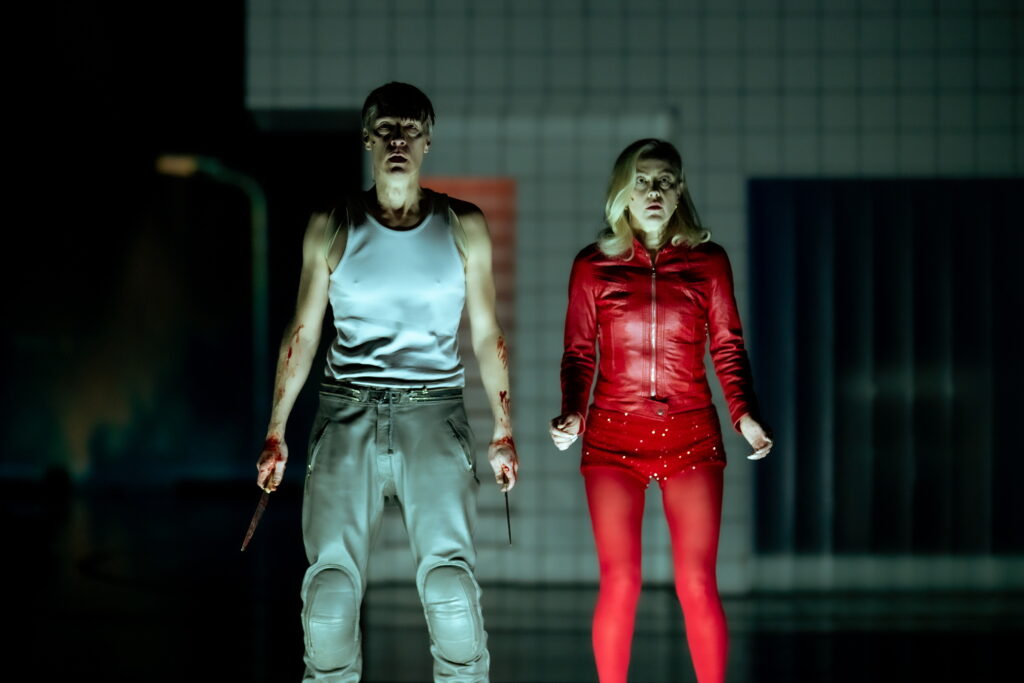
The very theme that the play revolves around, megalomania and arrogance, can easily be mirrored to today. Those who seek power for the sake of power, those who have such arrogance that they no longer care about fear or danger, will eventually get themselves killed. In today's society, there are plenty of these. One might hope that we are beginning to approach the last act, but there is little evidence of that.
October 20, 2025
On stage: Ola G. Furuseth, Marian Saastad Ottesen, Trond Espen Seim, Ole Johan Skjelbred-Knudsen, Alfred Ekker Strande and Jonas Hoff Oftebro
Director: Marius von Mayenburg
Scenographer and costume designer: Nina Wetzel
Composer: Nils Ostendorf
Lighting designer: Agnethe Tellefsen
Video designer: Sébastien Dupouey
Dramaturg: Hege Randi Tørressen
Mask maker: Nina König
Producer: David Parrish.
Director: Karoline Husjord.
Prompter: Lise Roesen.
Stage manager: Kristian Gunnerud Maurstad.
Lighting designer: Hanne Marte Griffiths.
Sound engineer: Stian Kjelstad Granmo.
Video director: Frode Finslo.
Production manager costumes: Maren Sælensminde.
Costume technician: Cecilie Marie Lind Hansen and Gracia Cerrato Thorsberg.
Props: Pelle Enebro.
PR manager: Hilde Crone Leinebø.
Communication manager: Gunhild Kilde.
Assistant to scenographer and costume designer: Asta Hansen. Dramaturg assistant: Ylva Armand Lillo-Stenberg.
Poster image: Erika Hebbert. Video: Jonas Falck Evensen.
Macbeth is written by William Shakespeare, adapted by Marius von Mayenburg and translated from German by Elisabeth Beanca Halvorsen.
October 17, premiere.
Main photo: Erika Hebbert. All other photos: Lars Opstad