
A sensitive Hedda Gabler
Katona József Theatre from Budapest has created an emotionally intense modernization of Ibsen's classic, which shows Hedda's feeling of emptiness and loss of control.
Meliorism will accommodate everything: heartbreak, fathers, loneliness, emergency supplies and the meaning of life. Not everything works, but when the performance hits the mark, it feels as if someone has taken the mind of a 19-year-old and laid it out straight on the stage floor.
Damn, I've never felt so watched in a theater before. As a 19-year-old girl who has just gone through the biggest change of her life, has just moved to Oslo, is newly single, and is fairly new to her studies – all at the same time. Both the actors and the play Meliorisme itself showed me that the questions in life never stop coming: Why do you have heartbreak and why do you really want to be with those who hurt you, and what should you have in your emergency supply? This performance showed me that I was not alone.
The Torshov group in 2026 consists of the actors Petronella Barker, Marte Engebrigtsen and Maria Kristine Hildonen. In Meliorisme they have brought along the lead vocalist of Valkyrien Allstars, Tuva Syvertsen, to create and develop this performance together. The premiere was originally scheduled for April 22, but due to Hildonen's illness, the premiere was postponed to April 27 - in the hope that Hildonen would recover. Unfortunately, we had the opposite outcome, and Hildonen was absent, and her lines and actions were read and performed by the other actors in collaboration with a prompter and stage manager.
Petronella Barker, Marte Engebrigtsen and Tuva Syvertsen are all a good deal older than me, but it felt as if they had lived my life and retold it on stage. Dressed in cool, embroidered overalls, made by set and costume designer Birgitte Mørk Winther, they opened up about all of life's questions. I was completely shocked when they asked the question: “Who are you when no one sees you?”, because this is a question I ask myself all the time. It is a question that involves all the helpless and strange thoughts you have as a young person, and the will and desire to find your place in this world.
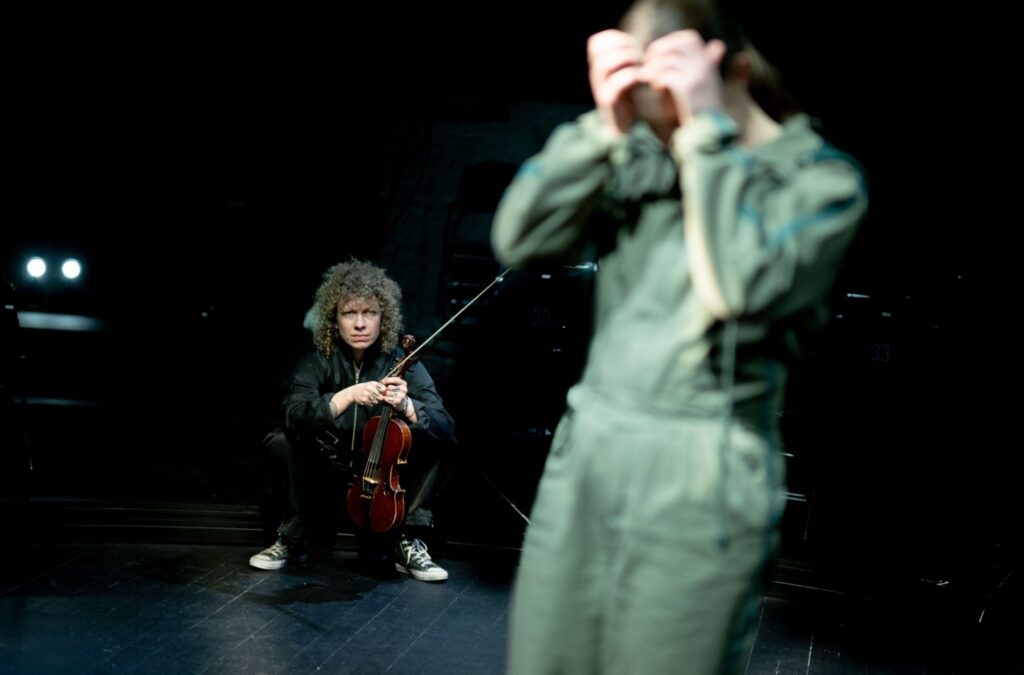
The theatre's website states that 'meliorisme' is a philosophical idea about what lies between pessimism and optimism, and that the performance itself is based on the actors' own experiences and lives. This makes the performance real and relatable, but also a bit incoherent. The actors' own names are used in the performance, so the distinction between role and private person quickly blurs. In this review I use first names when talking about role and last names when talking about actors.
The one-hour performance feels almost episodic, where each segment could stand on its own, but in the context of the others, the whole thing weakens because it becomes messy to follow. There are four different life experiences that are to be told in a fairly short time, and they don't quite manage to do that. The performance is a mixture of monologues, dialogue, prose and beautiful music played by Tuva Syvertsen. All the different forms are performed one after the other, and music is often played in the background of the performed monologues. The episodic expression arises from the fact that each form stands on its own on stage, and there are no smooth transitions from scene to scene, only unfulfilled jumps. This is especially noticeable when the three of them in one scene have a flowing conversation between themselves, and then suddenly Petronella is up on the second floor and begins to perform a poem. The stage space is high under the ceiling, and this void has been chosen by the Torshov gang to fill with several ropes and a rope ladder hanging from the ceiling. It seems as if these ropes are mostly for decoration and a bit so that the actors have something to hold on to so that everything doesn't come to a complete standstill.
When I entered the room, I was quickly reminded of my own time as an actor in the drama department at high school. There, you also had to create what you thought were really important performances, with a lot of ambition, but which often ended up being messy and at times a bit too personal for the audience to be comfortable with. This is also experienced as the case with the Torshov gang. As an audience member, it felt like I could see the processes and not the finished result. I could understand what they had wanted to do, but I saw that they had not quite got there.
Unfortunately, it was clearly noticeable that Maria Kristine Hildonen was absent from the performance, not only physically, but also in the mood and quality of the play. Some of the emergency solutions they had chosen worked, such as when Petronella and Marte took over Maria's monologues. But when the prompter would take over individual lines, it broke the illusion that I was in the theater. I was pulled out of this beautiful and thought-provoking world they had taken me into, and I jumped completely out of my train of thought. As someone who has seen Hildonen shine in other performances before, I could recognize the way the text was laid out and heard and saw in my head how I imagine she would perform it.
It is the first half of the performance that captivates me, and it is the one I dream back to. I dream back to the feeling I had of being seen on a theater stage and of feeling that I was not alone in this world, and that everything actually went well because the big questions often had no good answer. Large parts of the second half, however, are something I do not need to see in my dreams. After they have intertwined the ropes hanging from the ceiling into a large and long braid in the middle of the room, in complete silence, this silence is broken by Tuva making rhythmic thumps on the floor – which build up. And the actors join in, one by one, with the thumping. It is a very long sequence of thumping that unfolds slowly: First the thumping turns into movement with their whole bodies, then we see them begin to undress. It becomes a kind of animalistic movement, and in connection with the stripping of their clothes, it becomes quite uncomfortable and boring to watch for a long time.
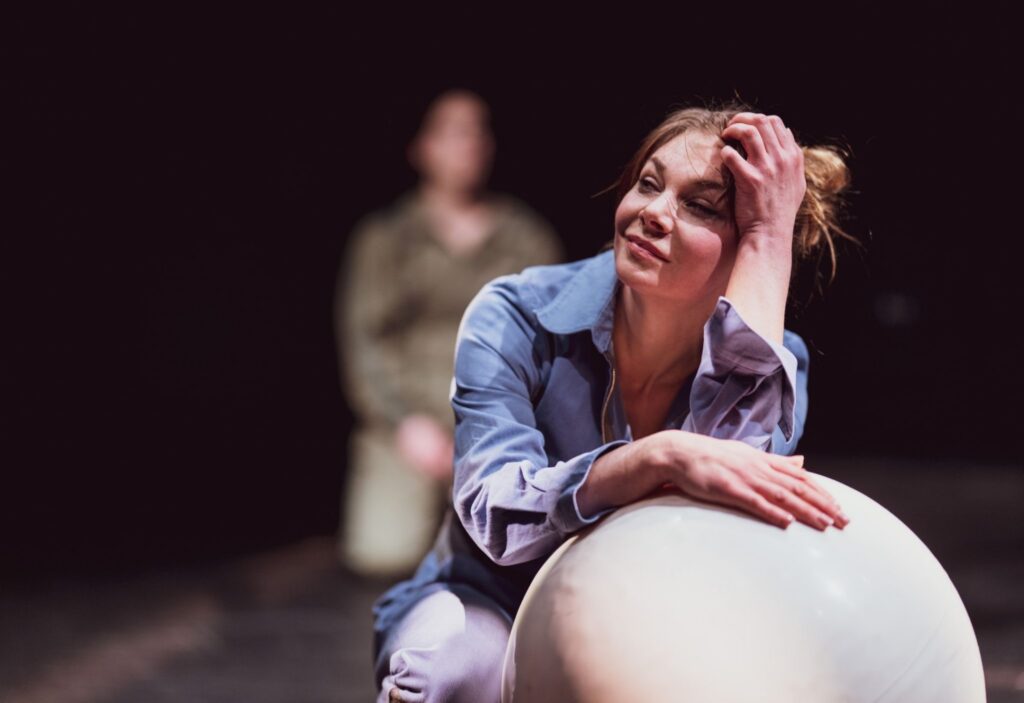
The rest of the second half wasn't as captivating (for better or worse). There were more monologues, even more philosophical conversations, but this time the conversations centered around a common theme. Much of what they said was about being the child of a parent, whether it's a mean father or an inattentive mother.
In general, there was a lot of talk about men in the second half, about fathers who are just a disappointment to you and how fathers can often become a hole and a loss. And how “blood can become so thin that it is thinner than water”. But they took the time to make us aware that “not all men”, not all men who are fathers are bad, not all men who rape, not all men who use their power in the world to oppress others. But where I sat, a 19-year-old girl completely new to everything, I felt that “no, maybe not all men, but a lot of them”. The fact that there were three women standing on stage and talking so much about men also made it seem almost like a bit of man-hating, and this part was no tidier than the first, so it turned into a kind of messy rant in different parts about man-hating. This was not entirely to my taste. Again, I can see what they want to achieve, and I would like to see them achieve it, because the ideas and messages are good, but the show could have been given a little more time to be fully completed.
There is still one consistent feeling I had during the performance, a wonderful feeling, not too bad and not too good, but somewhere in between, exactly how meliorism should be.
May 12, 2026
Occasionally: Petronella Barker, Maria Kristine Hildonen, Marte Engebrigtsen and Tuva Syvertsen
Choreographer: Kristin Ryg Helgebostad
Set and costume designer: Birgitte Mørk Winther
Lighting designer: Nils Haagenrud
Masker: Eva Sharp
Dramaturg: Elin Grinaker
Artistic consultant: Heiki Riipinen
All photos: Lars Opstad / National Theatre
National Theatre, Torshov Theatre April 27, 2026