
So stupid it's fun
The guys at Det Norske Teatret are so stupid that it's funny, writes Fiona Åtland (20) in this illustrated review.
Tani Dibasey innovates for the stage with the virtual world in the performance “Fight,” but a bumpy execution means that the theatrical experience does not reach its full potential.
The audience is given the responsibility of starting the performance at Det Norske Teateret, by choosing who is the main character of the evening. After a short introduction to the different characters, the choice fell on Mette when I saw her on May 16. The rest of the evening is her story, her “Fight!” that unfolds on stage.
The actress behind Mette's grey wig and big boxing gloves is Ane Dahl Torp. Lately, she has been in the media a lot with clear opinions about screen use in schools and concerns about today's youth, or "Gen Z" as they say on Scene 3. Mette's attitudes may be reminiscent of Torp's, but in a slightly wacky, neon pink and quite extreme reality. Exactly such a reality is revealed in the theater this evening.
In the show's alternate reality, Mette participates in a tournament, designed like a computer game. She meets opponent after opponent, mowing them down with fireballs that fly across a huge screen behind the game characters. The stage space is not very large, but the small space is utilized to the fullest with a back wall crammed full of large screens. A one-man band has also been given space on stage, with catchy music that helps set the mood. In addition, a green screen is ready on the side. From here, the main character's loud pep talk is broadcast directly onto the screens that surround us in the audience.

The first thing I think when the show starts is that what we are about to see is something completely new. This first impression arouses curiosity in me, and I am quickly drawn into a gaming world where everything is bigger and more powerful than in reality. It becomes easy to accept that this alien world of neon lights and sound effects is the stage reality. The characters have big personalities, catchphrases and their own superpowers. It all works as a kind of diversion, or a manipulation of the audience. We immerse ourselves in the exaggerated reality, which provides a strong turning point when the story picks up and the characters' masks fall.
After long, action-packed matches, the established format is suddenly broken. The action is moved behind the scenes, but on the screen the audience sees a live stream of Mette suddenly being home. Here her daughter Sasha is waiting, who needs support because she is not doing well at school. Mette asks her to talk to her friends about this, but Sasha has no friends, she wants to see a psychologist.
Mette follows her own rules, dismisses Sasha's request, and heads back to the tournament. The lady with the boxing gloves has a kind of contempt for her daughter's generation. She humiliates the Gen Z youth, calling them cowardly sissies who need to be taught a lesson. Yet Sasha's words have an impact on Mette, the way a warning of poor mental health would likely raise concerns in most parents.
Back in the tournament, Mette loses for the first time in 150 years. Then reality returns.
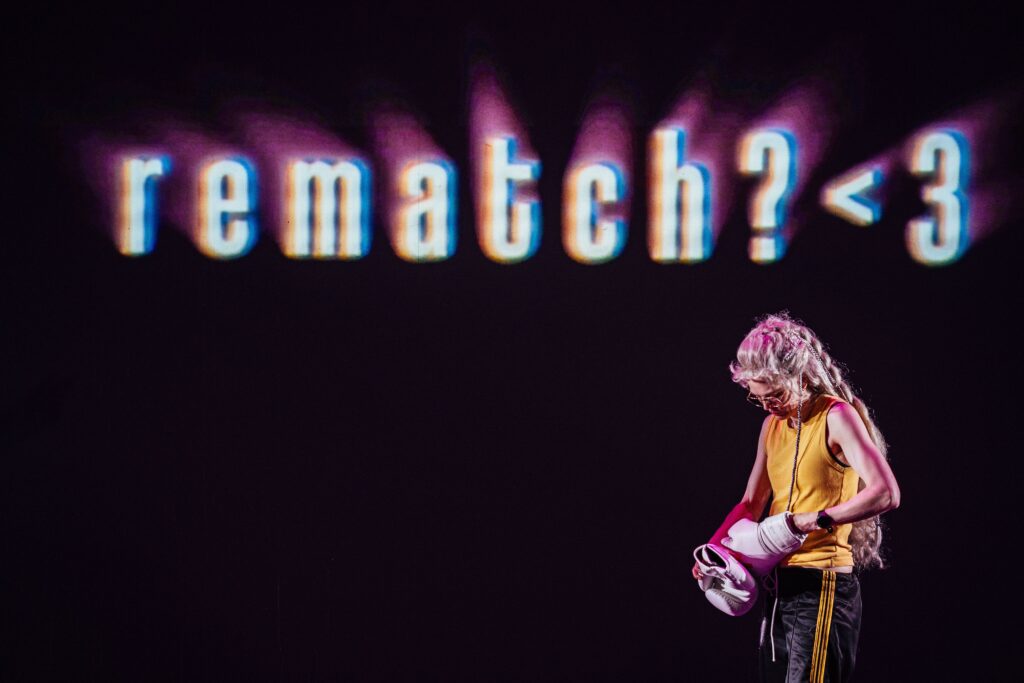
The design of the flashing world where anything is possible is clever. It distracts the audience, just like in a computer game. This contributes to a huge contrast when the music stops, the lights go out and the screen goes dark. Mette collapses on the floor, while the other characters sneak onto the stage. They sit around her, becoming part of the audience.
The room is dim, lit only by a few handheld flashlights. Mette slowly takes off her boxing gloves and red leather jacket, while Tani Dibasey explains that she must change her attitude to get out of the dark room she has ended up in. Mette protests, but meets resistance from the characters in the tournament – her colleagues at the theater . She is asked about Sasha, about Gen Z, and about her Fight against the Snowflake generation. Slowly the whole scheme is stripped away and the facade falls. Behind Mette is Ane, the actress. Soon it becomes clear that the discussion on stage is between Ane Dahl Torp, director Tani Dibasey and the other actors. It is not a script, but real thoughts and questions. Torp is challenged on her personal struggle and story, which she has drawn out to the fullest in the character Mette.
This is where magic is created in the theatre. The prize for roaring, fighting and crazy wigs is this unfiltered human encounter. It is strange how a more or less ordinary conversation gets stuck in the mind, as it does after the performance on stage 3. Here, the idea is for each audience member to discover for themselves that reality is changing right before their eyes. The breach of the agreement about what is true means that the truth comes as an incredible surprise. The layers of fiction in the performance change so elegantly that it creates thought-provoking thoughts even after the applause. This means that one can continue to ask oneself what was real or not, without knowing whether it was your own or someone else's understanding that was the correct one. There is no specific interpretation of the performance's play on reality, perhaps it is this wonder that is the whole point.
Unfortunately, it doesn't seem like Tani Dibasey has enough faith in either the audience or her own performance. Ane Dahl Torp puts on the mask again, and the story continues when Mette agrees to send Sasha to the psychologist. In this way, she escapes the darkness she was trapped in, and the fussy gaming world takes back its place on stage. After this, the story is coming to an end, but the performance takes a very unnecessary detour before it can end. Here I have a chicken to pick with Mr. Dibasey.
Because when the lights come back on stage and the screen is set in motion again, a video is played in front of Mette. Here we see Ane Dahl Torp and the entire team behind “Fight!” in meetings about the character and in an interview about the performance. As if we hadn’t realized it yet, the audience is explained that the conversation we just saw was real. This move removes all the magic that the audience has just experienced. The room immediately loses the quivering feeling of excitement and wonder about what we just saw. The audience is deprived of the feeling of having cracked the code, because there is no confidence that we have managed it. It is all a disappointing end to an otherwise quite unique theater experience.
In addition to this, I would like to criticize the underlying narrow-mindedness in "Fight!". In a performance that highlights the beauty of human encounters, it is sad that there is only one opinion that is correct. Being challenged on one's thoughts is important, and it is very interesting to see Mette/Ane argue and fight for what she believes. What is not interesting, however, is that the other characters' common opinion about Sasha's situation is emphasized as the correct one, and that Mette is forced to comply with this. Scene 3 has been opened to emphasize new thoughts and views, as a contrast to traditional institutional theaters. Here, disagreement and freedom of thought should be celebrated, instead of the majority's point of view becoming the only solution.
All in all, “Fight” at the Norwegian Theatre was an innovative performance. The performance is both current and innovative and brought a, for me, new expression to the theatre stage. The magic came, the magic went, but the thoughts still spin.
June 25, 2025
Fight! – The Norwegian Theatre
Concept, script, choreography and text: Scene 3, developed in collaboration
Video designer and graphic designer: Tani Dibasey
Game designer: ONLY SLIME
Set designer: Claudia Cox and the ensemble
Composer: Elias Tafjord
Animation and effects: Malik Lund Edo, Mona Huang
Illustrations and drawn animations: Mona Huang
Sound designer: Tobi Pfeil
Stylists: Paolo Hansen Pontecorvo, Frida Sulistiono, Claudia Cox
Visual content producer: Ulv Eyjolfsson
Dramaturg Intern, Oslo National Academy of the Arts and Université Paris Nanterre: Timothée Neie
With: Mona Huang, Mariama Fatou Kalley Slåttøy, Amalie Sasha Schanke, Ane Dahl Torp, Mohammed Aden Ali, Taume P. Dery, Oddgeir Thune, Tani Dibasey, Tobi Pheil and Claudia Cox
All photos: Monica Tormassy/The Norwegian Theatre
The Norwegian Theatre, Scene 3, May 16, 2025