
A sensitive Hedda Gabler
Katona József Theatre from Budapest has created an emotionally intense modernization of Ibsen's classic, which shows Hedda's feeling of emptiness and loss of control.
After The Lady from the Sea, I left the theater disappointed, but happy to have earned a six-pack.
The Lady from the Sea by Henrik Ibsen is about Ellida who ten years ago became Dr. Wangel's second wife, and had to move far from home to a town near the fjord. Three years earlier, Ellida and Wangel lost their infant child. Since then, Ellida has felt a mysterious attraction to the sea and an overwhelming fear that her ex-fiancé will find her and drag her back.
After the play, I had to ask myself and the nearest free ear: “Where is the magic?” I thought that once “The Stranger” arrived, I would feel the mysterious pull of the sea on Ellida, but it didn’t happen. When it started to rain on stage, I thought something would happen that would make me believe that The Stranger wasn’t just a good bed, but it didn’t happen either. It felt like they had taken this story of choice and belonging and reduced it to a love triangle.
When I first saw the set design; a grassy slope, with a white garden fence and a flagpole on the far right, I was skeptical about the performance. In Ibsen's original text, a lot of the action takes place outside Wangel's garden and I wondered how they would manage to depict the feeling of tourists pouring in, the fjord and the sea using only the garden. But then Lyngstrand walked up the hill like a penguin with broken ankles, and I was grateful for the simple set design. It made room for a very playful and expressive choreography.
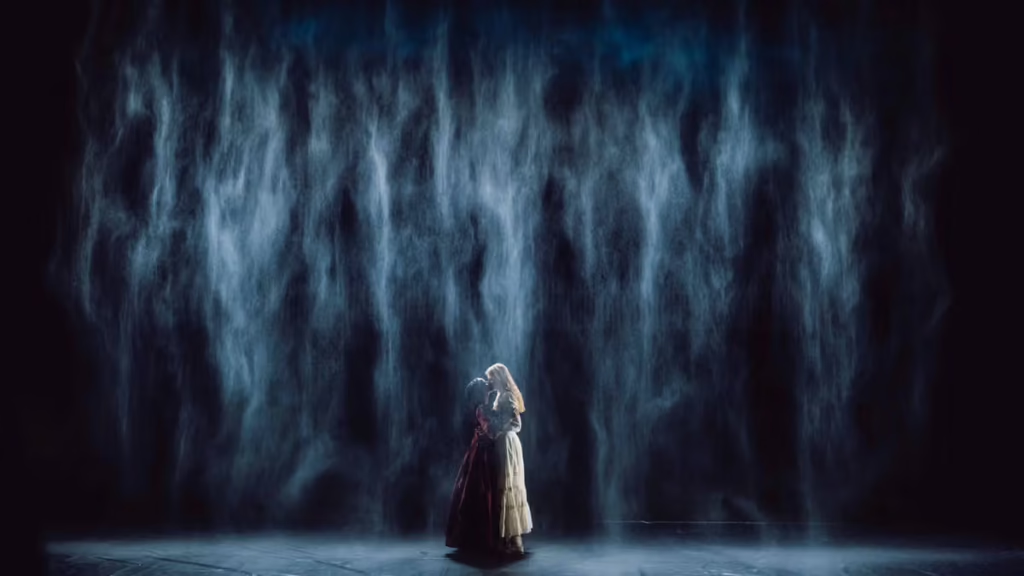
In the second act they played more with light and shadow, in addition to the rain and the music, that gave the piece a real "mood change". The music reminded me of Lorde: minimalist, electric and heavy. It was not just in the background sound, but highlighted moments, like when Ellida and Den fremmede hooka in the rain. My favorite part was when Lyngstrand had a conversation with Hilde about the role of women in relationships, while Ellida and Wangel acted out their conversation in the rain. It was a beautiful way to show the moment when Ellida chose to leave.
I could have spent two pages praising all the actors, the choreography, the set design and the music, but this version is missing something fundamental.
Since I saw the National Theatre's version of the play, I've wondered why it was so disappointing, when, as I said, there was also a lot of good stuff. It was when I met The Stranger that everything fell apart a bit. In the National Theatre's version, Ellida and The Stranger had little chemistry, which is okay because this is not a love story. But it felt like this version really tried to prove that they were madly in love.
In the original, The Stranger is like an embodiment of the sea. He is a character who lives between contrasts. Just as the sea is both deadly and healing, The Stranger showed both extreme passion and indifference regarding Ellida's choice. This paradox in Ibsen's original made me at least as confused as Ellida about who she should choose. In the original, it feels as if Ellida was facing an ultimatum: if she doesn't choose The Stranger now, she will never get the choice again. In contrast, the National Theatre's version of The Stranger was far too kind and straightforward, she didn't feel like the sea, but rather like an ex trying to get Ellida back.
Maybe this version of Ellida was too confident? When she started arguing with Wangel I completely agreed with her. Yes Ellida, you “sold” yourself into this relationship! Go and experience the FREEDOM OF THE SEA! – I thought. Original Ellida, on the other hand, is so neurotic that by the end of the play I was completely convinced that The Stranger had cursed her.
I also thought it was a shame that Dr. Wangel acted less like a doctor in the National Theatre's version, it took away a bit of the complexity of Wangel and Ellida's relationship. In the original, Wangel tried to understand her as both a wife and a patient, on the one hand he wants to help her and on the other he wants to have her for himself.
As I said, this play had a lot to offer, especially visually, but as an adaptation it lost that thread. It feels like they tried to turn a story about having to make difficult choices into a love story. All the little details of Ellida and Wangel's relationship fell away in this Nationaltheater version, and it made her big dilemma feel very small. In particular, making The Stranger a charismatic ex also took away a lot from the supernatural element and made Ellida's final choice feel very flat.
October 7, 2026
By: Henrik Ibsen
Director: Anna Balslev
Scenography and costumes: Laura Løwe
Composer: Victor Dahl
Lighting design: Øyvind Wangensteen
With: Stine Fevik, Trond Espen Seim, Selome Emnetu, Henriette Marø, Seda Witt, Alfred Ekker Strande, Trine Wiggen and Mari Maurstad.
Photo: Erika Hebbert
Set: September 10, 2026