
A sensitive Hedda Gabler
Katona József Theatre from Budapest has created an emotionally intense modernization of Ibsen's classic, which shows Hedda's feeling of emptiness and loss of control.
2002 ntoro yume is not for the faint of heart!
I'm at the bar at Det Norske Teatret waiting for the bells for Scene 2 to ring. On the floor above, up on the mezzanine outside the main stage, there's a private event (it sounds like a confirmation) and there's a good atmosphere in the whole place. I've brought my dad to the theater! I don't do that very often, so I'm excited and looking forward to seeing the show. The bells ring and we take the elevator down. Outside the stage, by the stairs, there are posters, cardboard figures with the actors on them and a shelf with CDs. On the floor are pictures and maps with various pop references from the early 2000s. Headsets are handed out and I go down and find my seat.
The stage is almost completely covered by a wall of graffiti and a large screen. Most of the performance is live and shown on the screen, towards the end the screen turns off, the walls part and we see the actors on stage.
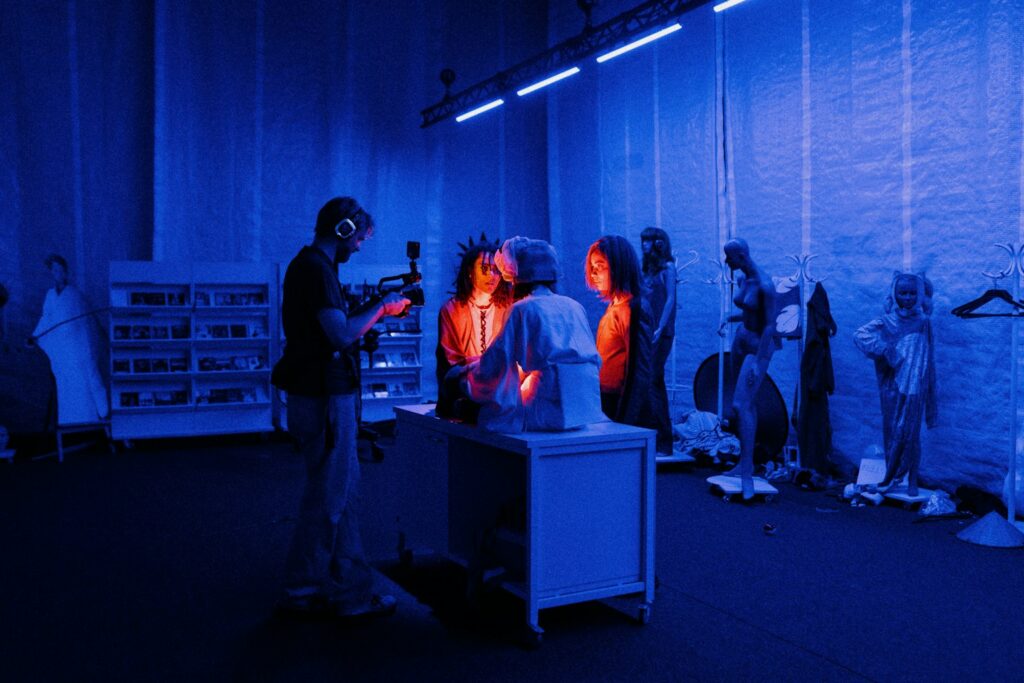
At the beginning, advertisements for other performances at Det Norske Teatret, headsets, walkmans, iPads and more appear on the screen. The advertisements are made by Io Sivertsen and Tani Dibasey, and in between the advertisements there are also trailers for other plays at Det Norske Teatret. In the very corner of the stage on the left side there is an old box TV with music videos from the 2000s, where there is a lot of Rihanna, Tupac and Gorillaz on repeat. After a few minutes of advertisements, a video with instructions comes on in a very 2000s style. It is a completely turquoise background where the only thing visible is the head of a man with the same headset as us. The video explains to us how to use the headset and what kind of channels we can listen to: The blue channel is the main channel. It is a trippy and chaotic story, while the red channel is a radio program, where we can hear songs from the early 2000s. The last is the green channel, it has a conversation that is supposed to be deep and close. The conversation is an existential conversation about how unlikely it is that you do what you do. The conversation is between two characters played by all the actors. They change actors throughout the performance depending on who is on stage, but the characters are the same. You can choose and switch between the channels yourself with a switch on the headset. I choose the blue channel, Dad the green.
The screen is split in two, with a large section that fills most of the screen, and a thin, narrow section that shows two seats in the hall where two actors are sitting. On the large screen, Oddgeir Thune asks himself the question: What if Hitler had entered the art school? He puts on a moustache and a scythe and is now Hitler. We are in the classroom at the art school. There he is hailed as an artistic genius and falls in love with a girl in the class, played by Malik Edo. They get married and she gets pregnant, unfortunately she dies during childbirth. It is not often that I see an actor actually play Hitler, I more often see descriptions of him without him being played out. I was a little surprised – the scene is not for the easily offended – but I am glad that they did it.
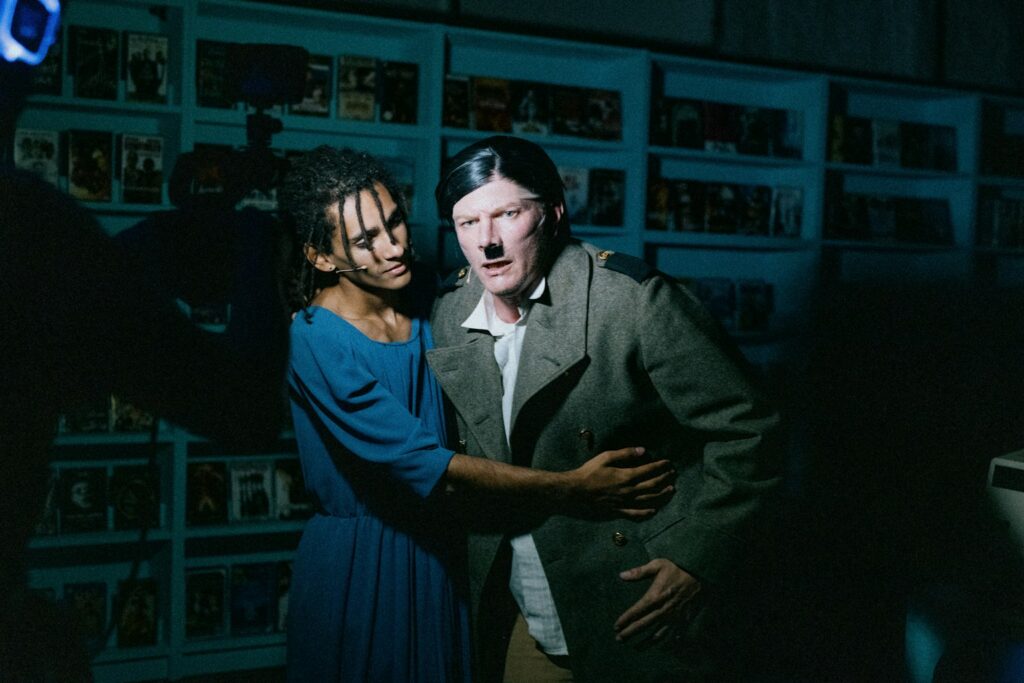
The piece is full of references to old movies, series and games. There are Star Wars, Sonic, Moses, Pokemon, Powerpuff Girls and much more. It became like a little competition with myself to find as many references as possible.
In another scene, we see Malik playing the Prince of Edo, who is trying to get to the Alexandria Library. After defeating the guardian of the library, he finds a hidden and secret room. The room is full of shelves with DVDs, games and posters on the walls. Most of the games and movies are from the late 1990s and early 2000s. In this room, he gets a vision of a future he wants to avoid. He finds a Rema 1000 receipt with a message written on the back: "2002 ntoro yume". He panics, he must avoid this being the future of his people. His answer is to burn down the Alexandria Library and all the books in the city.
For me, this play is far too chaotic, I couldn't follow the story because there were things happening all the time. For example, there was a montage scene when Sonic the Malik was exploring the world, it had no dialogue, just music. It lasted long enough that I changed the channel to both the radio station and the conversation. The radio station was playing Clint Eastwood from Gorillaz with the music video on the small TV on the edge of the stage. The conversation seemed repetitive from what little I heard. It was the same point over and over again, about coincidences, probabilities and that this generation is being destroyed by iPads and social media. It's an important discussion, but the same conversation for an hour is too much. Dad, who had listened to it, confirmed what I was thinking: There were nice and well-thought-out opinions and justifications, but it was very drawn out and it was too long. During the play, I also saw several people changing channels from the conversation on the green channel to the action on the stage on the blue channel. I must admit that I didn't catch much of that conversation because I was mostly focused on the blue channel, but to me it seemed boring and stuffy.
All the choices in 2002 ntoro yume are good and well thought out and there are scenes that I genuinely think are funny and clever. The problem is that I don't have time to think about what I'm seeing until something completely new happens that I have to deal with. One scene I really liked is when the prince of Edo finds the Rema 1000 note in the library. Edo's expression and desperation made the scene funny. However, there is too much going on, and it makes it chaotic to follow the story.
October 13, 2026
Director: Tani Dibasey
Video director, video material and clips: Io Sivertsen
Scenography: Io Sivertsen, Philip Isaksen and Aliese Isungset Agbota
Lighting designer: Philip Isaksen
Composers: KAROO (Diego Aguilar) and WHY KAI (Elias Tafjord and Kai Von Der Lippe)
Live camera photographer: Borgar Skjelstad
Graffiti artist: Eirik Hammer
Stylists: Frida Sulistiono and Paolo Pontecorvo
Visual material/graphic designer: Tani Dibasey
Playwright: Amy Black
All photos: Studio Abrakadabra
The Norwegian Theatre, Scene 2, September 12, 2026