
A sensitive Hedda Gabler
Katona József Theatre from Budapest has created an emotionally intense modernization of Ibsen's classic, which shows Hedda's feeling of emptiness and loss of control.
Unanswered Calls shows us how important and effective it can be to create theater for today's youth about terrorist acts.
The year is 2011 and Rebekka is about to start high school, barely a month after the attack on July 22. She didn't know anyone who was there, but she still feels deeply affected by what has happened. To what extent can one feel affected by an event that has not directly affected one before it appears that one has taken on an undeserved victim role? This becomes a common thread through a funny, strong, but somewhat thin story about starting a new journey in a time when society has been turned upside down.
The performance is based on the book of the same title by the author Nora Dåsnes. A book written for a generation that probably doesn't remember July 22, at least not very well. The production is also intended to appeal to an audience that probably doesn't have a strong memory of the worst attack on Norway since World War II. Most people sitting in the audience can still probably recognize Rebekka. As young people today, like her, we see concrete attacks against humanity without being directly affected. It outrages and scares large parts of the generation that Palestinians are killed, immigrants are thrown out of the USA and that fascists are gaining more and more power. Here I think Rebekka's role is brilliant. She shows us that even if you don't know anyone who was on Utøya, or who is in Gaza, it is completely natural and not least important to feel empathy for the victims. She becomes completely obsessed with the attack because she cannot understand how a person could do such a thing to others. At a time when democracy is greatly threatened, Rebekka reminds us of an important principle; No one is free until everyone is free, it might as well be you.
Not only does Rebekka become a representative of today's youth. Her brother is 18 years old and has locked himself in the boys' room to play computer games. From inside, foul words are heard and all forms of criticism are answered with blind aggression. He becomes an image of those who fall outside and the character further emphasizes why it is so important that we continue to talk about July 22nd.
Through the depiction of life at a high school in Oslo with school revues, teenage romances and friendships, the painful themes are woven in in a tasteful, funny and effective way. Nevertheless, the plot feels like a construction to get the messages across. The characters are shallow and all dialogue has a clear function. This is not necessarily a problem in itself, but towards the end of the performance the plot is cut short and the actors switch to reading stories from survivors. A powerful moment, but I start to wonder about one thing in particular: What happened to the brother? Because after the stories we are back with Rebekka sitting with her brother after some time has passed. Now he is back on his feet, but how? Even though he functions as a good image, it is still interesting to know how he got out of the darkness and did not end up like Breivik.
When I entered the hall and saw a skate park on stage, I was skeptical. Youth performances often try to woo their target audience with concepts that adults think are cool. This often involves skating, graffiti, slang and wearing a cap backwards. I think this performance also had that, but only aesthetically. Because the set design was effective for the plot by simply creating several different spaces. Still, skating could have been explored more than just Rebekka and her friend, Farida, standing on boards without any skills and without it adding anything to the performance.
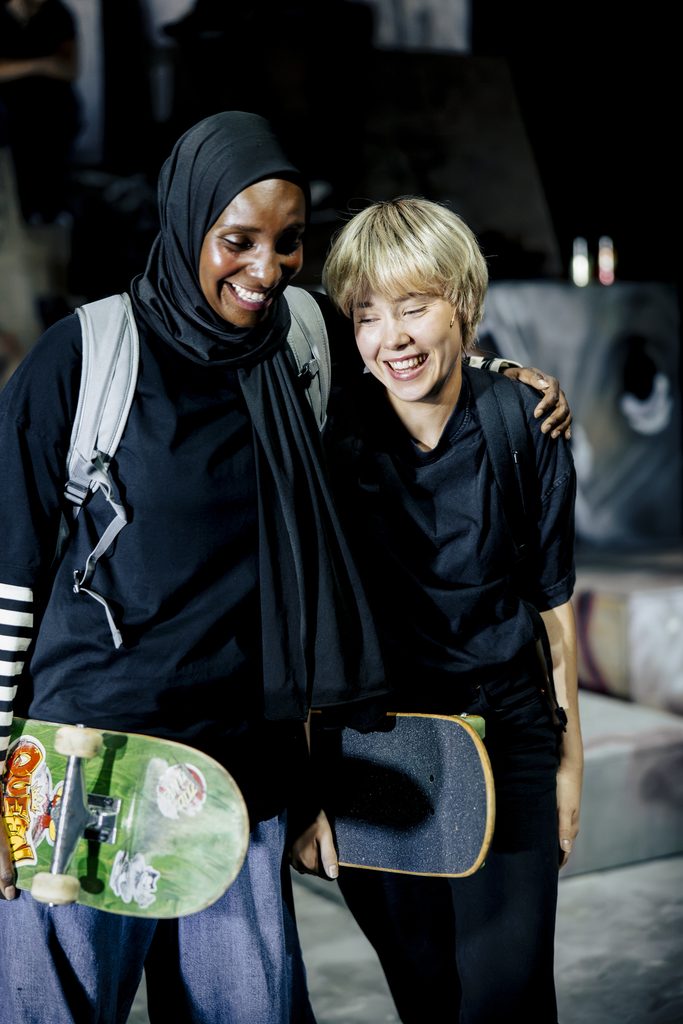
Although the performance can sometimes feel artistically shallow, it does its job well. The messages are good, it opens up questions and perhaps most importantly: I noticed that the other young people in the audience were carried away and appreciated the performance. As a high school student myself, I know how much it takes to get my generation involved in theater, at least when you are dragged along by school. So I can't help but consider Unanswered Calls a success that I am happy will be touring around Norway, so that as many young people as possible can see it.
October 9, 2026
By: Nora Dåsnes, dramatized by Toril Solvang-Kayiambakis
Director: Toril Solvang-Kayiambakis
Scenography and costumes: Marcus Olson
Video and lighting design: Oscar Frostad Udbye
Composer and sound design: Ida Flåten Kampenhaug
With: Hannah Adolfsen Fjeldbraaten, Christina Sleipnes, Amina Mohamud, Arjan Nilsen and Jawad Aziz.
Played on tour with the National Theatre
Set: September 17th