
So stupid it's fun
The guys at Det Norske Teatret are so stupid that it's funny, writes Fiona Åtland (20) in this illustrated review.
The Ghost in the Shell is an important play about two countries in a seemingly eternal conflict, disguised as a family drama.
On Scene 3 at the Norwegian Theatre, in a Black Box that has neither a stage nor an amphitheater, the play Gjenferdet inn is being recorded. The play is about Sonia (Seda Witt) who goes on holiday to her sister in Haifa, her father's childhood town. She really wants to take a break from acting, but ends up getting entangled in a production of Hamlet in the West Bank with a local theatre. Throughout the play, old family stories and arguments are brought up, while tension and violence between Israel and Palestine increase. The play is based on a book by Isabella Hammad, and as stated on the Norwegian Theatre's website, it was written before October 7, 2023 and takes place in 2017. October 7, 2023 was the day when the Palestinian armed group Hamas, after years of oppression, attacked Israel and triggered a bombardment that has rained down on Gaza for over 2 years since. The theme of the play is unfortunately still relevant as long as the violence against Palestinians continues.
There is minimal set design used throughout the performance, except towards the end when the Palestinian theatre group is about to stage the play they have been rehearsing. Here a huge chandelier is hung and all the actors have been given appropriate costumes. Up until then, during the rehearsals, the costumes have been relatively simple. Apart from a sofa, some pallets, a box of “junk”, a suitcase and a skull, there are also few props used. The two musicians Nawara Alndaffad and Peter Baden set the mood in the different scenes and also played when we entered the hall and during the break.
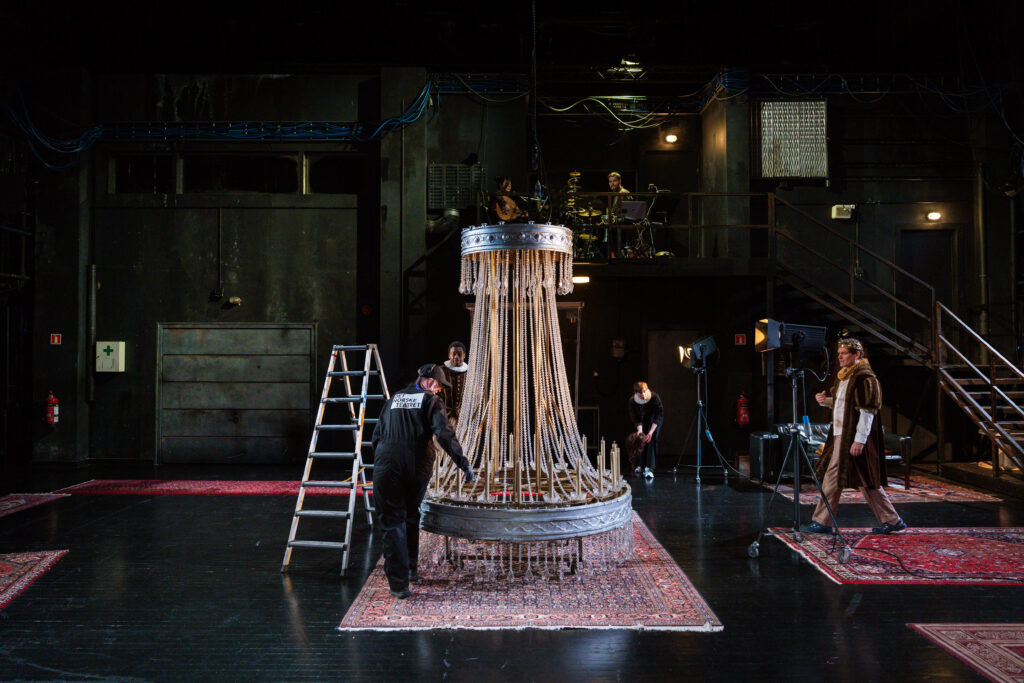
When I enter the room, it is filled with loose conversations between both the audience and the actors. Carpets have been laid out on the floor, so that we as the audience become part of the landscape of the story, and the bar at the back of the room is open. It almost seems more like a pleasant party, than the wait between arrival and the start of the performance, and this feeling of a group of friends is present throughout the performance. Suddenly the lights are dimmed and a spotlight is shone on Kyrre Hellum, who welcomes us. In the shadows, Ibrahim (Kenneth Homstad) approaches with a sword raised high, and Kyrre Hellum has now become George. The scene is the first scene of Hamlet , where Ibrahim plays Bernardo and George Francisco, and is also the opening scene of Gjenferdet inn .
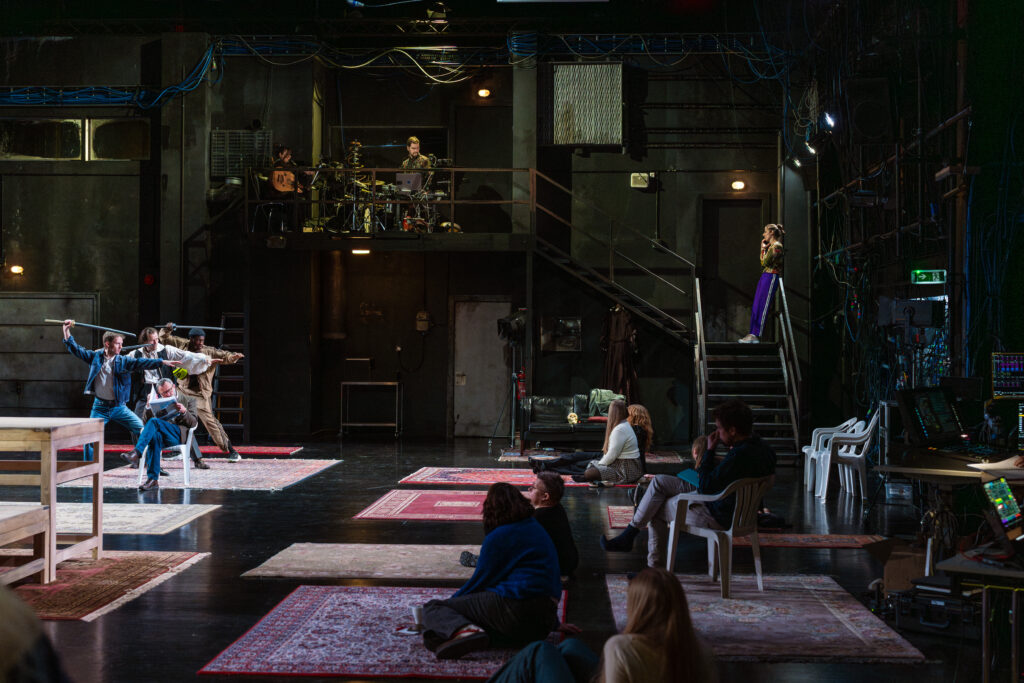
There are several places where the transitions between the different scenes are completely seamless and not least original. I think a lot of the reason for this is that there are several places where the actors are in different times and spaces, even though they are standing side by side on stage. The physical space is gone, and we find ourselves in a space beyond realism, where the lines between now and then, and here and there, are whispered out. Another example of this comes just after the intro. The main character Sonia rushes in with a suitcase, right into the opening scene of Hamlet . She waits impatiently as she gives the others on stage her passport while they look at her strangely, as if she is in the wrong place at the wrong time, as if she interrupted their rehearsal. She herself does not seem to care, and begins to tell the audience what she is doing, she is on her way to Haifa to spend time with her sister. This is one of many examples of how the room is divided by invisible walls and the scenes bleed into each other. The audience is drawn further into the performance, and in this case to Haifa.
Another example of how the actors easily move in and out of their roles as actors and narrators is during a rehearsal in the West Bank, Wael (Serhat Yildirim) is to perform the “To be or not to be” monologue. It has been mentioned earlier in the performance that Hamlet has been translated into Arabic. Although everything up until now has been performed in Norwegian, here Wael’s monologue is performed in Arabic. It is as if we have been watching a play up until now, but are now being pulled out of it and into the real world, we are standing on the outside. Sonia translates the monologue into English for the audience, performed as if she is translating to herself. There is something about this scene that still lingers after I have walked out the doors. How the actors move in and out of their roles, like a ghost.
A recurring theme in the play is the ghost, which is also reflected in the title, Ghost in the Shell . The ghost appears in Hamlet, in the actors' discussions about interpreting the play they are about to perform, and in Sonia's apartment. Like a shadow. In the theatre group's production of Hamlet, it is planned that the ghost will be in the form of a shadow that is cast up the high wall. The figure can also be interpreted in video clips. On the wall above the bar, a darkened figure is shown on several occasions performing monologues in English. The lights are dimmed in the rest of the room and the scenes are not mentioned by the actors at any time. The figure is precisely like a ghost.
There are several possible interpretations of what the ghost can symbolize, also depending on which levels you look at it. For my part, I interpreted the ghost as a symbol of the conflict between Israel and Palestine. The ever-present violence and control that the Palestinians experience, like a ghost that haunts them.
In the performance, the theater group encounters resistance from both the worsening situation in the West Bank, but also internal conflicts within the group. Despite the obstacles they encounter, the theater group manages to carry out the play, and the penultimate scene is from their own production of Hamlet . It may seem as if the world is currently, or always has been, haunted by a ghost dressed in a suit, tie and power. The Ghost inn describes how one can navigate such a world, what art can say for the resistance struggle and how one must light the flame of hope themselves, when no one else does.
February 16, 2026
By Isabella Hammad
Dramatization: Melanie Mederlind and Njål Helge Mjøs
Translation: Njål Helge Mjøs
Director: Melanie Mederlind
Scenographer and costume designer: Katrin Nottrodt
Composer: Peter Baden
Lighting designer: Charlotte Marr
Sound designers: Peter Baden and Jonas Vikanes Alfhei
Oud, vocals, flutes: Nawara Alndaffad
Drums, electronics, strings: Peter Baden
Dramaturg: Anders Hasmo
Publisher: The Agency (London)
Excerpt from Hamlet by William Shakespeare translated by: Edvard Hoem
Thanks to: Ashtar Theatre in Ramallah
With:
Sonia: Seda Witt
Haneen: Hibba Najeeb
Mariam: Kirsti Refseth
Wael: Serhat Yildirim
Ibrahim: Kenneth Homstad
Amin: Ken-Philippe Tete
Majed: Gard Skagestad
Faris: Svein Roger Karlsen
George: Kyrre Hellum
The Father (on video): Edward Mullaem
All photos: Ole Herman Andersen/ The Norwegian Theatre.
Scene 3, The Norwegian Theatre. February 13, 2026