
So stupid it's fun
The guys at Det Norske Teatret are so stupid that it's funny, writes Fiona Åtland (20) in this illustrated review.
A children's performance, developed for the visually impaired, shows how the uniqueness of radio theater can be transferred to the stage.
Monster is very different from a children's show I saw myself through Den kulturellter skolesekken, which was developed with a similar concept for the visually impaired, and which I vaguely remember as Tuting. It would probably captivate me today, but as a primary school child I found it completely strange to sit in the dark listening to wind instruments. Monster , on the other hand, is easy to get carried away with. I would have liked to see it as a child, because behind the superhero action we find the vulnerable main character Thea.
“Oh no, I forgot to take the tag off the new sweater, that’s probably why they whispered like that,” says Thea after a long day at school. Who hasn’t made the same mistake? Thea finds herself in the middle of a tangle of puberty, rumors and the feeling of being left out. Can’t it just be a little easier? She thinks that if she could just hear what everyone was whispering, she could change and then no one would backbite her. The next day she wakes up to an overwhelming stream of sound. The spider crawling under the bed, her parents wondering if she’s on her period, her neighbor brushing her teeth and at school she can hear all the mean things being said about her. She has to learn to control her super hearing and in the process a real superhero story begins to take shape.
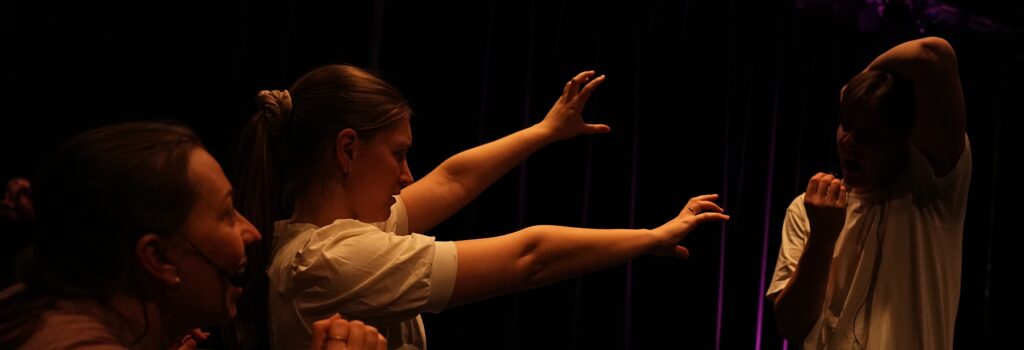
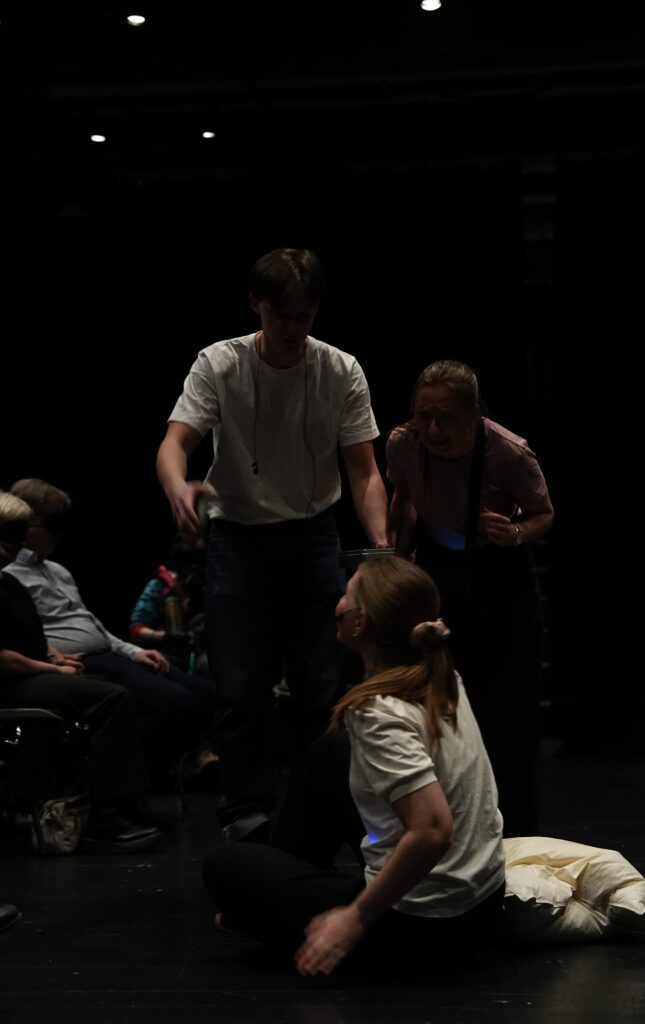
Monster is written by Helene Nybø, directed by Peter Kolbjørnsen and staged at Lier Kulturhus. At the entrance, the director himself stood and handed out eye masks to everyone in the audience and took the time to strike up a conversation with several of the attendees. Inside the hall, chairs are placed in a square on the stage, with an empty playing space in the middle. While the actors themselves instruct us to keep the masks on throughout the performance, a quiet, meditative sound is played in the background. We put on the masks, and when a school bell rings, the performance begins. The action unfolds closely around us, with actors running around the room to create a busy schoolyard. The actors are supported by pre-recorded sound that enhances the experience of place, like background noise from a noisy schoolyard.
Sitting blindfolded at Lier Cultural Center took me back to when I was eight years old on a car trip and heard a crime radio play that was broadcast on dab radio. It was Spill i mørke (1979) by Edith Ranum and I get chills when I think about it. I picture how poor blind Beate Gran turns out to have strangled her sister in contempt. I remember her pale skin, her innocent voice and the marbles she dropped to remember where she had been at the moment of the murder. The images are still very clear to me, twelve years later. They have become a part of my childhood because my mother has fond memories of the children's hour, a radio program with music and stories that was big in the 1970s, when preschoolers staying at home were still the norm.
I shared this memory with my mentor Anette and claim that the actors were better before with solemn voices like Lise Fjeldstad. Anette listens to what I say, but instead starts talking about how the sound production at the Radio Theatre was completely different before the 2000s. In the “old days” everything was recorded simultaneously and she illustrates an image of actors walking in the sandbox and the props people standing and clucking coconuts while the dialogue was going on. Today the Radio Theatre is closed, but NRK still makes some productions of audio dramas, especially Easter crime. The sound image is completely different, because effects are often added afterwards. I start thinking about the dramatic effect it has on an actor to feel the gravel crunching under their shoes while they are trying to live out a late night in central Oslo.
It is precisely this kind of interplay between sound and empathy that is evident in Monster . The actors could stand still and read their lines, we see nothing. But it is the feeling of the sound moving around the room that gives me the impression of being part of the action.
The sounds can also invite the listener into spaces they have never been in before. One of the things that made me completely immersed in Edith Ranum's radio play was that she depicted a social class I was unfamiliar with. A world of actors sitting at the Theatercafe after rehearsals, hopelessly in love playwrights and authors going to literature seminars and book launches. It was a wonderful escape into a cultural elite who are quick with their lines and live leisurely lives on Oslo's best west side.
Seeing Games in the Dark on a theater stage might not have been as engaging as hearing the play on a road trip. Traditional set design can be underwhelming compared to what the story is trying to convey. Costumes look like costumes and scene transitions become convoluted, which is why many directors end up with a "black box" style with empty rooms, few props and a minimalist, almost brutalist, frame that is supposed to symbolize everything, but can feel cold and abstract.
I watched a bit of the political satire film No Comment (2025) yesterday and I had the feeling that the director thought “this will make a nice picture”. The direction was very theatrical and staged, as in a scene where the parody of Erna Solberg is placed at the end of a formal long table with lots of pizzas around her, while the caricatured advisor writhes like a hyena on the other side of the table. This is an example of how visual scenography can become too leading, and therefore also too obvious and boring.
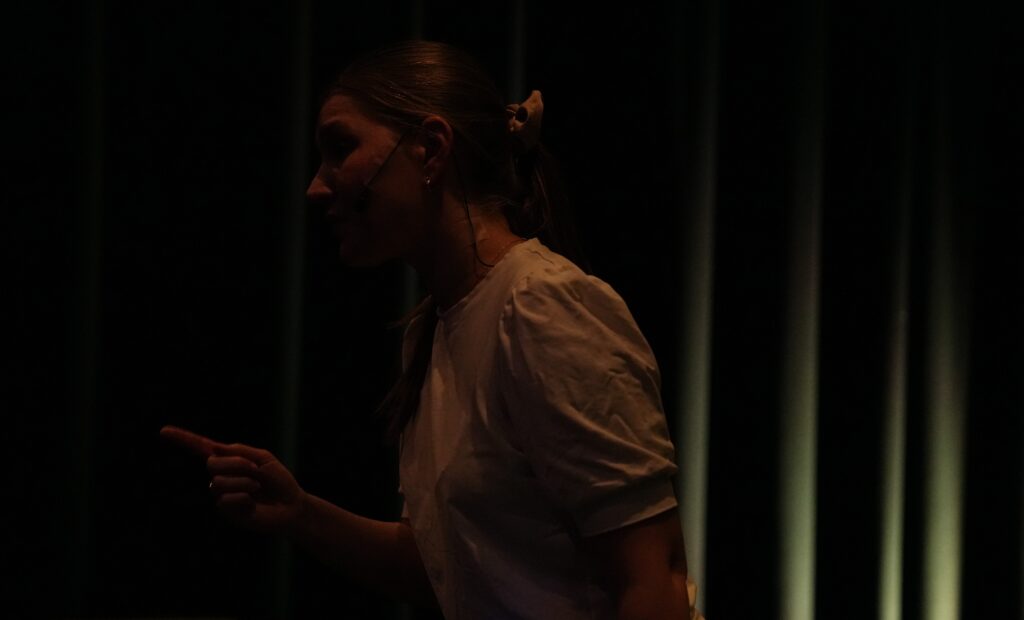
In Monster, however, only sound is used to create living spaces, and that makes the plot unlike anything I've seen before. When I was going to recount what I had seen to my mother after the performance, I said something like this: "a girl with super hearing who fights a monster that lives in the sewer under the school toilet". It sounds like an NRK super series, I thought. The dramaturgy of the performance is reminiscent of an easy-to-read comic book, like Captain Supertruse or A Pimp's Diary. There are quick turns, clear images and small, silly details that catch your attention right away. In the first scene, we are introduced to a pubescent classmate in a voice changer, who is secretly in love with Thea. It is a slightly embarrassing moment with the same wonderful humor as when Thea forgot the note on her jacket.
When the vision is removed, something extra happens to the humor, it becomes stronger because I myself have to fill in everything that is missing. The characters get an extra life, in the form of my own environment and funny personalities I have met throughout. In another scene we hear a recording of a child's voice telling us that her friend is not allowed to come to her birthday, without us ever seeing the girl. It makes it feel like standing outside and eavesdropping on something private. I get to experience a world that children share among themselves, that adults are not a part of.
Vision dominates our attention. I remember even in high school when teachers would give a presentation in front of the class, but if the student in front of me started Googling something on the computer (I had a classmate who watched 100 Pound Sisters in every history class), it took all of their attention. When vision is taken away, you are forced to listen to what the text is actually saying, and that is the nature of radio theater.
It is therefore a shame that many people do not know what radio plays are. Children born after 1980 have grown up with radio plays to a lesser extent, and their use seems to be decreasing the younger the generations are. Tilman Hartenstein's book The Invisible Theatre (2001) refers to research in which radio theatre was performed for school classes. The findings indicate that “the suggestive power of radio plays has not disappeared, but that radio plays do not penetrate today's diverse media environment”.
When I was in high school and was about to stage Ibsen's An Enemy of the People , the whole class sat in the school's drama hall and listened together to the Radio Theatre's 2004 production of the play. Without any visual distraction, the double-bottomed subtitles stood out more clearly. Hartenstein describes how radio theatre suits Ibsen because “the preponderance of words over stage action (…) makes Ibsen's plays relatively easily applicable to radio”. In the conversations between acts, my classmates had gained new interpretations that they had not gained from reading. Suddenly, Hovstad had a new motif, in which he appeared to be romantically interested in Thomas Stockmann's daughter.
This experience points to something more general. In The Invisible Theatre, Hartenstein further writes that listening has become a secondary activity, something you fill your mind with while you wash your hands or drive your car. The days when the whole family gathered around the radio are over, and listening can now become lonely. When the book was published, the radio plays were played maybe once or twice on the radio, and if you wanted to hear them again you had to buy them on a separate CD.
Where Hartenstein describes listening as more individual and fragmented, Monster and my own experience from listening together to An Enemy of the People showed how one can use theater to create a shared space for attentive listening.
In 2001, Hartenstein could not have imagined what a common reference phenomenon the NRK radio app and podcast culture would become. I was recently at a birthday party where a friend started explaining something he had heard on the NRK podcast Krimromme t, about the Høiby case, without knowing that over half of us had already heard the same episode earlier that day. I have experienced exactly that situation many times, whether it is on TikTok or Spotify, where some share something they think is new, and it turns out that the rest have already seen the same thing. We no longer listen to different CD recordings. We listen to the same things, often at the same time.
NRK also shows how collective listening works in the encounter with literature. NRK's Leseklubben has in a short time become a popular format where literature is discussed together with a famous person who guides the interpretation. Classics such as Markens grøde and 1984 gain a new relevance when they can be processed together. What was previously a heavy reading experience becomes a collective project together with others who are also listening. In a similar way, Monster makes listening an activity in itself, just as children once gathered around the radio to listen to the children's hour in the 1970s.
In the end, you're left with a funny paradox. We live in a time where everything we listen to feels personalized based on "for you" lists, algorithms, and recommendations, but then it turns out that we're actually listening to exactly the same thing as everyone else. The only difference is that we're not aware of it.
April 24, 2026
Screenplay: Helene Nordbye Nybø
Directed by: Peter Kolbjørnsen
Cast : Katrine Lovise Oppstad Fredriksen and Tobias Kolbjørnsen (actor)
Sound design: Anders Tveten
Instrument carpenter: Jon Halvor Bjørnseth (instrument carpenter)
Target group: 5th-7th grade + specially adapted for the blind and visually impaired.
Lier Cultural Center, March 14, 2026 at 12:30 PM
All photos: Kine Sofie Steffensen