
Honest, raw, spit and hysterical laughter
Who has the power to keep a patient in a place they don't want to be? How can words create chaos, confusion and frustration? These are questions that the performance Blue/Orange raises.
Blue Orange makes a strong impression on this reviewer, leaving her with an unease that lingers long after the applause dies down.
What happens when the system that is supposed to protect the most vulnerable instead tears them apart from within? In the play Blue Orange, the audience is thrown straight into a psychiatric power struggle where truth and lies merge, and care becomes a weapon. With intense scenes, disturbing symbolism and brilliant acting, themes such as mental illness, racism and institutional violence are explored. For me, this was a shocking reminder of how dangerous power can be when it is wrapped in professional titles and white coats.
Blue Orange is a play that is intended as more than entertainment. From the first scene, one is drawn into a reality where the masks of care easily fall, and where what was supposed to be protection becomes a tool for control and oppression. The performance challenges both emotions and thoughts, and left me with a strong impression of how complex and dangerous human relationships can become when they are woven into the framework of the institution.
Blue Orange is set in a psychiatric hospital in London, where we follow three characters: Christopher, a young woman with serious mental illness; Bruce, a committed and empathetic doctor; and Robert, a cynical and manipulative senior consultant. Through their interactions, we gain insight into power struggles, ethical dilemmas, and structural racism in the healthcare system.
The play opens with a symbol-heavy and disturbing scene. A woman dressed in a wig and with a blanket over her shoulders crosses the stage, completely absorbed in an orange ball. She makes loud noises reminiscent of moans, while two people in the background are dressed as and move like birds. Suddenly the woman has a breakdown, she cries out, holds her head and sits on the edge of the stage. There she takes off her wig. Another person, wearing a white coat, comes and sits calmly next to her. This turns out to be the patient Christopher and Bruce, her attending physician. Early on, I was confused about the character Christopher – was he meant to be a man or a woman? His name is typically masculine, and the other characters consistently referred to him as “he” and “him”. Yet the role was played by a woman, and both the makeup and the costume made me perceive the character as more feminine. It created a confusion for me, and I wasn’t sure if I should refer to Christopher as “he” or “she” in this review. All the characters had masculine names but were played by women, which was confusing, but it was really only Christopher that I was unsure about. I thought that Robert and Bruce could be used as last names for women, and since they were doctors, it felt natural to use the last name. But since Christopher was the first name, it was more uncertain. That’s why I chose to use “she” in the review. Maybe it was a deliberate move on the director’s part, to challenge our understanding of gender?
Through a lengthy conversation between Christopher and Bruce, we get to know both of them. Christopher has been diagnosed with schizophrenia (stage 1) and struggles with strong hallucinations, including the belief that her father is Uganda's former dictator Idi Amin and that oranges are blue. Bruce acts warm and empathetic, and appears to be a doctor with genuine concern for the patient's well-being.
But then the third character is introduced: Robert the Superior. She believes that Christopher should be discharged, not for the sake of the patient's health, but to free up space and to promote her own controversial theories about mental health and race. Robert appears cold, cunning and manipulative, and her attitudes are clearly marked by racism. She believes that Christopher's disorders are genetically caused and linked to her ethnic background, and uses this as an argument to end treatment.
What follows is an increasingly intense and destructive power struggle between Bruce and Robert. Bruce tries to stand up for Christopher and what she believes is professionally and ethically right, but encounters a superior force in Robert, who manipulates the situation to make her suspicious.
At the same time, Robert is also manipulating Christopher. She plants the idea that Bruce won't let her go home because she wants to hold her back, not help her. Christopher, seeking security and belonging, begins to doubt Bruce and turns against her. This is a tragic turn of events, because Bruce is truly the only one who has Christopher's best interests at heart.
Bruce is increasingly pressured, both professionally and emotionally. She loses control and eventually has her own breakdown. The play ends quietly but powerfully: Christopher is written out, Robert gets what she wants, and Bruce is left devastated, stripped of his job, his integrity, and his self-confidence. In the final scene, we see Christopher walk off stage, holding an orange in his hand. A light hits it, and it appears blue. The audience gets a glimpse of the world as Christopher sees it, a poignant reminder of how our perception of reality can be deeply personal and disrupted by inner chaos.
The stage itself was large and divided into two levels, which created a sense of depth and variety. It almost acted as two separate rooms, giving the audience a wider area to focus their attention on. This created visual interest and at the same time gave the actors more space and freedom to explore their roles. They could move more naturally, and it opened up a greater range of body language and interaction. The costumes play a clear symbolic role in Blue Orange by emphasizing the balance of power and the psychological changes the characters undergo. At the beginning we see the doctors dressed in strong, vibrant colors, especially pink and red, which give them an air of control, confidence and energy. The patients, on the other hand, are dressed in neutral, dull tones such as white and gray, which make them appear pale and almost faded, as if they are on the verge of disappearing both socially and mentally.
As the play progresses and the power relations shift, the costumes also change dramatically. As Robert begins to manipulate, her clothes become noticeably darker. She eventually ends up in a skirt reminiscent of a birdcage, which becomes a powerful image of confinement and control, combined with a black latex top and large, exaggerated gold heels. This gives an impression of superiority and a display of power.
Even more visually dramatic is the transition Bruce undergoes. She starts out in a dark red-pink, glittery blouse and a classic white coat, a typical doctor's outfit that signals security and authority. Towards the end, when she almost breaks down mentally, she stands on stage in an all-black, tight-fitting latex suit with high, black heels and a black blouse. The white coat still hangs on her like an imposed role she no longer fits into. This costume change clearly illustrates how power has begun to eat away at her, and how she has lost some of her original security and identity. It creates a strong image of an inner collapse masked behind a professional facade.
Robert's shoes stand out in particular and act as a deliberate means of showing that she "won" the fight. The high gold heels seem almost out of place in contrast to the otherwise dark outfit and white doctor's coat, which is precisely why they attract attention. Gold is often associated with success, victory and status, and unlike Bruce, who loses his grip, Robert is left with his authority intact. The heels can symbolize how she has risen above the others and emerged victorious, albeit through manipulation and power play. It is as if the shoes function as a victory trophy that she wears with pride, a visual point that clearly emphasizes who is actually in control in the end.
I often go to the theatre, and I know how rare it is to experience a production like Blue Orange . The actors deserve great praise for both their diction and their acting. I actually don’t think I’ve ever seen a performance where the roles are conveyed so clearly and strongly, while the lines are so precisely articulated. It is particularly impressive how Isabell Sterling, in the role of Christopher, manages to scream, stutter and express the intensity of the character without compromising intelligibility. She really managed to create a very good balance between overly exaggerated theatre and reality. She clearly showed that being “away” was not something she chose, but something that just happened to her. It made the role feel both real and vulnerable, and reminded us of how important such nuances are.
Several of the scenic choices are also very effective, especially the way everything scenic was used to show how Christopher experienced the world. Through both lighting, movement and placement on stage, we as the audience got a clear insight into her perception and perspective. This meant that we not only followed the action, but also to a large extent could feel what it was like to be her. We gained a deeper understanding of her and learned about her in new ways, which meant that we created a stronger emotional connection to the character. The scenic work simply lifted the play and made the overall experience stronger and more poignant. The set design was simple, but well adapted to the theme, especially in how it reflected the environment of a psychiatric hospital. Although they used few props, their use was thoughtful and effective.
It is rare to see a play that manages to make the theme so accessible, while maintaining the complexity and respect for the characters' experiences.
The performance Blue Orange made a strong impression and sparked many thoughts.
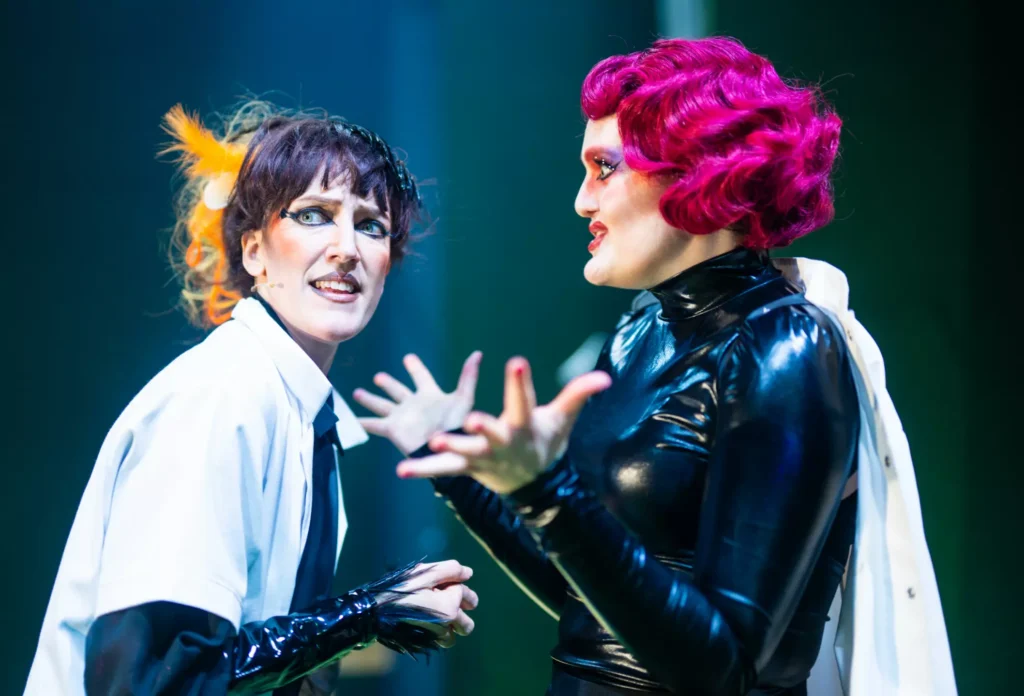
One of the most poignant scenes in Blue Orange is when Dr. Robert sits with a small ball in his hand and begins to squeeze it hard. It may seem like an insignificant detail, but it takes on enormous significance. Every time she squeezes the ball, both Bruce and Christopher react as if they are feeling physical pain. The ball becomes a charged symbol of how psychological violence and manipulation can feel. Not just in the mind, but in the whole body. Robert uses the ball to press on Bruce and Christopher's weakest points, and it makes clear how the pressure increases until they can't take it anymore.
When an authority figure like Robert plants guilt, doubt, and fear through his words, it can take hold in the body. The pain becomes real. The ball makes the invisible visible.
The performance is a powerful psychological chamber drama that reveals how fragile the line is between help and abuse, care and control. It shows how words can become weapons, and how power, when abused, can break even the strongest. And when the orange finally turns blue, we understand: Reality is not always what we see, sometimes it is what we are told.
All in all, I have almost nothing but positive things to say about this performance. It was strong, provocative, and full of thematic depth. If I had to roll the dice, it would be a strong 5, maybe even a 6.
July 1, 2025
By: Joe Penhall
Direction and concept: Terese Mungai-Foyn
Aesthetic advisor: Anna Iurinova
Costume: Terese Mungai-Foyn
Lighting design: Mathias Langholm Lundgren
Sound design: Terese Mungai-Foyn
Mask designer: Ingfrid Vasset
Sound consultant: Festus Mwenda
Dramaturg: Marianne Sævig
Artistic advisor: Cliff Mustache (Nordic Black Theatre)
Artistic supervisor: Hans Henriksen (Oslo National Academy of the Arts)
Scenography supervisor: Gunhild Mathea Husvik-Olaussen (Oslo National Academy of the Arts)
Choreographic supervisor: Sylvi Fredriksen (Oslo National Academy of the Arts)
Psychiatry consultant: Jakob Kirkebak
Technical coordinator: Christer Berg
Costume contact: Ellen Wang Thommessen
Stage manager and production assistant: Ida E Heggen
Production employee: Maria Brym
With: Isabell Sterling, Tone Oline Knivsflå and Ingvild Holthe Bygdnes
Oslo New Theatre, Central Theatre, April 30, 2024
All photos: Lars Opstad/Oslo New Theatre