So stupid it's fun
The guys at Det Norske Teatret are so stupid that it's funny, writes Fiona Åtland (20) in this illustrated review.
“No, we will not give up,” says the actor in “The Revolution’s Promise.” The play tells heartbreaking stories from the occupied West Bank.
On Kloden The Oslo Theatre is performing “The Promise of the Revolution” for the third time. The performance tells real stories from Palestine and is based on texts and interviews with Ahmed Tobasi, Ali Abu Yaseen, Arna Mer-Khamis, Dareen Tatour, Juliano Mer-Khamis, Loai, Tafesh, Mariam Abukhaled, Mohammed Bakri, Suhail Khoury, Rania Elias, Yousef Swaitat and Zakaria Zubeidi. Several of these are artists or actors who are mentioned or played in the performance.
The actors on stage, Gisle Hass, Anna Dworak and Marius Kolbenstvedt, are Norwegian and make no secret of the fact that these are not their stories, but that they are using the opportunities they have been given to tell the stories that are not told. They tell of theatres that are razed to the ground so that only dust and ashes remain, and of the people who try to rebuild it with what little they have. The simple scenography gives space to the stories and reflects the gloomy content. On stage there are no more than a few spotlights, three shouters, three stools, a string player, a snare drum and a cymbal.
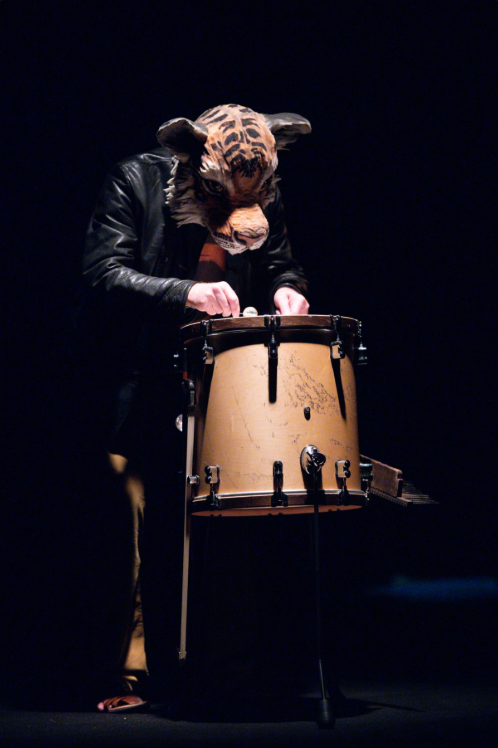
The music is not noticeably from Palestine and apparently has no composer, but the instrumental melodies follow the tempo of the performance and on several occasions they give rise to associations with both drones and bombers raining down on Palestine.
The actors immerse themselves in tragic lives, which are almost impossible to imagine. The lives are real and lived by tens of thousands of Palestinians every day. They tell the story of Juliano Mer-Khamis who was one of the founders of The Freedom Theater in Jenin and ran it until he was shot and killed right outside the theater in 2011. They tell the story of Ahmed Tobasi who was imprisoned as a political prisoner when he was 17 years old, the same age I am now.
It is impressive how the Norwegian actors convey their stories and jump between the characters they play. Throughout the performance, the Norwegian actors alternate between standing without masks and pulling tiger masks over their faces. This creates a clear distinction between which characters they are playing, the Palestinian artists or themselves. Anyone can hide behind a mask. This creates distance between the two and gives us room to fill in the face of the voice ourselves.
This is less a play than it is a raw conversation between the artists. It feels like they are speaking directly to us in the hall, so that it becomes a kind of conversation between the artists and the audience as well. The storytellers and the listeners. The Palestinian voices and us in Norway.
When Ahmed Tobasi was released, aged 21 after four years in prison as a political prisoner, he began to explore how art can be used as a defense. The performance shows what place art has under cruel circumstances. How art can give meaning to life, something to live for when everything seems hopeless. As Borr i Bekmørtna said in the NRK series Nattseilere: “Theatre is almost as important as food and water”. Art is not just art, but a break from the madness. The war. The genocide. But time and again we are reminded of how fragile it all is. But art is not just material, and even after death their voices will not be silenced.
Art also provides an alternative opposition front where one can stand up for oneself and one's people without having to take up arms. This is also something the performance dwells on. How one can say what one thinks through art, whether it is through acting and theater, poetry, painting and drawing, or dance. Art provides space to grow as a person, but can also give strength against a greater power. Between the lines one can also glimpse how art not only gives something to fight for, but also with. Like bombs that do not tear apart, machine guns that do not shoot. Like a weapon that does not kill.
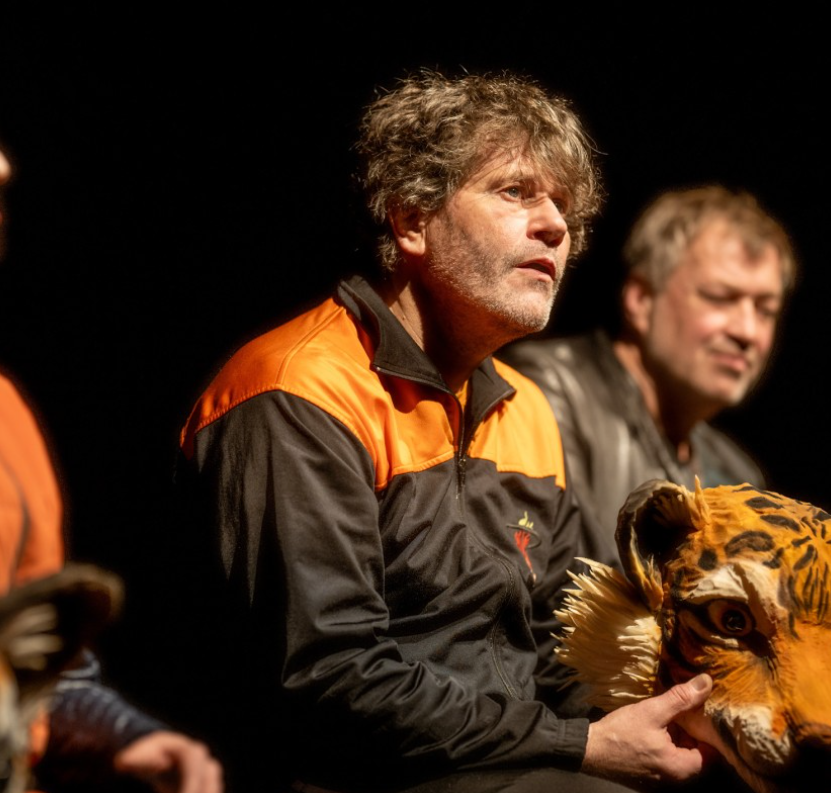
Towards the end of the performance, the actors go to their respective places and start telling stories. Fragments of life in captivity, suffering, torture and death are all you get. I think this is a good way to portray it. They don't have enough voices to tell all their stories, but they have enough to tell some. It reflects the unmanageable chaos of war, you don't get everything, but you get the most important things:
Something must be done. No one else can die while we just stand by and watch.
The performance gives voice to all the horrific images you have seen. Reminds you that behind every white sheet lies a person with a story. In the world we live in today, we need more people who convey stories like this.
Tørstad, Tor Magne, director “Friend and Wizard.” Night Sailors , season 1, episode 4, 1984. NRK , https://tv.nrk.no/serie/nattseilere/sesong/1/episode/FBUA09000384 . Accessed September 21, 2025.
September 24, 2025
With
Screenplay: Zoe DELEMERE Lafferty & Ahmed Tobasi (Artists on the Frontline & The Freedom Theatre)
Translation: Vibeke Harper & Marius Kolbenstvedt
Lighting design: Kristian Belgau
Scenography/visual expression: Vibeke Harper
Mask maker: Kari Noreger
Actors on stage: Gisle Hass, Anna Dworak, Marius Kolbenstvedt
Afterword: Wesam Almadani
Director: Marius Kolbenstvedt
Co-director: Rebekka Nilsson
Producer: Contraceptions
Co-producer: Kloden Teater
The Promise of the Revolution is a documentary theatre project by Artists On The Frontline and The Freedom Theatre
Written by: Zoe Lafferty
Based on texts and interviews with: Ahmed Tobasi, Ali Abu Yaseen, Arna Mer Khamis, Dareen Tatour, Juliano Mer Khamis, Loai, Tafesh, Mariam Abukhaled, Mohammed Bakri, Suhail Khoury, Rania Elias, Yousef Swaitat and Zakaria Zubeidi
Affiliated artists: Alia Alrosan, Mustafa Sheta, Ahmed Tobasi and Zoe Lafferty
Dramaturgy by: Micaela Miranda
Translation and transcription by Alia Alrosan and Rachel Vogler
The performance premiered at Showbox 2024 and is supported by Scenekunstbruket , FFUK and Free Word.
Kloden theater, Oslo Culture Night September 12, 2025
All photos: Lars Opstad/Showbox