
So stupid it's fun
The guys at Det Norske Teatret are so stupid that it's funny, writes Fiona Åtland (20) in this illustrated review.
Thorbjørn Harr creates a playful and nuanced character study, where the music opens up for an unexpectedly vulnerable Peer Gynt. But it seems as if the first and second acts were directed by two different people.
In the mild evening sun at Gålå, Masud Gharahkhani spoke in front of an excited audience, dressed in woolen clothes and hiking boots, as he declared the Peer Gynt Festival 2026 open. The President of the Storting was able to reveal that over 500 volunteers have contributed both on and off stage. Together, they have made it possible to put on this year's performance, an example of what people can achieve when they stand up for each other. Without love for the people around us, the trolls awaken in us, Gharahkhani clarified. They quickly find fertile ground in a world where power trumps human dignity. Therefore, Gharahkhani's reminder was right: the importance of a person is measured in what we do for each other, more than in who we are and where we come from. It is the exact opposite of the trolls' credo "be yourself - enough".
When Mother Åse tells Solveig about how she and Peer lived together when he was little, she says; “One uses liquor, another uses lies; Oh yes, then we used fairy tales”. Peer's stories are more than juggling and provocation, and that characterizes Thorbjørn Harr's Peer Gynt.
The performance begins with Harr gently strumming a piano. He treats the music as a finely tuned tool to captivate the listener. When Mother Åse enters the stage, Harr creates a great storytelling art for her. He carefully weaves his way around his mother and conjures up the Buckeritet on stage. With the help of a very rhythmic ability to imagine, Peer Gynt manages to physically drag the entire audience with him across Gjendineggen. Despite the fact that the dialogue in Buckeritet is one of the most quoted in Norwegian theater, it feels like I am seeing Buckeritet for the first time in Harr's fresh and original interpretation.
On his way to Hægstad Gård, Peer imagines life as an emperor. He fantasizes about beautiful girls and ostentatious wealth, but is surprised by a group of men from the village. The men make fun of him in a superior way and Peer gets fired up. Among other things, the men call him a drunken pig. It is clear that no one has much taste for Peer, but when he starts playing, the atmosphere changes.
Peer brings a saxophone and plays for a dance at Hægstad. Together with a live band, he creates pleasant and enticing jazz tones. The music accurately describes the influence Peer has on the people around him. Even though he is both lazy and unreliable, Mother Åse is unhappily charmed by his communication. He has the same power over the audience when all the wedding guests sway to his tunes. The charm makes it possible to understand how he managed to maintain an entire life as an egoist.
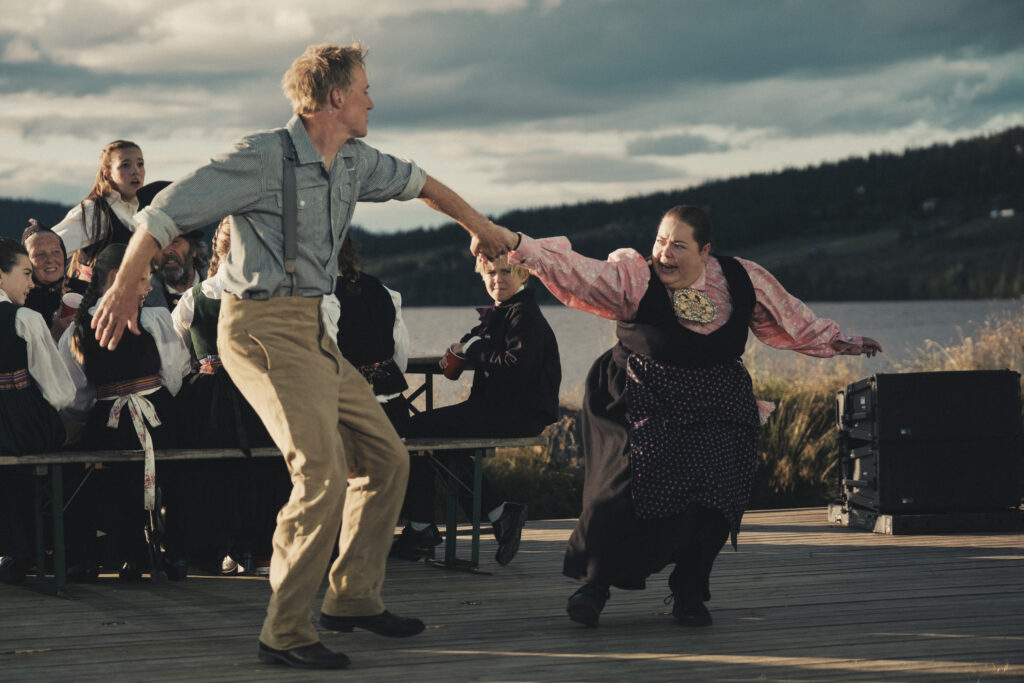
When Peer meets Solveig, the music becomes soft and tender. He blushes and shows her the gentle side of himself, a side he has previously only shown to Mother Åse. For a moment, time stops and only the two of them exist. The performance makes it clear that Peer is multifaceted because his abilities are not only used to escape from reality, but also to understand those he loves. This is beautifully revealed in Mother Åse's death, where Peer uses his imagination to ride his mother into heaven. He carefully lies down in bed with her and acts as if he is a little boy again. When she falls asleep, he plays Grieg's Aase's death softly on the saxophone, which gradually breaks out into a sour, mournful howl from the saxophone.
I think it's elegant that the saxophone plays the main role. When Peer plays, he is listening and responsive to the sound in the room. At the wedding, it's as if he's standing outside and looking in, before using the music as a sneaky entrance. That makes Peer less intrusive and more searching. I've previously experienced other Peer Gynt interpretations as far more sizzling and with their claws out from the start. Then it becomes obvious from the start that this is a performance about a big ego. Here, however, I think that one opens up more to one's own personal understandings of Peer.
After the break, Peer Gynt's journey is conceptualized considerably. At Begriffenfeldt's asylum, the patients are trapped in a digital world in front of telephone stands, Anitra has become Ai-nitra and the passenger on the boat is a mechanical copy of Mother Åse. This modern style creates many beautiful tableaux on stage. In contrast to the wild nature, it is fascinating when the Button Maker came rolling into a plate where a Nav-like office had been set up. It was nice to watch, but the magic of the first act was missing.
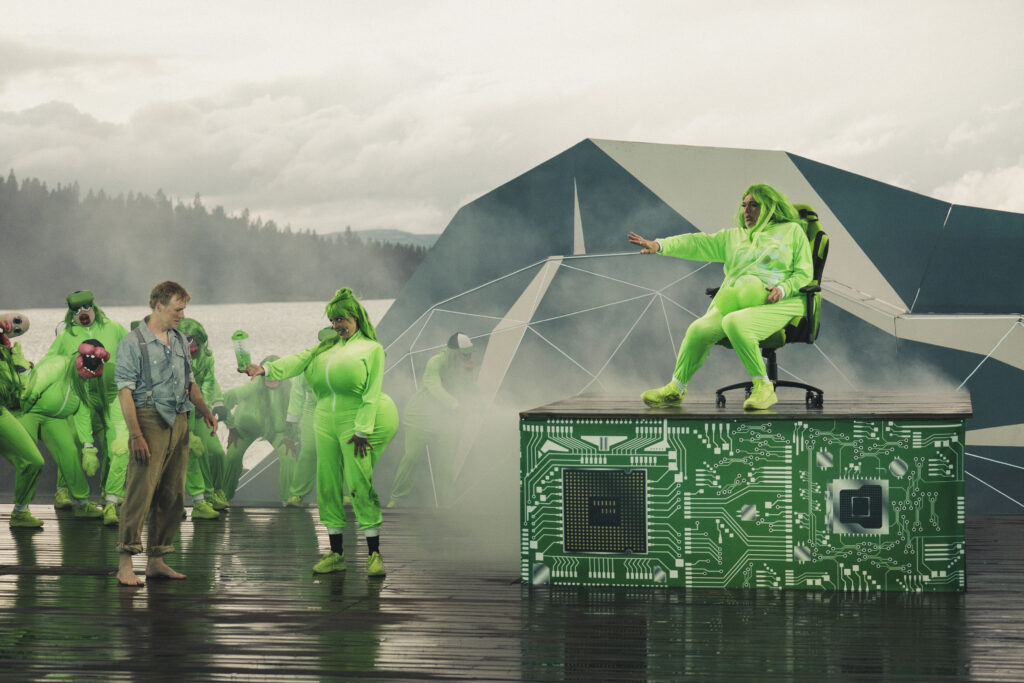
The first act was a masterful character study of Peer and how he relates to reality, but in the face of the futuristic staging in the second act, Harr is at times overshadowed by the visual expression. He is more static and moves quickly from situation to situation. As an audience, we lose a bit of the inner perspective and stand more on the outside watching what he does.
When Peer returns home and realizes that no one really cares about his life, the volunteer actors gather around him with large inflatable figures. The figures are large and colorful, but at the same time they are empty inside and can easily blow away, which reflects the substance behind Peer's facade. I mention this example to explain that the modern directorial techniques are wise and thought-provoking, but that they do not play on Harr's superpower, namely his imagination.
This year's Peer Gynt is made with love and fascination for the man behind the facade. Even though the second act didn't work as well for me, this performance is the most beautiful theater experience I've had so far in Young Voices.
August 12, 2026
In the roles:
Thorbjørn Harr: Peer Gynt
Ellen Birgitte Winther: Mother Åse, The Strange Passenger
Gina Bernhoft Gørvell: Solveig
Terje Strømdahl: The Old Man of Dovre, Master Cotton, The Priest
Ingrid Rusten: The Green-Clad One, Anitra, Ingrid
Håkon Ramsad: The Button Maker, Hussein, Solveig's Father, The Bend
Cato Skimten Storengen: Begriffenfeldt, Aslak Smed, Kokken, Eberkopf
Artistic team:
Peer Perez Øian: Director
Alf Lund: Musical Director
Dagny Kleiva: Set designer
Ingrid Nylander: Costume designer
Stian Danielsen: Choreographer
Embla Skognes: Mask designer
Ingrid Nilsen: Dramaturg
Øyvind Wangensteen: Lighting designer
Simen Scharning: Sound designer
Karina Aase: producer
All photos: Bård Gundersen / Peer Gynt at Gålå
Gala, July 31