
A sensitive Hedda Gabler
Katona József Theatre from Budapest has created an emotionally intense modernization of Ibsen's classic, which shows Hedda's feeling of emptiness and loss of control.
The Sisters is one of the biggest ventures of the theater season, but the brand new performance is a crumbly cake on stage, sprinkled with cream, jam and grandiose wishes.
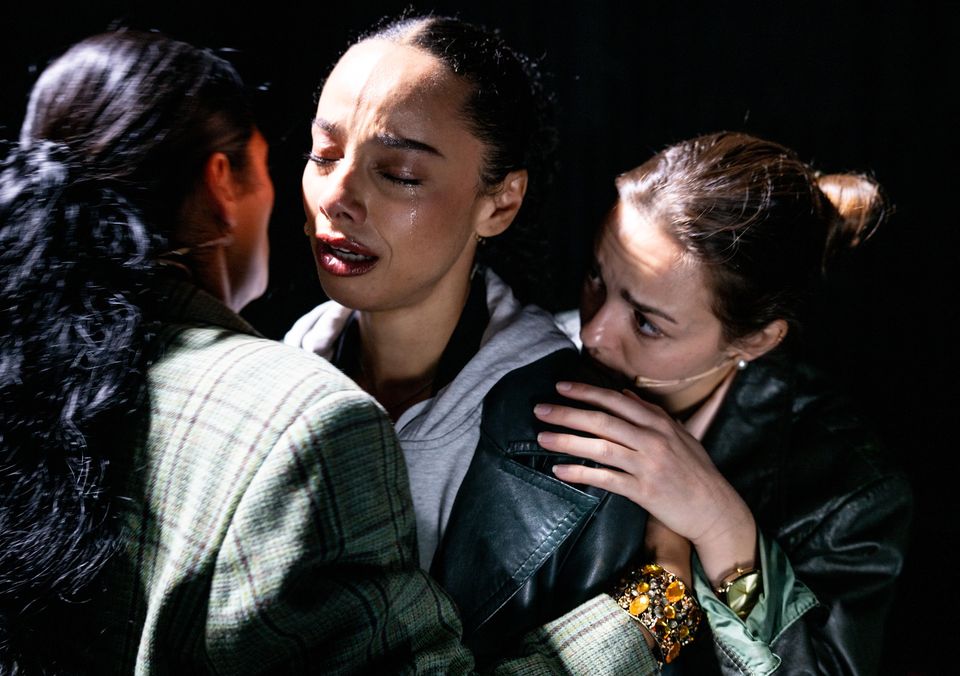
On the main stage of the Norwegian Theatre, the audience is greeted by a wide, towering, scaffold-like wall of platforms and stairs behind a dense, gray, lattice facade. The structure towers across a smaller concrete block that extends far into the dark stage space. Suddenly, the spotlights are turned on, party music flows from the sound system and the entire stage space is set in motion. Three figures come walking purposefully across the concrete as if on a catwalk, and introduce themselves as the play's main characters: the Mikkola sisters Ina (played by Elpida Stojscevska), Evelyn (Nathalie Bjerke Roland) and Anastasia (Hibba Najeeb).
The three sisters speak directly to the audience, recounting in words how they have just gotten into the coolest party of the evening, New Year's Eve 1999. Another important figure also arrives at the party: Jonas. He is a friend from the sisters' childhood in the shantytown outside Stockholm, and eventually takes on the main role as the narrator of the performance.

The narrator Jonas, played by Nader Khademi, stands wide-legged on stage in black, neutral clothes, with his hands folded tightly in front of his chest. He resembles a presenter, and that is actually exactly what his function is in the performance. As if he were Fredrik Skavlan himself, Jonas begins to guide the audience through a packed evening. The play's diverse cast of characters become the evening's guests, and their detailed stories become the source of feature after feature. He takes us back to childhood with the sisters, before we travel forward in time to see how they all find their own paths in the story. Jonas also lends the role of presenter to the three girls, so that they themselves can tell about episodes from their own lives.
“The Sisters” is based on the best-selling novel of the same name, written by the Swedish Jonas Hassen Khemiri. It was Maren Bjørseth, the director of the production, who herself came up with the idea of turning the 650-page book into a play. In an article on the website of Det Norske Teatret, she refers to the whole thing as a “megalomaniac” project. Megalomania is a term from psychiatry that means “ morbid delusions of one’s own greatness .” Although that may not have been exactly what Bjørseth meant when she used the word, it rings a few bells from the three hours I spent in the theater. Ironically, the word that was supposed to emphasize the director’s great ambitions ends up as an embarrassing reminder that quantity is not better than quality.
Turning a book into a play is inherently difficult, and it doesn't help that this book spans forty years, four main characters, and three cities on different continents. Nor does the endless sprinkling of side characters and derailments make the cake any easier to digest. The megalomaniac director praises the book's lack of conclusion because it nevertheless takes the reader through a description of life itself. Unfortunately, the experience is not the same for theatergoers. Without a conclusion, the performance becomes bland and random.
In a desperate attempt to reproduce as much of the book as possible, large parts of “The Sisters” are devoted to the story being recited rather than experienced. Halfway into the first act, Anastasia takes over the baton from Jonas and begins telling her story. She takes the story out of Europe, to the city of Tunis in Tunisia, where she falls in love with the German engineer Daniella. Instead of letting the love unfold in the moment, Anastasia turns to the audience and explains in words what is happening between the two characters. This tactic undermines the magic of theater, the art of the moment. Theater differs from literature in that it can convey emotions and relationships by letting it happen in reality, completely wordless. The possibilities of theater are thus wasted in large parts of the performance.
The story is not cut well enough, which leads to huge amounts of time being eaten up by establishing and explaining all sorts of irrelevant stories. This makes the plot of the play appear messy and directionless.
A glimmer of light appears in the darkness in the second act, when the actors begin to address each other and allow the story to move forward through dialogue and action. At this point, much of the excessive establishment is done, and the characters can finally begin to live in the world they have built. The three sisters are now adults, and are given plenty of time to talk to each other about what has been and what will be, and what paths they want to take next. There is also an electric atmosphere in the meeting between Jonas and Evelyn, the middle sister, when they find each other in New York. They are allowed to carry on their conversation without the circumstances stealing the focus, it is not so important where, when or what they are, only the relationship between the two people and all the difficulties of life. Evelyn also gives a trembling monologue in which she breaks with the complicated life she has lived for so long. In these scenes, the theater magic is finally allowed to throw the last of its magic dust over the hall and stage.
A good book does not guarantee a good stage script. “The Sisters” falls into this trap, becoming an imitation of the book instead of relying on the uniqueness of the theater. The performance inflates itself in an attempt to accommodate as much as possible, but it becomes a castle in the air, an illusion of grandeur that bursts in the lack of direction.
September 18, 2026
By Jonas Hassen Khemiri
With: Nader Khademi, Elpida Stojcevska, Natalie Bjerke Roland, Hibba Najeeb, Ane Dahl Torp, Gard Skagestad, Kaia Varjord, Amell Basic, Carl Martin Eggesbø
Dramatization Kristofer Grønskag
Translation Brynjulf Jung Tjønn
Director Maren E. Bjørseth
Set designer Olav Ryland Myrtvedt, completed by Norunn Standal
Costume designer Alva Walderhaug Brosten
Composer and sound designer Alf Lund Gobolt
Lighting designer Norunn Standal
Choreographer Ida Wigdel
Dramaturg Siri Løkholm Ramberg
Assistant director Andrine Nilsson
Publisher Colombine Teaterförlag
All photos: Lars Opstad
Set September 11, 2026