
A sensitive Hedda Gabler
Katona József Theatre from Budapest has created an emotionally intense modernization of Ibsen's classic, which shows Hedda's feeling of emptiness and loss of control.
The confident line “et graut” belongs in a Norwegian folk tale, not in the mouth of one of Sweden’s most dangerous gang leaders. This is one of several logical flaws in the play Ord for blod that makes Faysa Idle’s initially painful coming-of-age tale boring to me.
Before the wealth tax became the big issue that divided the right and left during this year's general election, Norwegian immigration policy was one of the most debated issues. Party leaders often point to the situation in Sweden as a horror example. On the Progress Party's website , "Swedish conditions" are described as a society characterized by daily murders, shootings and car fires. In 2015, a gang of criminals were shot and killed in the Swedish capital. The murders became part of the scare statistics that we Norwegians often use, but for teenager Faysa Idle it was the loss of a close friend. Faysa Idle is the sister of the former leader of the criminal network Shottaz in Sweden. She was only 15 years old the first time one of her friends was killed in gang violence. In an interview with NRK, she stated that she lived in a different Sweden than what is considered "normal" society. In "her" Sweden, there were no crisis teams with safe adults to welcome her.
Behind the stigmatized term “Swedish conditions” are individuals, like Idle herself, who rarely get a say in this debate. In her book A Word for Blood, she takes us into a world that is completely unknown to most of us. I only wish that the Riksteateret, with Seluah Alsaati’s dramatization and with Affe Ashkar directing, managed to lift this world onto the theater stage.
The structure of Words for Blood becomes very predictable: First a monologue, followed by transitional music (usually rap music) and then a scene that plays out what we have just been told, a new monologue follows and we are already familiar with the structure.
In my notebook, I have written “MEAN GIRLS” in capital letters. If you remember how Janis (the outsider) gave a summary of the different gangs at school to the new student Cady (Lindsey Lohan) in the movie Mean Girls , the director in Mean Girls has a similar approach to presenting the environment. If you don’t remember or haven’t seen the movie, in Mean Girls , the main character Faysa speaks to the audience and unfolds her entire upbringing, while the other characters either freeze in a background play or act out what Faysa is talking about. As the audience, however, we become passive spectators. I want to get to know the characters , not just hear their story.
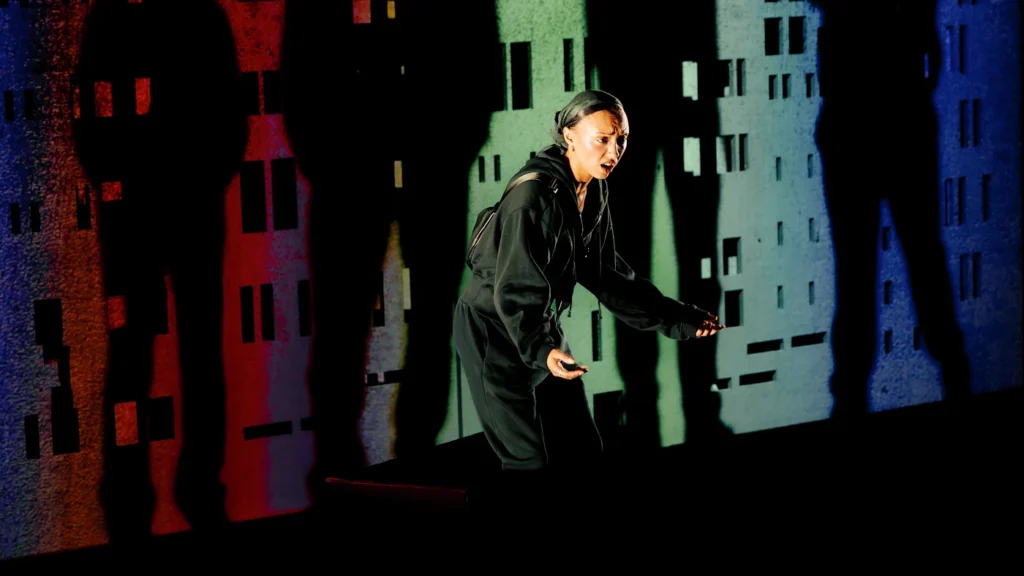
In one of the first monologues, the main character, who, like the author, is also called Faysa, tells how as a child she thought she was going on holiday to Amsterdam, but was instead sent to live with family in Kenya as punishment for shoplifting. The rescue came in the form of her first menstruation; she had then become impure and was sent home. It is an absurd story and the performance could have profitably drawn out such scenes. It could have been a tragicomic moment that shows how the main character has learned to regard the lack of control over her own life as something completely normal. Or it could have been explored physically with the use of voice and body to show how it feels. Instead, the main character rushes through the text, not in a way that emphasizes the normalization, but in a way that makes it sound very literal. The words on stage lack the extra dimension that inflates the lines into more than just a script. It seems as if director Affe Ashkar has relied on the fact that Idle's biography alone is able to create its own universe that lives in the audience's imagination.
Words for Blood is a collaboration between the Norwegian Theatre and the National Theatre. The dialogue is probably therefore written in Nynorsk, but it seems more like a stylistic move than an organic choice. Sentences like “The guys are from one of the gangs, this gang thing has become a thing now, often the gangs are tied to an independent area that they are supposed to control”, do not sound good in the actors’ mouths. It is clumsy and not least it weakens the biographical storytelling. The Norwegian Theatre has a tradition of using Oslo’s sociolects/multi-ethnolects, for example in the performances of Don Martin, something Words for Blood would have benefited from using. I have little faith in the criminal gang leader on stage, when he confidently says “a porridge”. It just sounds silly.
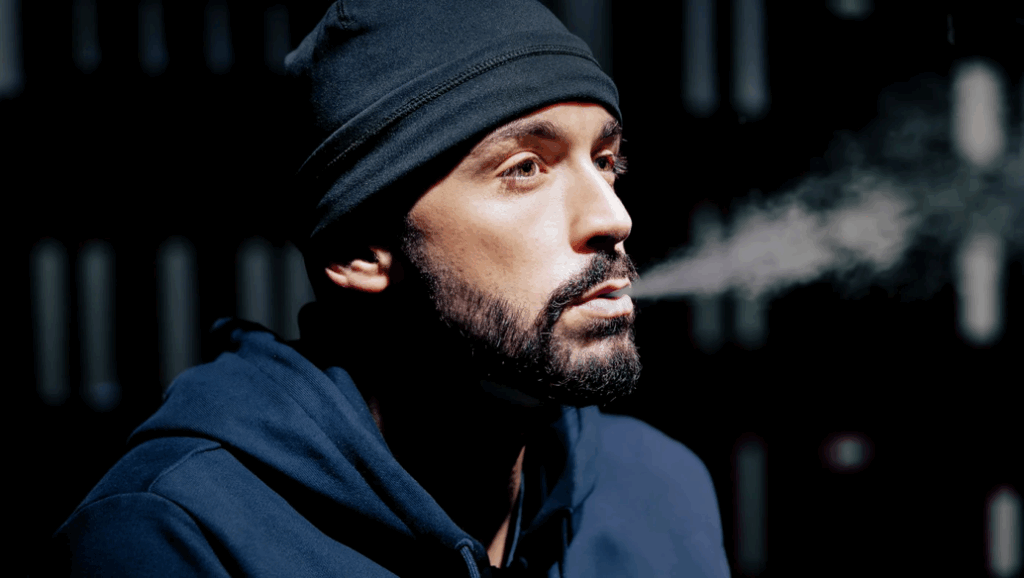
The performance seemed planned and looked stylish, but when neither the set design nor the music touched me emotionally in the sad parts, I think it's because the performance lacks direction.
Where the Riksteatret/Nationaltheatrets Prima Facie and Teater Innlandets Den Fræmende , two other monologue and touring performances of the year, used the format to create an innovative and dynamic universe, Ord for blod does not make any daring artistic choices. I miss an innovative directorial approach that could have given the performance a clear theatrical concept, broken up the predictable dramaturgy and elevated the text from book to performing arts.
In The Stranger, the distances in space, lighting and structure of the text were used to provide a deeper understanding of the main character's relationship with other people. I think Words for Blood just became a lot of words, while the other devices were just "there".
The dialogue scenes in particular lack important nuances. Examples of this are that Faysa's first love, played by Serhat Yildirim, is primarily portrayed as a hash-smoking criminal. We only meet Faysa's brother, played by Ken-Philippe Tete, when he is aroused. This is a mistake. Yes, it is part of reality, but not the whole of reality.
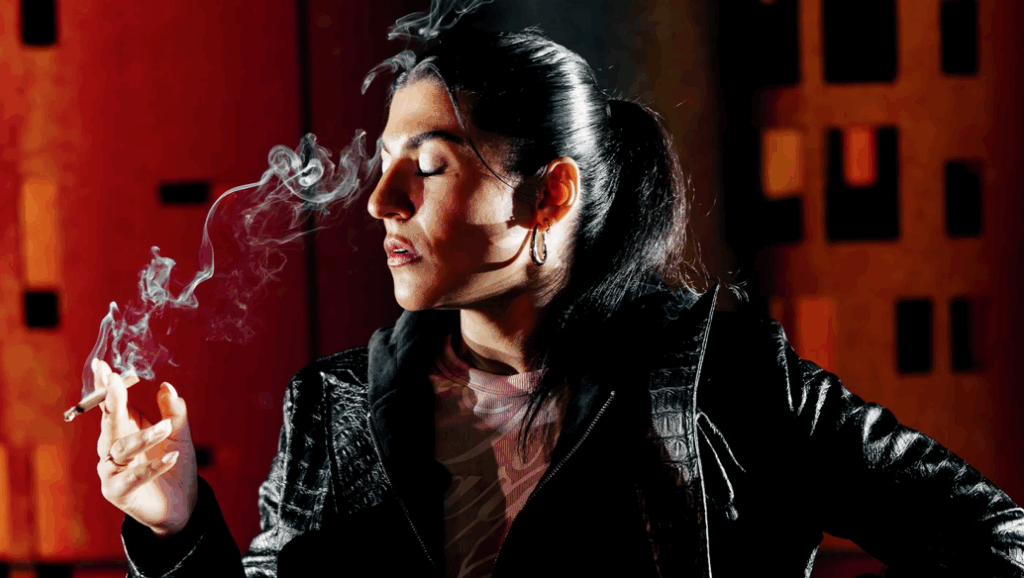
An actor once told me that she didn’t find it difficult to work with actors who spoke a different language than hers because, despite the language barrier, “everyone gets hungry, has to go to the bathroom, and freezes when it’s cold.” The same goes for the gang criminals.
Faysa is an upbeat woman with a strong rhetoric and good communication skills. Her brother Bilal is so socially active that he has become a gang leader. However, the play spends more time illustrating the stereotypes instead of showing that these people are also like everyone else. They fall in love, not because the person in question is a criminal, but because that person arouses interest. Faysa's brother is a watchdog, not because he is a gangster, but because he wants the family to be safe.
If the show had stopped and taken breaks, the audience could relate to these human moments and the contrast with the world they live in would have made it all more poignant. Then the perspective would have shifted from fear of gang crime to grief over losing individuals.
September 25, 2025
By: Faysa Idle, Daniel Fridell and Theodor Lundgren
Dramatization: Seluah Alsaati
Translation into Norwegian: Ingelin Røsseland
Directed by: Affe Ashkar
Scenography and costume design: Jasminda Asplund Blanco
Lighting and video designer: Anders Ekman
Composer and sound designer: Simon Wimmer
Dramaturg: Marie Persson Hedenius
Artistic advisors: Castro and Emnet Kebreab
Language consultant: Inger Johanne Sæterbakk
Assistant director: Embla Hane
With: Nokokure Dahl, Hibba Najeeb, Ken-Philippe Tete and Serhat Yildirim.
Co-production between Det Norske Teatret and Riksteatret. The performance is part of the International Fosse Festival 2025.
All photos: National Theatre / Maja Moan
The review is based on the dress rehearsal, September 6, 2025 at the Riksteatret, Nydalen