
So stupid it's fun
The guys at Det Norske Teatret are so stupid that it's funny, writes Fiona Åtland (20) in this illustrated review.
Although “The Never-Ending Story” is visually impressive and has several strong scenic moments, there are some weaknesses in the direction and dramaturgy that gave me the feeling that the play truly became a “never-ending story,” for better or worse.
Overall, The Neverending Story is a play that offers a magical experience, with impressive visual effects, creative set design and humorous touches. Still, it felt like a long journey, with a pace that could have been tightened up. I found it a bit repetitive and tiring, but there is no doubt that the performance has many strong elements that can engage both children and adults.
Bastian Baltasar Bux is a bullied boy who finds the mysterious book, The Neverending Story , during a visit to the theater. In the book, he discovers Fantasia, a magical kingdom threatened by “Nothing,” a force that destroys all hope. Bastian becomes part of the story and meets Atreyu, who is trying to save Fantasia. Atreyu must save the Child Queen, who can only survive if she is given a new name, a name Bastian must give her.
Bastian gains magical powers through the amulet Auryn , which allows him to shape Fantasia with his imagination. Gradually, he becomes more selfish and loses touch with who he really is. He becomes arrogant and wants to become the ruler of Fantasia. But every time he uses his power, he loses parts of himself.
Finally, after being manipulated and losing his own name, Bastian gives up power and finds his way back to his human identity, and Fantasia disappears with him.
The play "The Neverending Story" is a magical retelling of Michael Ende's classic novel, published in 1979. Bastian's journey in The Neverending Story reflects the inner struggle between dreaming away and facing reality. He begins as an insecure boy who seeks escape in the world of fantasy, a natural reaction to challenges and uncertainty. Throughout the journey in Fantasia, it becomes clear that escape is not enough; imagination can both elevate us and lower us, if we are not careful.
Ende's book has been adapted into films several times, and both the films and the title tune "Never Ending Story" by Limahl have achieved cult status. However, the author was dissatisfied that the films deviated from the novel's style and message, and he unsuccessfully sued the film company.
One of the strongest parts of the play is undoubtedly the scenic touches. Here, director Peer Arne Perez Øian, together with set designer Arne Nøst, has managed to create a magical atmosphere with creative solutions and impressive visual effects. An example of this is when the characters ride the dragon of fortune, and the audience feels the wind blowing against them, thanks to a real air machine that is placed towards us. They have also used another machine to make the actors actually hang/fly above the audience. These details help to make us feel like we are part of the story, and give us a real insight into the fantastic world they find themselves in. Another funny detail is when a face, which I think was called Mora, sneezes and has confetti squirting out of its nose. This moment gave both children and adults a good smile, and showed that the director has an eye for engaging and playing with the audience, which was important, especially since many of the audience were children.
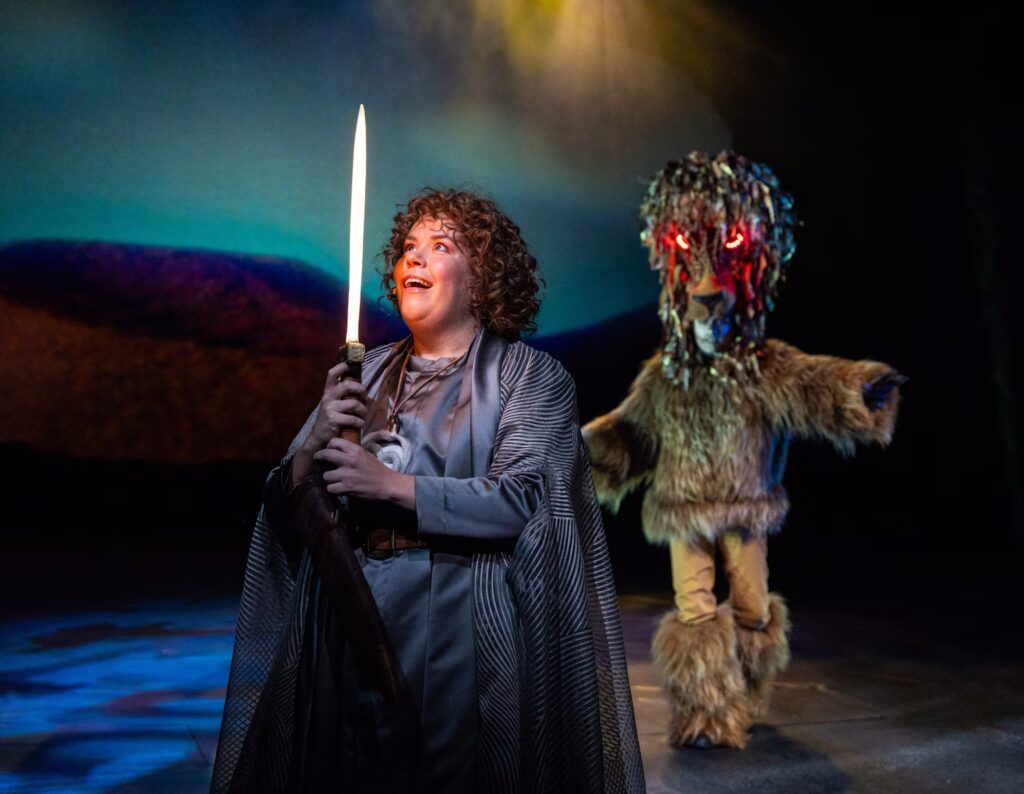
The director put a lot of emphasis on colorful costumes, simple jokes, and easy-to-understand scenes, which probably works well for families with children who want a fun and light experience together. I noticed that I had a little difficulty connecting with the characters or getting carried away by the story. The play is made more contemporary by mixing in modern references, like when one of Bastian's other classmates suddenly shouts and dances to “Ballerina Capucina” and “Tung Tung Tung Sahur”. The kids in the audience thought it was fun, but I couldn't help but feel that it was a little petty. I understand that humor and pop culture can be good, but it didn't feel entirely natural to me as a viewer.
I think both the pace and the variety could have been better thought out. The story moves at a steady, but a bit too slow pace, without any clear rhythmic shifts that hold the attention. Many scenes drag, especially the dramatic moments and climaxes, which could have had more intensity and drive. Instead of building tension, it felt like the story was standing still for too long, and it drained the energy from the experience. I eventually became quite exhausted by the fact that it all felt like a long and endless journey. If they had just tightened up some scenes and cut some things, the play would have had more energy right away.
Although The Neverending Story sparkles in form and imagination, the story loses some of the narrative drive that could have made the journey as magical as it appears.
November 10, 2025
In the roles:
Ina Svenningdal – Bastian Balthasar Bux
Francisco Kalle Navarro – Atréju
Gard Skagestad – Coriander / Cairon / Gmork / Gråógramán / Armored giant
Rafid Arsalan Islam – Fuchur / Student
Iben Alida Carlsen – Artax / Jicha / Teacher
Joachim Rafaelsen – The Lantern / Morla / Argax / Akarai-Slamoff
Geir Kvarme – The Hero Hynrik / Yor / Dr. Joachim Bux
Mona Huang – The Child Queen / The Snail Racer / Uyulála / Dame Aiulá / Akarai-Slamoff
Ingrid Jørgensen Dragland – Ygramul / Xayide / Akarai-Slamoff / Omvisar
Johan Hveem Maurud – The Stone Crusher
Artistic team
By: Michael Ende
Dramatization: John von Düffel
Translation: Runa Kvalsund
Director: Peer Arne Perez Øian
Scenographer: Arne Nøst
Costume designer: Bianca Deigner
Composer and sound designer: Sol Heilo
Video designer: Åsmund Bøe
Lighting designer: Torkel Skjærven
Choreographer: Kristin Rygg Helgebostad
Dramaturg: Anders Hasmo
Extras: Erik Hove Holtet, Finn Arne Ottesen, Oda Ruud, Amalie Sunde
Conductor: Hedda Haaland
Production staff: Suzanne Svae-Johansen and Gry Hege Espenes
Lighting designer assistant: Gyril Høgberg
Assistant director: Frida Wee
Props: Ada Hesjevoll
Prop makers: Eduard Alqézar Blasco, Jarle Teigen Olsen, Signe Dalsgaard
Makeup artist and wig coordinator: Camilla Brandslet and Julie Sand Johnsen
Carpentry workshop and blacksmith coordinator: Siri Hundvin
Coordinator of the target hall: Kjell Åge Meland
Costume Coordinator: Kitty Krohn Riege
Sound engineer: Vibeke Blydt-Hansen
Lighting installation manager: Aleksander Kolstad
Video technicians: Knut Nikolai Bergstrøm and Raymond Stubberud
Stage master: Kalle Von Hirsch
Technical producer: Anders Audum
Publisher: Nordiska ApS
The Norwegian Theatre, Saturday October 18th
Photo: Siren Høyland Sæter/The Norwegian Theatre.