
A sensitive Hedda Gabler
Katona József Theatre from Budapest has created an emotionally intense modernization of Ibsen's classic, which shows Hedda's feeling of emptiness and loss of control.
The children's theater in Frognerparken works well as light and charming summer entertainment, but could also be used as a means to explore difficult topics for both children and adults.
Before the performance in the circus tent began, I was greeted by a nice group of young people who accepted tickets, worked at the kiosk and welcomed the audience with a warm smile. This group was the second class at the Oslo National Academy of Dramatic Arts. The students, together with the director, Mine Nilay Yalcin, have staged their version of Ronja Røverdatter this summer.
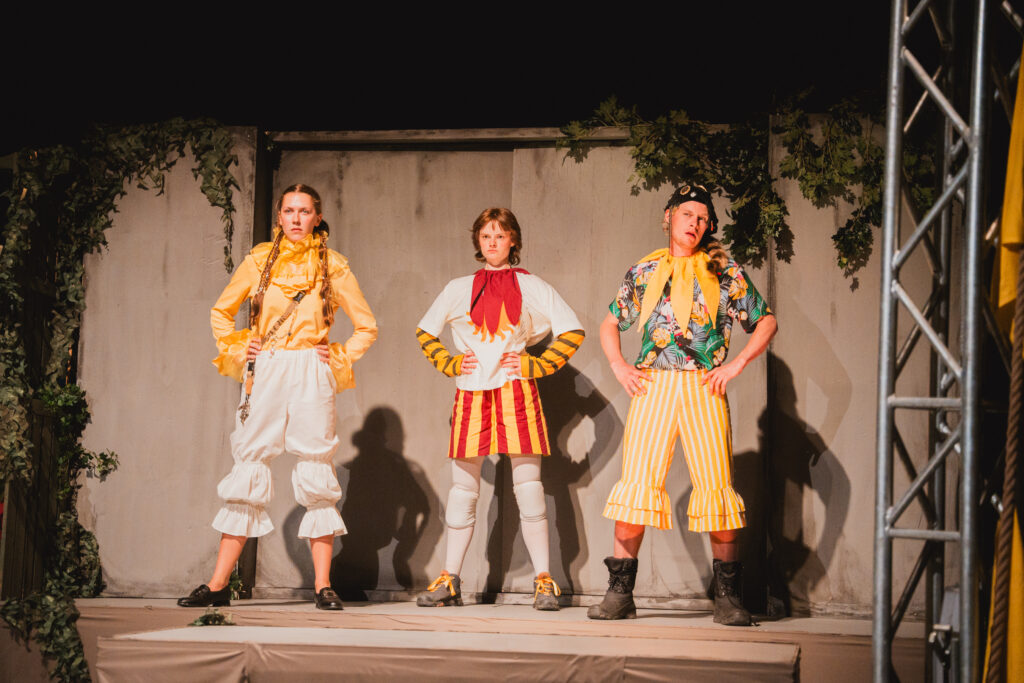
My relationship with the story of Ronja is not that strong. I must admit that I always doze off to the film adaptation on NRK during Christmas, but I remember that the story spans several years. Two whole summers and one winter will be accommodated inside the circus tent. Director Yalcin has therefore chosen not to waste time on large scene changes. The entire play is centered around an amateur-built wooden castle. This set design gave me a nice picture of a playground in a kindergarten that changes in the children's imagination. The play uses the same logic as kindergarten play, namely that the wooden castle can quickly change into a forest because the actors pretend it is there. It doesn't take much to create clear images in the children's minds, and that takes the performance seriously.
But the images it tries to create can sometimes be messy. At one point, there is a time jump where the newborn Ronja, a plastic doll, is transformed into an older and living Ronja (Anna Filippa Hjarne). She is wearing a princess dress over hiking pants as if it were outdoor class in kindergarten. On stage, a lot is happening at the same time. For example, Ronja's father Mattis is standing there talking and laughing about someone called Borka, while Ronja is doing something completely different. It is stupid that this conversation is not given more focus as it establishes that there is a conflict between the families of Ronja and Birk, whom we meet later. These small and large parallel actions that happen next to each other create a living space, but it is difficult to distinguish what is important and what is not for an untrained audience who does not know the play.
There is much about the performance that is impressive. For example, the actors are good at listening to the audience. They take into account any crying or noise from the little ones, but if you are going to play a child, you have to see the world from their eyes and not just recreate what children look like from an adult's perspective. In this performance, it seems that the actors are primarily going to play children, but that does not mean that they are actually conveying what it is like to be a child.
Visually, it is clear that we are supposed to understand Ronja and Birk as children, but in the character portrayal they are drawn towards something younger and more childish than what we know from the film.
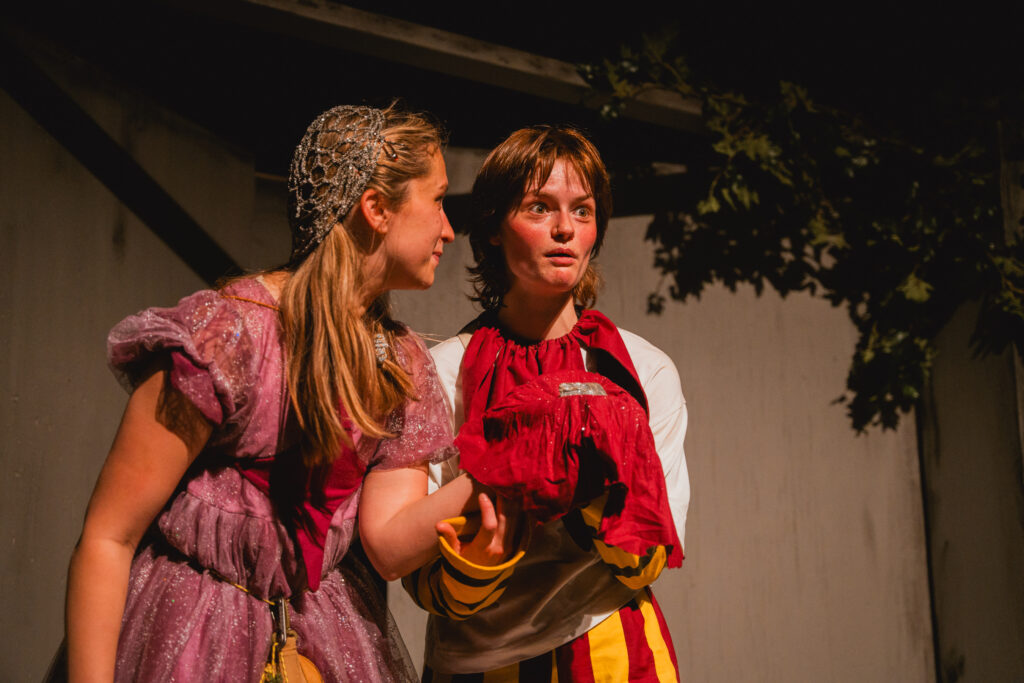
Ronja is both energetic and boisterous, but the childish seriousness that characterizes the film version does not have time to settle down because it slips into something more light and non-committal. It is certainly charming and perhaps more accessible to a young audience, but it also simplifies the characters. An example of this is the scene where Ronja and Birk escape from Borgen, and Ronja says "it's so strange that you can be both happy and sad at the same time". The line expresses her inner conflict: the joy of her friendship with Birk and the sadness of having distanced herself from her family and their values. She has made a brave and frightening choice. The scene slips directly into her father's loud screaming and then the first spring scream of the year. Such quick transitions, combined with a childish style of acting, dampen the serious backdrop of the story. The escape into the forest here becomes more of a playful adventure than a desperate act driven by courage and need.
Borka, played by Aksel Almaas, impresses with a calm and reserved appearance. With few facts and a clear voice, he gives the father figure a seriousness and credibility. He creates a character with authority and saves on the big emotions. This restraint makes him exciting to follow.
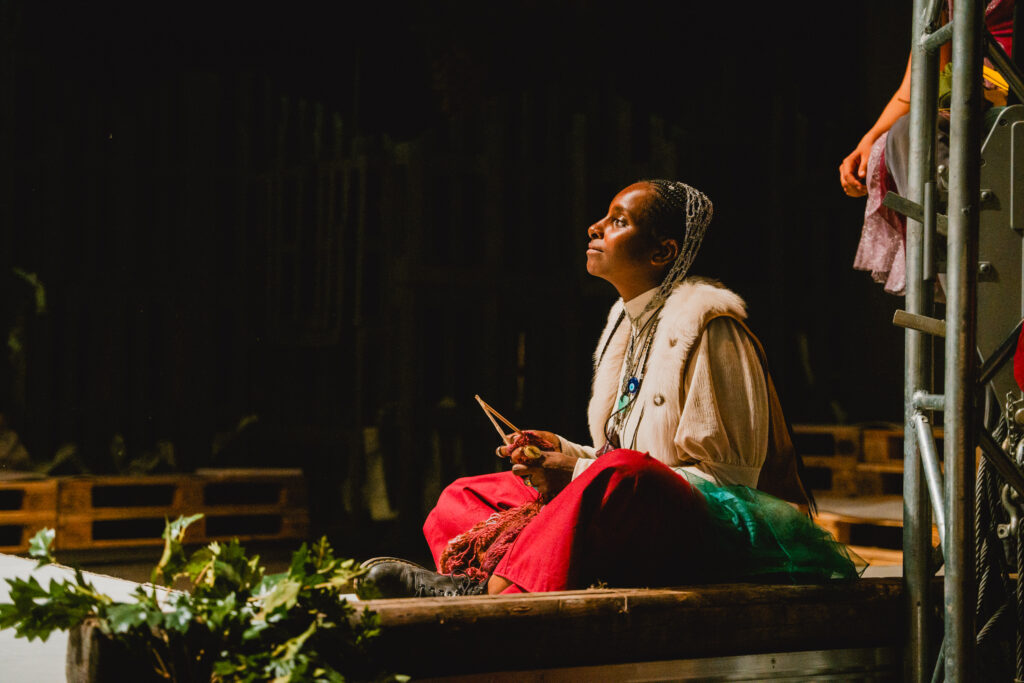
I would also like to highlight Amina Mohamud who plays Lovis. She has a slight hipster aura and portrays a mother who sometimes gets tired of all the antics of her husband and daughter. It is both funny and a character I recognize from real life. Mohamud also jumps nicely into several small supporting roles, which add both energy and humor to the show. I look forward to seeing more of Almaas and Mohamud in the future.
The performance is all in all very energetic and charming, but it becomes too naive in its portrayal of the story of Ronja. I miss the drama and seriousness, but I don't think the target audience did. I must remind the reader that I am approaching 20 years old and am not representative of the target audience "children". The girl with a pacifier in her mouth in the row in front of me is definitely a child, and she said she loved it to her mother as she left.
August 21, 2025
Last modified: September 3, 2025
Summer Theatre in Frognerparken 2025 with the second class at the Theatre Academy.
Directed by: Mine Nilay Yalcin
Scenographer: Philippe Schneider
Lighting and sound designer: Kai Luni Fjell
Costume designer: Fanny Bjørn
Composer and musical director: Heine Røise
With: Anna Filippa Hjarne, Amina Mohamud, Idunn G. Ekker, Balder Scheen Jacobsen, Thomas Røstgård Stenberg, Eline Hundstad Haugen, Sigurd Solheim, Aksel Heider Almaas and Mathilde Cuhra.
All photos: Jacob Nasseri.
Frogner Park, June 26