
The musical Ingvar – it's typically Norwegian to be good
On Thursday, September 10, IKEA came to Østfold in two formats. One as a physical store, and the other as a musical. Unfortunately, I made the trip to the wrong IKEA.
On May 17th I waved the flag from the moment I got up until I went to bed. I rowed for Norway-Brazil and had mild national mourning when we lost to England. Today I cheered for Arne Treholt, a traitor. How the hell?
Today I'm going to see Oslo Nye's musical about Treholt, which they themselves describe as “a musical based on a true story that no one has agreed on, staged by people who weren't there.” It's impossible not to ask the question: How is this going to work? Oslo Nye Teater is still in a financial pinch from the Oslo city council and is fighting to defend its existence and stay alive. Could a new, Norwegian musical be what gives them air in their lungs and life in the hall?
When I arrive at Oslo Nye's main stage, there are posters everywhere. There are descriptions of people who are closely connected to history in addition to authentic newspaper clippings and front pages from that time. There are people like the spy hunter Ørnulf “Ørnen” Tofte, the lawyer, diplomat and politician Jens Evensen, the KGB officer Gennadij Titov, journalist and presenter Kari Storækre and, last but not least, Arne Treholt. The first thing I think is that this is going to be like some kind of documentary.
It's a fun audience to share the hall with. There are both older and younger people. The hall is filled with chatter and laughter, a couple of ladies are sitting behind me discussing the Treholt case and a faint aroma of alcohol surrounds me. In front of me is also a younger man reading an old NRK case about Treholt, here people are both experienced and curious. I myself have only heard about the Treholt case in my Norwegian and social studies classes in middle school. Something I didn't follow very much either. I was advised to listen to a podcast before I saw the performance, so I could freshen up a bit. He loved running, started a sports club with his friends as a child, (rule no. 1 in the club was: No talking to girls) and he has been convicted of one of the biggest espionage cases in Norway. Suddenly the lights dim.
The actors Karoline PU Schau, Ingvild Holthe Bygdnes, Sindre Postholm, Henriette Faye-Schjøll and Gunnar Eiriksson take the stage wearing light brown Adidas track suits and stand up as a kind of lump facing the audience. They may be reminiscent of the gesture jazz hands , but they are completely static. The only thing that moves is the gaze that roams the audience. The audience is already laughing a little. Suddenly, a little gold glitter falls from the pockets of some of the actors. Sindre Postholm takes out a tuning fork, hits her knuckle and finds the tone. The opening number begins and the iron curtain rises. The stage is divided into two walls of cardboard boxes that resemble an archive, between them is a blue vault. The cardboard boxes also feel like a kind of hint: It is the archive of what the state has on Arne Treholt; everything from logging of surveillance, pictures, confessions, etc. etc.
When the opening number is finished, Sindre Postholm leaves the group of actors. He steps forward, looks at the audience slyly and fishes a pair of glasses out of his pocket. He puts them on, and now he is Arne Treholt. Throughout the performance we follow Arne Treholt through his life. Everything from his childhood as a newspaper boy to his sentencing. And everything is told through music and end rhymes on every single sentence. This gives the performance a really playful feel. It is clear that the group that has processed the material also loves musicals. I noticed this towards the end of the first act, because then there is a little nod to musical lovers and the song: “Good Morning Baltimore” from the musical Hairspray, but this time the song is “Good morgen Fornebu”. It was also around this point in the performance where I had to write down in my notebook: Why am I cheering for Treholt?
I found this really exciting. And strange. This man has been convicted of espionage and is referred to as a traitor. But when I think back to my social studies classes a few years ago, I remember it was often mentioned in interviews and documentary clips that he was: “a really charming guy”. Sindre Postholm shows this very well. He carries an attitude and an energy that makes it difficult to be on the same team as the “good guys”, i.e. POT agents and the spy hunter Ørnulf.
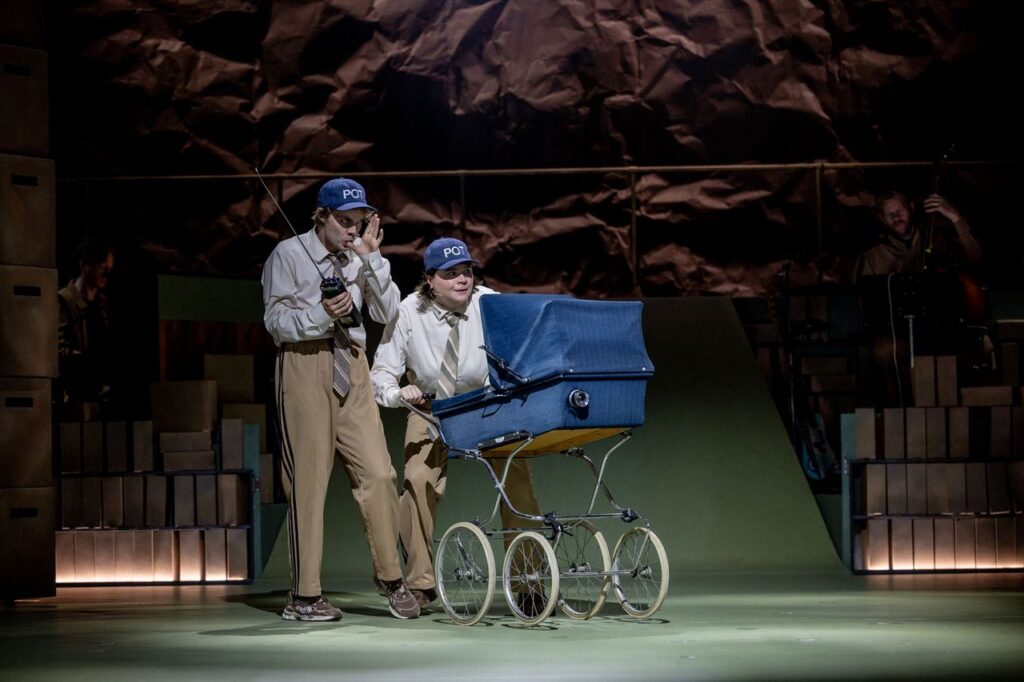
I also think the format they have chosen to portray the POT agents has something to do with it. Treholt carries an earnestness with him throughout the performance, we see him talk his way through problems and find solutions. These semi-professional POT agents have more of a revue about them. That is also where I find much of the humor in the performance lies.
The Treholt musical is difficult to take a stand on. At the same time, I am activated. I am cheering for someone I don't really feel like cheering for. I laugh at the revue brilliance of the POT agents. I am fascinated by the trial scene where they use real audio recordings from the case and meet it with what I, as an unskilled dance professional, would call modern dance. At the same time, they play with rhymes that require me to follow along a little extra, which means that I as an audience member have to put in a little extra effort in meeting the performance. Towards the end, there is something in me that hopes that Arne Treholt will manage to talk and charm his way out of it all. But the course of action is the same as in reality.
Karoline Schau ends the performance with a monologue sprayed with so much power and energy that you are knocked to the ground, but what they mean I do not understand. Or I understand it, she is talking about the theater having to mean something. Which the performance does not really do. They do not take a position. They do not say guilty or innocent, they argue: “Is there evidence that Arne did serious damage” “They said it cost Norway three defense budgets” “Never documented” and “How classified was the material that was delivered” “Have you been charmed?” and so on they go on. I guess that when you put on a performance about a story that no one has agreed on, staged by people who were not there, it becomes difficult to take a position. It is quite natural that you then end up in a “gray zone” .
September 18, 2026
By Henriette Faye-Schjøll (text) and Peder Varkøy (music), based on an idea by Runar Hodne.
Direction and choreography: Thea Bay
Set design and costumes: Christina Lovery
Lighting design: Martin Myrvold
With: Sindre Postholm, Henriette Faye-Schjøll, Karoline PU Schau, Gunnar Eiriksson and Ingvild Holthe-Bygdnes.
Orchestra: Peder Varkøy, Aleksander Sjølie, Andreas Stoltenberg Granerud, Kristofer Staxrud and Morten Michelsen.
Photo: Tale Hendnes
Set: September 4, 2026