The musical Ingvar – it's typically Norwegian to be good
On Thursday, September 10, IKEA came to Østfold in two formats. One as a physical store, and the other as a musical. Unfortunately, I made the trip to the wrong IKEA.
The red carpet had been rolled out, and a blue and yellow balloon arch greeted us at the entrance to Blå Grotte in Fredrikstad. The kiosk sold Swedish favorites like raspberry tops, punch buttons, and meatballs. Coincidentally, IKEA opened a store in Dikeveien, Fredrikstad on the same day that Ingvar the Musical! – a furniture saga premiered. A brilliant marketing ploy, I thought, but it was actually just a coincidence.
Expectations were high when I sat down in the auditorium. Østfold Teater was behind the production, and behind the stage curtain stood the professional actors ready to show what they had created.
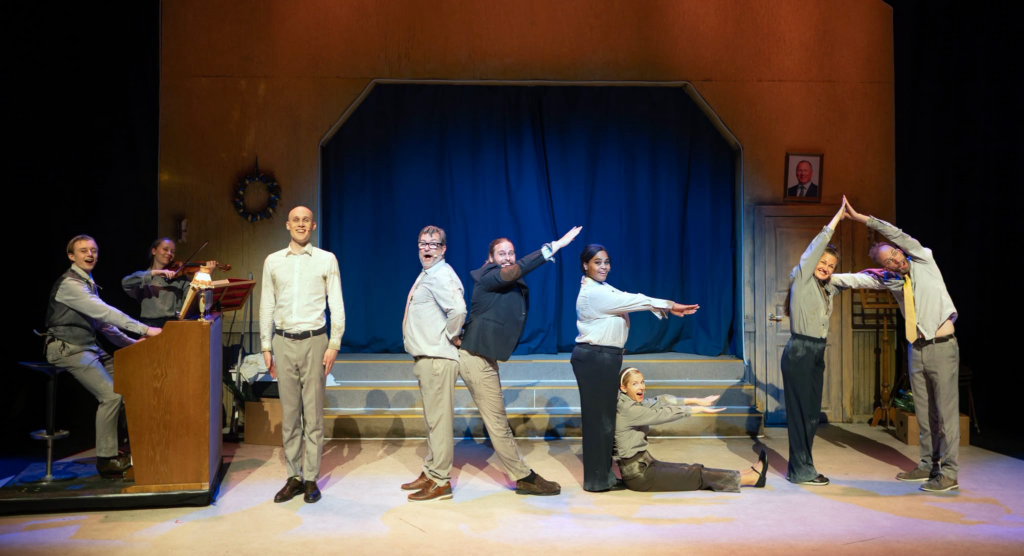
The musical Ingvar is built around the story of the start-up of the famous furniture store IKEA, its journey to the large, successful company it is today, and not least the founder himself, Ingvar Kamprad (Erik André Hvitsten).
The performance, however, began with Norwegian stockbrokers on their way to Sweden. They made their way through a fictional forest, played behind a transparent cloth on stage, and then arrived at an abandoned church where the rest of the performance would take place. Their long journey had soiled the stylish suits they were wearing. They must have packed little with them, because they wore the same suits for the rest of the performance, even though they jumped between several characters. Oil fund manager Nicolai Tangen, on the other hand, had found space in their luggage, when at the beginning of the play they hung a picture of him on the wall. This picture hung until the last penny. Whether this was a symbol of capitalism, or how the intro connected with the rest of the performance, I unfortunately could not figure out.
They then took us further into Ingvar's childhood where it became clear to us that he had always been a born entrepreneur. His failed attempts at several business ideas eventually led him to what we know today as IKEA.
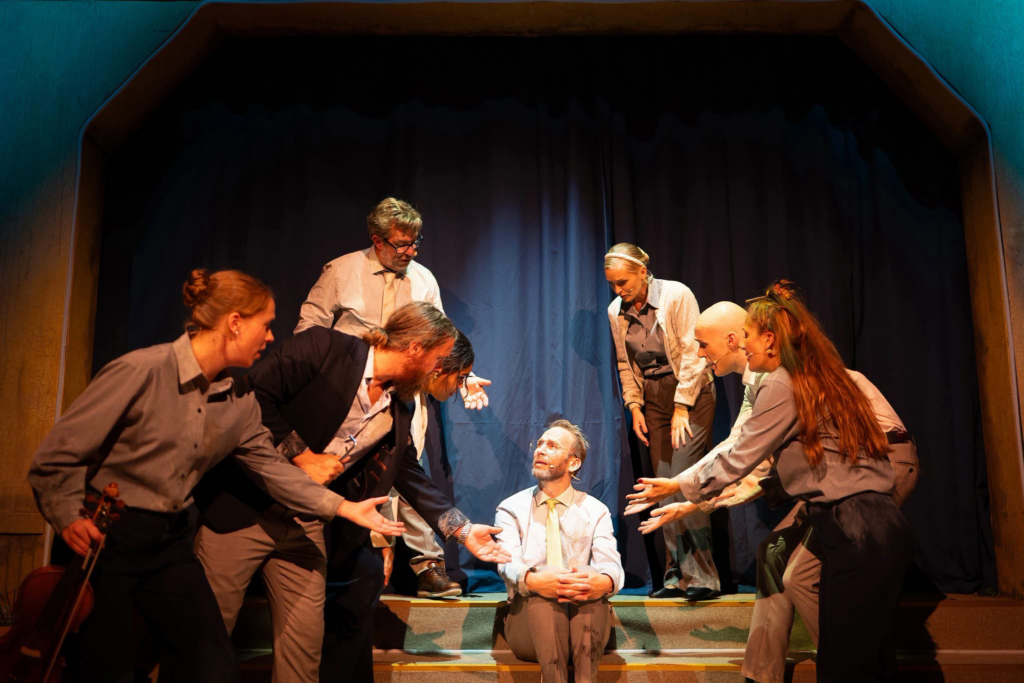
We follow Ingvar's entrepreneurial journey through ups and downs, success and failure. It started when Ingvar was 5 years old, selling matchboxes. Until he found his passion for furniture, he also sold ballpoint pens, seeds, Christmas cards, fish, clocks, picture frames and much more. Ingvar shows many times during the performance that he is creative, solution-oriented and thinks outside the box. Ingvar adapts to the customers' demands and expectations, but perhaps does not have as much focus on the employees' wishes, which creates internal conflict in the company, and ends up with Ingvar being hanged on the cross by his employees. It is a reference to a Bible story, which we are served several times during the performance where Ingvar represents Jesus, and his employees represent disciples.
Other fun references worth noting are small stage references from other musicals such as Book of Mormon , Beauty and the Beast, and Mamma Mia . This was especially fun for me, who is extra into musical theater.
Although the common thread was clear, there were many elements that made it difficult to grasp the actual message and purpose of the play.
Only one character was introduced
Despite the fact that there were nine actors on stage at any given time, it was difficult to understand who they actually represented. They were introduced to us as Norwegian, injured stockbrokers, played roles such as Ingvar Kamprad's family, before moving through several biblical roles. I'm probably not the strongest at biblical history myself, and perhaps that affects my ability to perceive these references, but I still think that there was a lot of ambiguity about this. I also got confirmation of this when I overheard other guests' astonishment and mild frustration at not understanding what we were being presented with, both during the intermission and after the play.
Nevertheless, I would like to highlight Erik André Hvitsten who plays the lead role as Ingvar Kamprad. Hvitsten's energy is beyond compare. He conveys with clarity and precision, while being very expressive with both his face, body and voice. Hvitsten gives Ingvar a light and playful expression on stage, which is a good fit for bringing humor into the play. At the same time, I think that the character can be somewhat one-sided as the plot is based on a real person with ups and downs. This is still a move that director Erik Eger-Schøyen has chosen, and does not necessarily have anything to do with Hvitsten as an actor. Based on how the role is designed, I can see why he was chosen for the role that would carry the play.
The actors sang, just to sing
Absolutely the entire Musical Ingvar, every single line, was performed via song. This was a new concept for me, as all other musicals I have seen have been a mixture of both music and lines. I quickly found that for me this choice of only using song as a storytelling method was completely unnecessary. I experienced much of the music in the play as childish, flat and a bit boring. The music was performed by two very talented musicians on violin and organ, but these instruments unfortunately were unable to serve the big musical numbers that I believe this play needed. For me, it felt like the song lyrics were repetitive, superficial dialogues and informative text about the main character, which was conveyed through song. The songs had very few end rhymes, and made me prefer pure dialogue over melody (a sentence I thought I would never say). I also believe that when a performance is going to consist of only song as a method of communication, the diction of the actors MUST be good. Unfortunately, I believe that several of the actors did not live up to this. At several points I found myself falling out of the story, simply because I couldn't decipher the words that fell out of the actors' mouths. When a story is being told, you shouldn't have to concentrate to understand what is being said. Then you completely lose your "sense of reality", and suddenly become very aware that you are sitting in a hall watching theatre. - That's where they lost me.
Even though the content of the songs was difficult to understand and despite my frustration with how the story was conveyed, it must be said that the singing voices were impressive! The ensemble delivered fantastic harmonies, and they all had powerful voices that complemented each other very well. There were also a few moments where individual voices were allowed to shine so that the hairs on my arms stood up.
Slack movements from professional actors?
– I myself am incredibly fond of dance, and love when it is included in performances. I am therefore very disappointed when it is not done 100%. My gaze was drawn several times towards the limp and sloppy legs and arms on stage, which could have been very easily cleaned up. For me, effort and commitment are linked, and this rubs off on us in the audience. The choreography itself was relatively simple, and when the few movements are then done half-heartedly, the overall impression automatically becomes much worse.
In the headline I wrote: It is typically NORWEGIAN to be good.
As I struggle to capture the message in the story, find depth and feel empathy, I feel that the story of the IKEA founder is as captivating as a Wikipedia article. It was too informative. They should be. But if I had googled someone, the choice would have fallen on some of our big Norwegian names like Rema-Reitan, Terje Høili, who is from Fredrikstad, or oil fund manager Nicolai Tangen, with whom the piece actually began. What he did in the story of Ingvar Kamprad and IKEA I still don't understand.
The questions remain unanswered, and it's a frustrating feeling to walk out of a theater with.
The musical Ingvar! – A furniture saga, Østfold theatre
With: Erik-André Hvidsten – Ingvar Jonathan Tufvesson – Johannes Malin Soli – Judit Ole Jacob Lindberg – Markus Kornelia Sletten Haugen – Rut Mats Gukild – Matthew Jakob Amadeus Hetland – Lukas, musical director, musician Odette Johansen Toukam – Magdalena Julie Waaler Skogrand – Ester, musician
Erik Eger-Schøyen – Director Gjermund Andresen – Set and costume designer Belinda Braza – Choreographer Mats Bergström and Marko Dahl – Sound design Klas Abrahamsen – Composer and screenwriter Erik Gedeon – Screenwriter and composer Henrielle Faye-Schøll – Translator Ronja Bosy – Assistant Director
Original title: GINGER! – a musical furniture saga
Photo: Harald Fossen
Premiere: September 10, 2026, Blue Cave in Fredrikstad
Other articles
Arne Treholt, what a charming... traitor?
On May 17th I waved the flag from the moment I got up until I went to bed. I rowed for Norway-Brazil and had mild national mourning when we lost to England. Today I cheered for Arne Treholt, a traitor. How the hell?
In an attempt to dig up the painful and the awkward in Alf Pøysen's lesser-known stump songs and songs, there is little room for the humor and the oblique view that makes Prøysen so unique.
Mura gave me an impression of war and what it was like in the past. I thought it would be boring, but it wasn't.
CriticismMusicalTheatre Theatre
Festival Editorial Team, The Market for Music and Performing Arts
Consent 🍪
Cookies are used on scenekunstbruket .no for necessary functionality and traffic analysis. We process personal data in accordance with the laws and regulations in force at any time.
Functional
Always active
Data storage or access is necessary to be able to use a specific service explicitly requested by the subscriber or user, or only for electronic communication.
Preferences
Data storage or access is necessary to store preferences that are not requested by the subscriber or user.
Statistics
Data storage or access is used solely for statistical purposes.Data storage or access is used solely for anonymous statistical purposes. Without a subpoena, voluntary consent from your internet service provider or a third party, information stored or retrieved for this purpose alone cannot usually be used to identify you.
Marketing
Data storage or access is necessary to create user profiles to send advertising or to track the user on a website (or across multiple websites) for similar marketing purposes.