
So stupid it's fun
The guys at Det Norske Teatret are so stupid that it's funny, writes Fiona Åtland (20) in this illustrated review.
"The Knife in the Fire / Terä tusselsa" at the National Theatre offers a beautiful visual depiction of Kven culture and a life on a journey through the North Calotte. The forces of nature and people are set in motion on stage, but are dampened by a heavy, literary stage text and poor timing.
Ingeborg Arvola's novel "The Knife in the Fire" quickly became a bestseller when it was published in 2022. The book is about Arvola's own great-great-great-grandmother, Brita Caisa Seipajærvi, and her life as a brave, Kven woman in Norway in the mid-19th century. Director Cecilie Mosli has been tasked with adapting the book for theater, and staging Brita Caisa's story.
The story begins when Brita Caisa Seipajærvi chooses to leave her home in Finland, in favor of the hope of a better life along the Norwegian coast. Together with her two illegitimate sons, Aleksi and Heikki, she sets off to catch the spring fish and find a man to marry. This plan is quickly scrapped, and Brita must put a lot at risk to follow her strong will and brave heart.
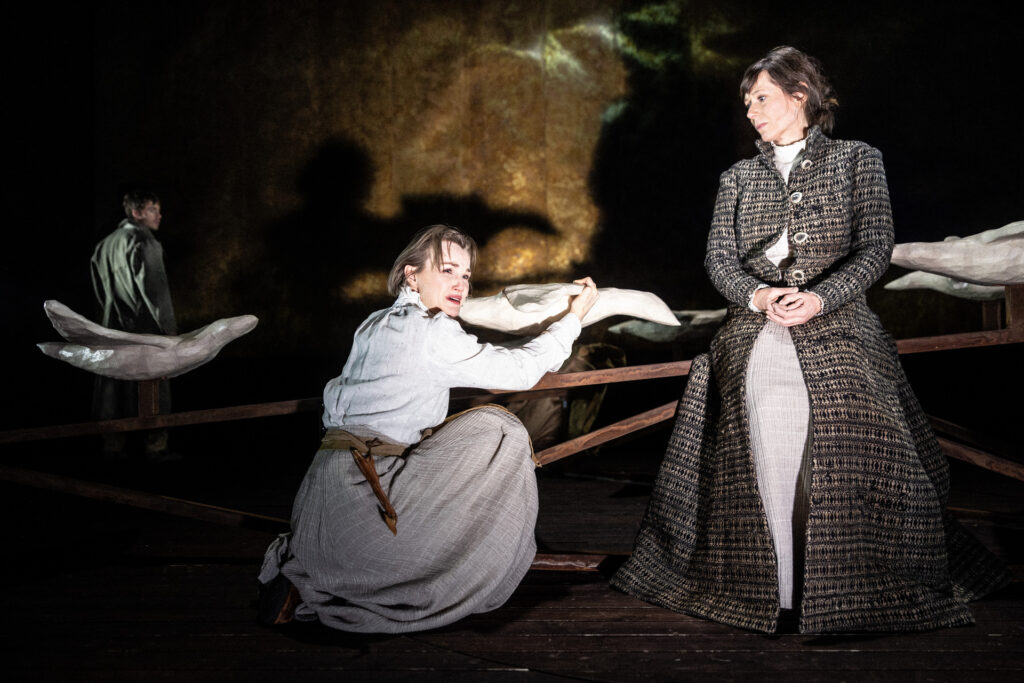
From the very first journey towards the coast, the audience is introduced to the unique scenic expression of the performance. Instead of strapping on their skis and going, the six actors begin to dance. Dance is used many times in the performance, often as an image of hard physical labor. They use organic but distinct movements, varying according to the activities and surroundings that are to be depicted in the dance.
For example, the important spring fishing becomes a dance in which the men jump and spin across the stage, stomp the floor and throw themselves around. The movements are powerful, just as if they are out in rocking boats on a rough sea. At the same time, the women imitate the movement of gutting the fish that is being pulled ashore, in a repetitive and rhythmic choreography.
The performance's scenography consists mainly of a large, V-shaped iron installation that stands on a turntable. On top of the installation are mounted white-painted birds, carved from wood. Without context, this looks like a flock of migratory birds flying over the parts of a crane, but on stage it becomes the bow of a boat, a herd of reindeer, a vulture, a sauna and much more.
Around the same time that Brita Caisa Seipajærvi traveled to Norway with her family, the Norwegianization policy began to take effect in Norway. The goal of the Norwegianization policy was to unite the Norwegian people, and to achieve this, all of the country's minorities were to be assimilated. A ban was placed on using the Kven language, and people who did not speak Norwegian were not allowed to own land. The Norwegianization policy continued until the 1960s.
A hundred years of oppression have left a deep mark on the culture and language of the minorities. Kven teaching in schools was only permitted in 1980, and since then great efforts have been made to preserve and build on the Kven tradition.
The performance "Kniven i ilden" is a collaboration between the National Theatre and Kväänitatteri, the Kven national theatre. They want the collaboration to contribute to the repair work after Norwegianization, and to highlight a side of Norwegian history that is not often told.
The physical expression in "Knife in the Fire" is innovative and playful, and gives the performance both freedom and great power. The choreography and set design allow the actors to fill the stage with their bodies, without major scene changes and props. This is a declaration of trust in both the actors and the audience. The actors are to carry the performance forward, and the audience is to imagine the country they are traveling through, the sea teeming with fish, the steaming sauna and the reindeer herd. This works very well. On stage, the audience sees a beautiful composition of nature and people, and how people relate to nature and to each other.
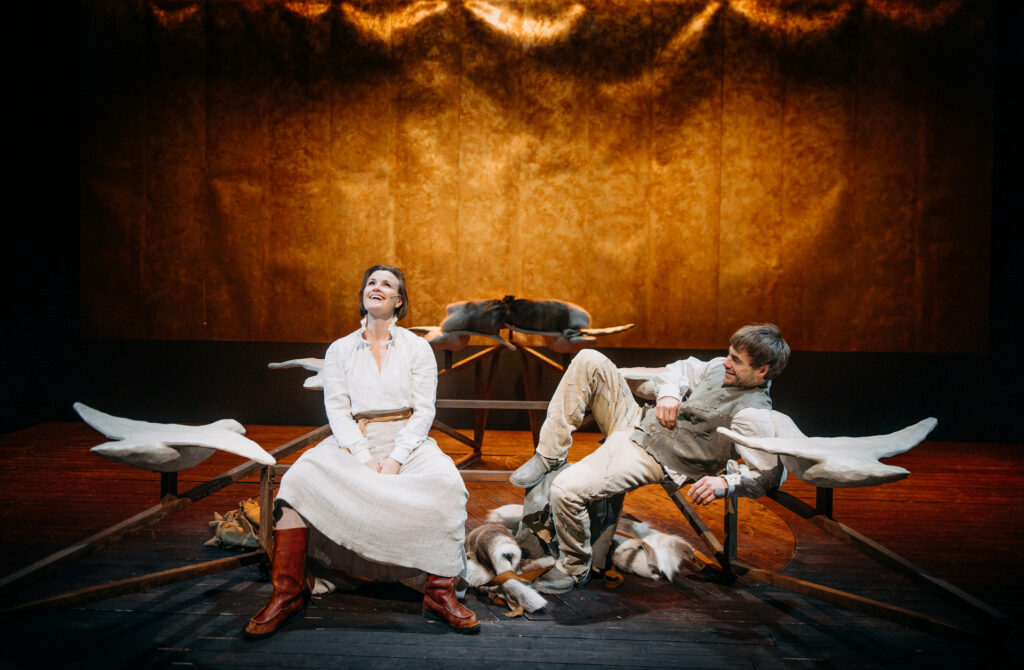
The dramatization work from book to theater is not as good, which puts an end to the theater magic. The text is too bookish for the theater, and forces itself on the free, flowing form of the performance. The combination becomes unnatural and confusing. In several places, the director relies on the text to explain the story well enough, and drops props and games. This makes the story unclear. In some scenes, the actors start talking to the audience rather than playing against each other. This takes away a lot of the interaction and power of the performance.
The story of Brita Caisa Seipajærvi is long and detailed, and the time on stage quickly runs out. This results in the performance having many loose ends, and some parts of the story becoming vague. There is not enough time to explain what is happening in Brita Caisa's life to make a proper impression on the audience, because the story is constantly moving forward. For example, Brita Caisa is called upon to heal some sick people while she is traveling, but these qualities of hers are never explained further. Nor is the taxation of the Skolt Sami explained. This gradually removes the show's touch with the ground.
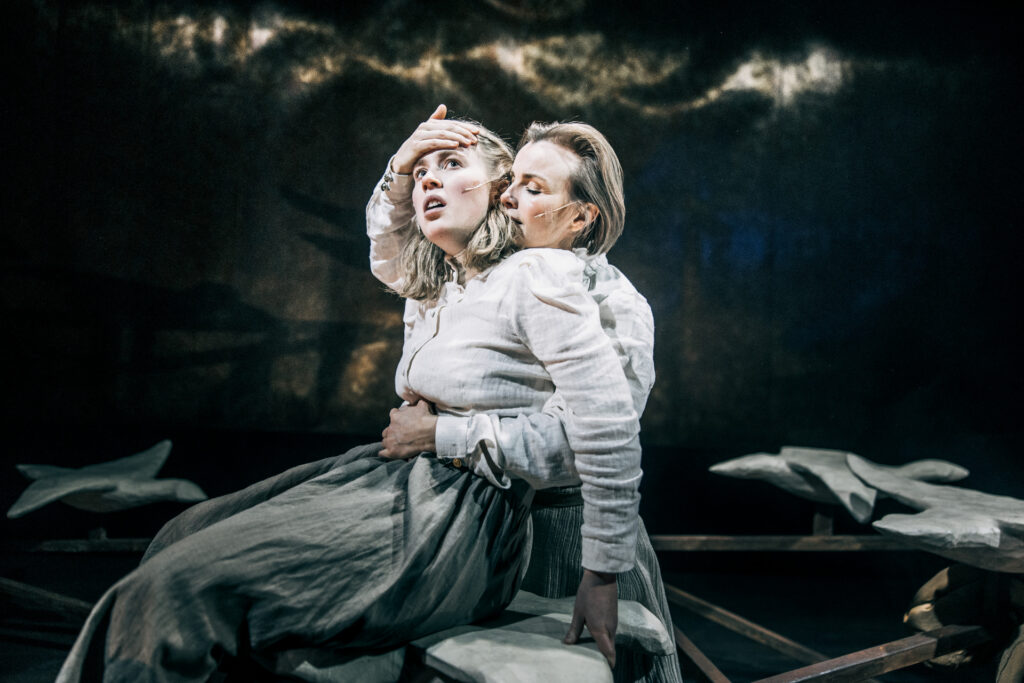
The National Theatre and Kväänitatteri wanted to contribute to reconstruction and reconciliation after the Norwegianization with the performance “Kniven i ilden”. They are opening the national theatre stage to a rare Kven story, but are fumbling with the transition from book to stage. The story of Brita Caisa Seipajærvi’s life in an important and significant time has great potential to show the audience a part of Norway’s history that is not so well known. Unfortunately, it is minimized to a simple love story about stockfish and morality, instead of highlighting the love for the Kven culture and people.
February 5, 2026
The National Theatre in collaboration with Kväänitatteri
By: Ingeborg Arvola
Director and playwright: Cecilie Mosli.
Scenographer and costume designer: Milja Salovaara.
Lighting designer: Martin Myrvold.
Composer: Arve Henriksen.
Co-composer and musical director: Ida Flåten Kampenhaug.
Sound designer: Andreas Vidhammer.
Choreographer: Eva Svaneblom.
Dramaturg: Siri Løkholm Ramberg
With: Lena Kristin Ellingsen, Ivar Beddari, Ida Løken Valkeapää, Arthur Hakalahti, Bernt Bjørn and Pernille Sandø
January 30, 2026, premiere
Played on tour with the National Theatre from February 5th to April 30th.
All photos: Magnus Skrede / National Theatre