
So stupid it's fun
The guys at Det Norske Teatret are so stupid that it's funny, writes Fiona Åtland (20) in this illustrated review.
Sugar uses humor, satire, and brutal honesty to expose how skewed representation can become when it is controlled by those outside the target audience.
Right from the start, Sugar at Det Norske Teatret captivated me with a satirical and sharp portrayal of how I experience cultural life in Norway today. The premise of Linda Gathu's performance is that an artist (Ameli Isungset Agbota) is brought in to save a museum in crisis. It begins with two people; the museum director (Lasse Kolsrud) and the curator (Gjertrud Jynge), talking about an audience they do not belong to. Two older, white people discuss how to attract a target group that consists of young people and not just white people. And they completely misunderstand what the target group is looking for. They end up spending enormous amounts of time and money that could have been spent on something else.
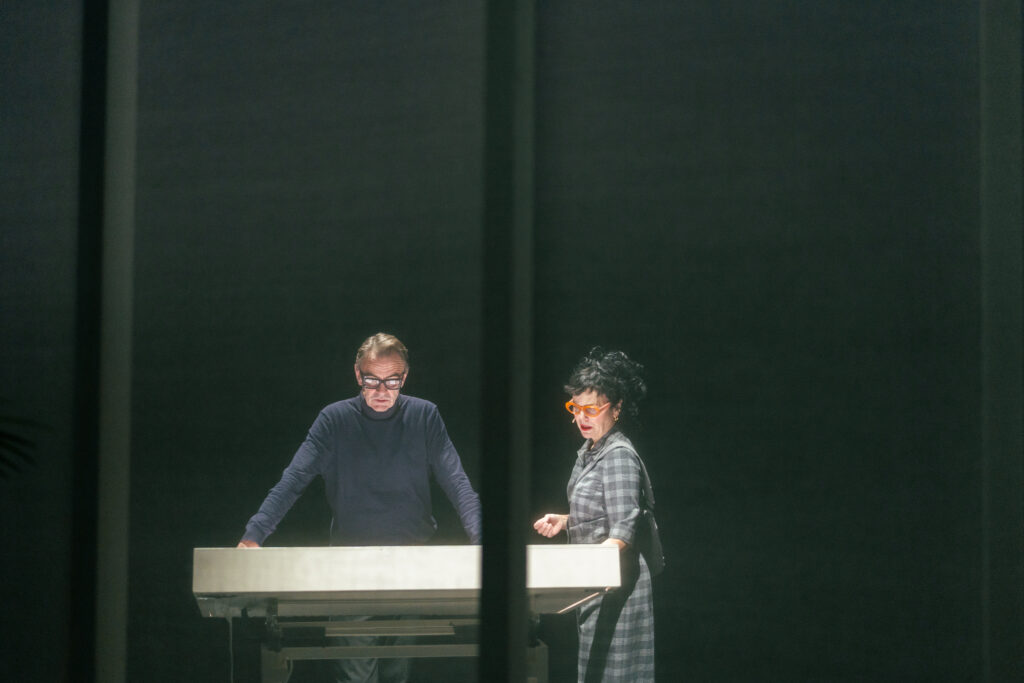
Sugar shows how it is often people outside the target group who decide, define and set the framework for what is considered good culture and what money should be spent on. A large part of the piece also consists of time travel through many centuries. Small stories from many different eras (from the past) are shown, which the young artist interacts with.
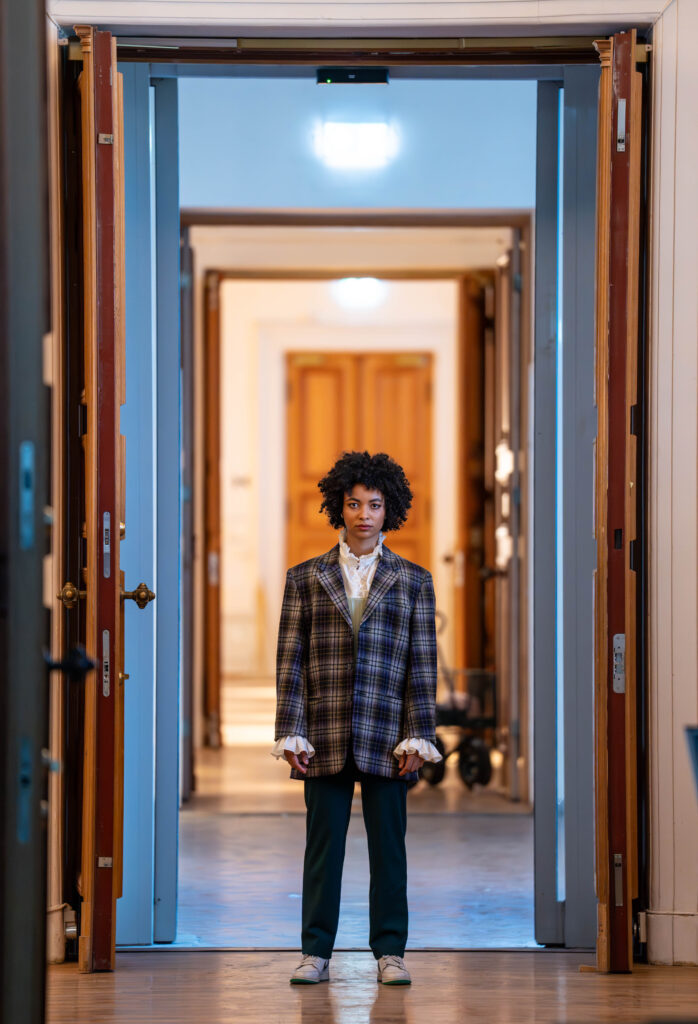
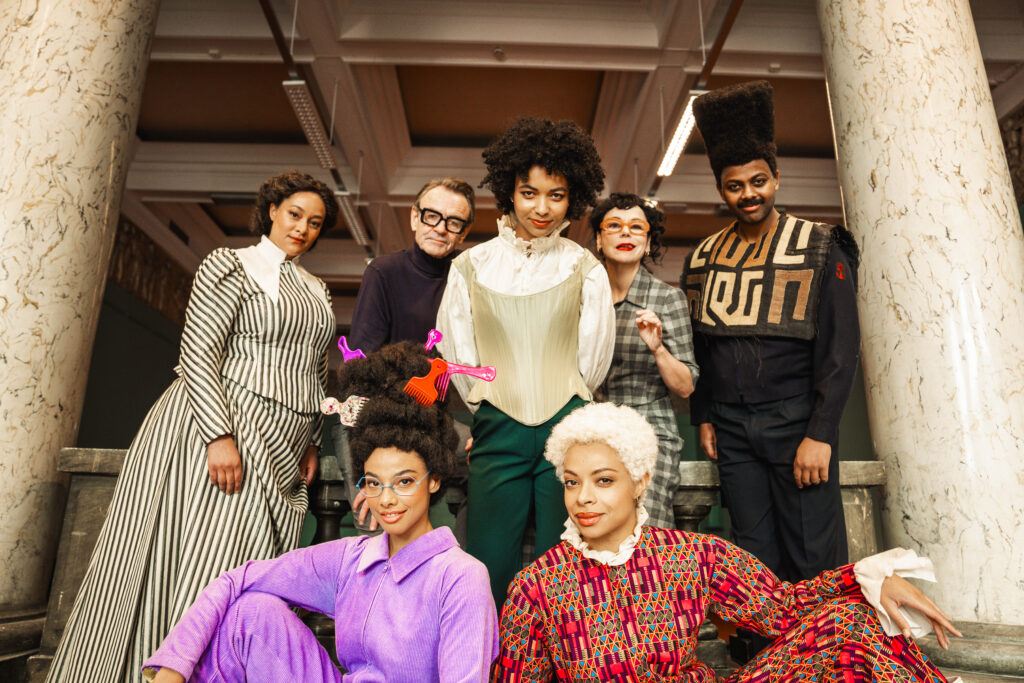
The costumes are inspired by many different eras, such as the 17th century, the 1940s, the 1960s, the 1980s and a slightly gray 2020s. There are only 6 actors in the play, but they have far more roles to play, so they had many costume changes along the way. One was in the role of Afronaut wearing a 1980s purple bodysuit and a giant wig with lots of hair combed in. One of the other characters, played by Khalid Mahamoud, wore what could be like a count costume with fur and velvet, also wearing a wig, in a noble role. Everyone changes costumes many times and the costumes are detailed, well thought out and full of character. This is very effective and complete in execution, and it also makes the performance particularly interesting for those interested in costume design.
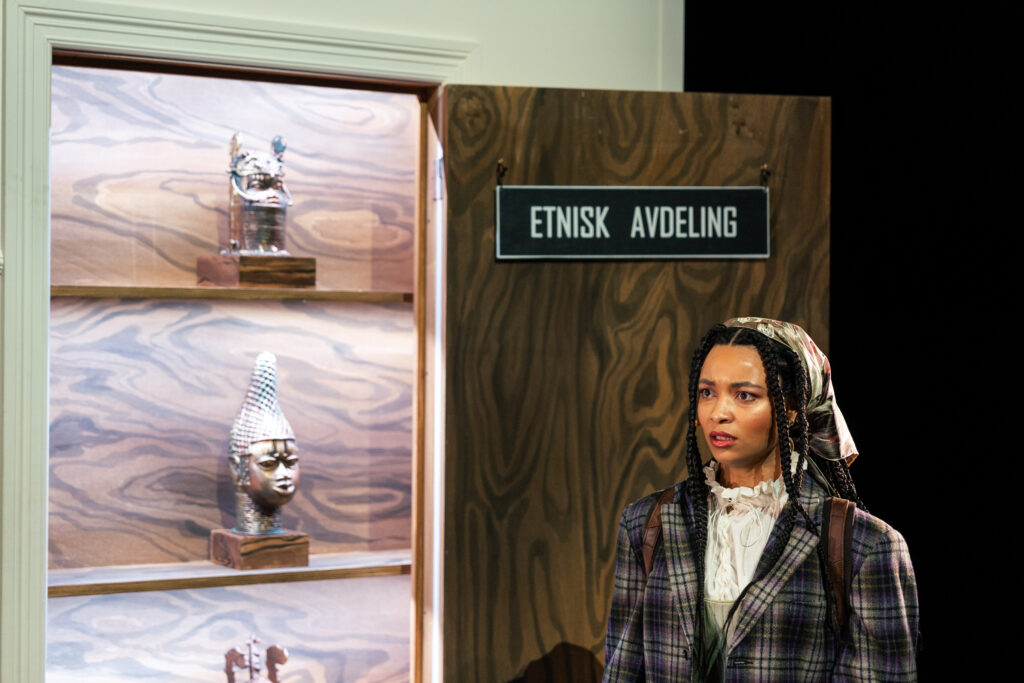
The set design by set and costume designer Eli Mai Huang Nesse surprised me positively. At first I thought it would be boring, as the stage was just a white wall with moldings. But behind this simple facade were hidden rooms, doors and movable elements that made the stage alive and dynamic. In addition, there were many hidden props in the set design. It gave the whole performance a much more visual touch and was sooo cool!
The start was perhaps a bit slow as it was a dialogue between two older characters about all sorts of things, but it was very important in establishing the setting of the show. It had its own charm, which gave me a strange Karl & Co vibe, almost like a little comic element in itself. Especially considering the way the characters talked to each other, including finishing each other's sentences, and in their clothing style they looked like they came from this TV series, which was made in the late 1990s.
I think this performance must be a dream for a social studies teacher interested in theater. The reflective way Sukker is made makes the performance seem like it was made for someone who is socially engaged, but who also dreams of making theater. Linda Gathu uses the means of theater to convey socially relevant themes that both make it good theater, but also educational. After the slightly slow start, we come to a large part that I would call reverse racism: Someone who tries to get another young artist/person to be a representative of an entire group – against their will – and who does it for money and the audience's attention. It ends up with pressure being put on this young artist to be someone they are not – or at least turns the person into a minority instead of a human being. The two characters who put pressure on the young artist are also the ones who throughout the play make semi-racist or prejudiced comments with full knowledge that it is wrong against the young artist.
One line that particularly stuck with me was: “There are a hundred dialects in this country already, so what’s the use of another?”, said by an American singer (from the 1850s) to a favored broadcasting executive. That sentence in many ways summed up many of the arguments against the racist and prejudiced comments.
The audience this evening consisted of a mix of people; a few young people, a good number of pensioners and the rest somewhere in between. And everyone who could stand gave a standing ovation at the end. The performance is both entertaining and dares to address difficult topics such as racism, stereotypes and how we often speak on behalf of others in the best sense. It shows how some people talk about their own struggles and assume that others' experiences are similar, while in reality it seems intrusive and just plain mean to assume such a thing. This is an important point that comes out particularly well in a conversation between two of the characters. One character, who is gay or bisexual, talks about what it has been like for him from the 1970s onwards. I got the impression that he was involved in creating positive changes in society for the queer community, and he talked about how difficult this was. At the same time, he put words in the mouth of the other character; a young, melanin-rich artist and claimed that she experienced it the same way, only with racism. He thus forced a role on her that she clearly did not want, in the way he portrayed her, as a minority.
It is both a concrete story told about different people and individuals' stories and a clear common thread here, with characters from different times and situations that reflect today's society. The play questions what happens when younger people lose interest when you start talking about culture.
It struck me that there were many older people in the audience, but I don't think the performance was really aimed specifically at them. Perhaps Sukker is just pointing out an important point: that the art and cultural scene today is not always able to adapt to new audience groups.
October 28, 2025
By: Linda Gathu
Playwright and director: Linda Gathu
Set and costume designer: Eli Mai Huang Nesse
Lighting designer: Randiane Sandboe
Composer and Sound Designer: Emily Adomah
Artistic sparring partner and coordinator: Ingrid Askvik
Choreographic assistance: Mariama Fatou Kalley Sjöttøy
Dramaturg: Siri Løkholm Ramberg
Actors: Ameli Isungset Agbota, Mariama Fatou Kalley Slåttøy, Gjertrud Jynge, Natalie Bjerke Roland, Lasse Kolsrud & Khalid Mahamoud
Main image: Monica Tormassy/The Norwegian Theatre.
All other photos: Ole Herman Andersen/Det Norske Teatret
The Norwegian Theatre, stage 2.
Premiere October 10, 2025, set October 17, 2025