
Not the Britney show I expected
I expected a big dance number and show, but was instead met with a single actor on a simple stage.
At first, Infinite Life seemed like something I could have done in my middle school art class. But without realizing it, I find myself sitting there with tears in my eyes, making eye contact with the actors on stage.
I entered the National Theatre on crutches, from an injury that gives me chronic pain in my knee. The week has been long and hard, my hour at the hospital is approaching and I have forgotten to read about the play in advance. The lights go out and the play begins. What met me was so personal and painful. Before I realized what had happened, I was holding back tears and had a pressure in my chest that made it difficult to breathe.
Endless Life is about five women and one man at different stages of life, all suffering from different types of chronic pain. Some with illness and some with injuries. We meet Sofi (Mariann Hole) at a resort hotel that promises to cure her illness with a water diet and sun. It is a last hope of getting better and she is desperate. Sofi meets one of the other patients while she is lying in one of the sun loungers overlooking the bakery down the street. She appears cold and closed in front of the other patients.
On the stage are five deckchairs made of planks. They are simple in design and can be folded up into beds. There is a row of spotlights placed above the chairs, pointing towards the audience. They are used to make it seem like the sun is rising and setting by dimming them one after the other. Some of the actors bring blankets or towels that they put on the deckchairs. The costumes are simple, most are wearing bathrobes or comfortable clothes. The simple scenery makes me expect something uncomplicated, and perhaps a bit amateurish, but that turned out to be completely wrong. Stripping down the set design completely makes the performance more raw, and vulnerable. It has nothing to hide behind, so it gives it its all.
As time goes by, we get to know Sofi better as she opens up to the other patients about her struggles. It seems as if Sofi hates herself for the things she does. The way she puts up a wall around herself against the other patients tells me that she doesn't want to share what she's feeling. She turns away from conversations around her, and buries her nose in a book. She doesn't engage with what those around her are doing. It seems like she'd rather just curl up and pretend everything's still fine.
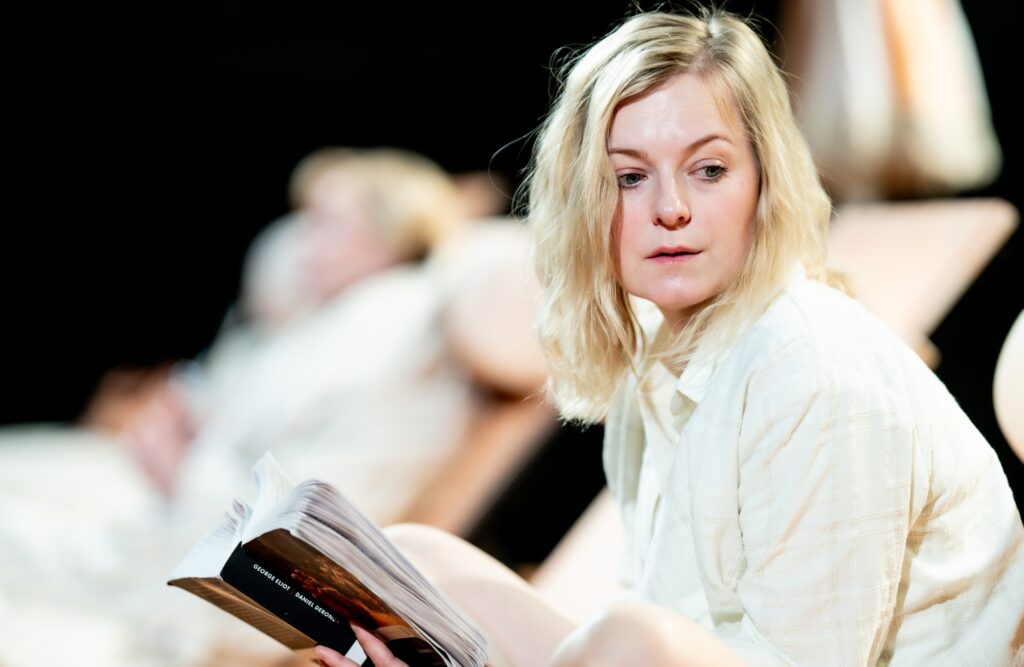
Asking for help is one of the themes in the play. That trusting another, a stranger, is one of the hardest things you can do. Especially when you are vulnerable, but would rather be tough and independent. Having to ask for help for something most people do without having to think about it can be shameful. Not because there is shame in it, but because you know you need it.
This play moved me more than I expected, and maybe that was exactly what I needed to get some perspective on things. There aren't many plays that deal with chronic pain and the shame that this pain makes you feel. Infinite Life is a play about perspective and a potentially real life. It's not a grand drama, or big sets, it's raw, heavy and painful. But they still make it fun. It's typical Norwegian gallows humor, where you say hurtful things with a grin and joke about it. In some scenes I have tears in my eyes and in others I smile broadly. And often there were only seconds in between. When Sofi opened up about her pain and looked at the audience with pain mixed with shame, it took my breath away.
Towards the end of the performance we get to see the inside of an intestine, it was so unexpected and strange that I spontaneously started laughing. It gave me a real shock and got me out of the serious atmosphere that was on stage a few seconds before. Being able to mix painful themes and stories and still make the audience have fun is great work. I walked out feeling that I had watched something that was important, relevant and necessary for many.
August 21, 2026
By: Annie Baker
Director: Sigurd Ziegler
Scenographer and lighting designer: Norunn Standal
Costume designer: Maren Saedi
Costume designer: Maïna Joner
Composer and sound designer: Alf Lund Godbolt
Choreographer: Ida Wigdel
Masker: Iselin Natalie Garcia Fredriksen
Dramaturg: Elin Grinaker
Actors: Mariann Hole, Liv Bernhoft Osa, Andrine Sæther, Tone Mostraum, Marika Enstad and Ola G. Furuseth
Producer: Ida Holthe Lid
Director: Karoline Husjord
Prompter: Heidi Sørsdahl
Prompter: Eirin Winther Mossefin
Stage manager: Hans R. Jarn
Lighting Master: Dag Tømmerbakke
Sound engineer: Sven Einar Erga
Costume designer: Frida Emilie Moss
Costume technician: Tove Klaussen
Props: Mone Rustøy
PR manager: Abdirahman Hassan
The National Theatre, Amphitheater
Photo: Lars Opstad