
So stupid it's fun
The guys at Det Norske Teatret are so stupid that it's funny, writes Fiona Åtland (20) in this illustrated review.
Feil Theatre's Not That Kind of Story is a raw and precise story about youth, exclusion and the path to radicalization.
Feil Teater has created a performance that hits right in the heart. Not such a story is based on an incident that could have happened anywhere: a ninth grader is beaten up outside the school gates. The incident is filmed, but both the victim and the gang of boys behind it refuse to say anything. From this silence grows a drama about exclusion. What happens when online reality flows into the classroom, and when the community cracks?
Not Such a Story is produced and created by Feil Teater by Amanda Hedvig Strand, Vilde Johannessen and Sebastian Skytterud Myers. The project has been developed in dialogue with the HL Center, Dembra and the Ministry of Justice and Public Security, who know the mechanisms of radicalization up close. This professional weight is noticeable in how the play is written: realistic, nuanced and free from sensationalism. This is a play about radicalization, but it is just as much about responsibility, community and the need to be seen.
The performance takes place in a classroom at Voldsløkka School, where the audience sits on desks and chairs along the walls. The three actors, who are also the aforementioned producers of the play, sit among us. Vilde Johannessen opens by telling us that we are going to hear a story, and so begins the story of ninth-grader Leo. He stays home from school after the violent incident, and spends much of his time online. In online forums and game rooms, he meets OdinRage, a figure Leo has previously spoken to. OdinRage seduces with a language of community and strength, but actually cultivates distrust and hatred. Leo's teacher, Kaja, tries to piece together the truth about the violent incident, but is also in her own struggle between trust and control. Towards the end, Leo is at a crossroads, and the play ends there.
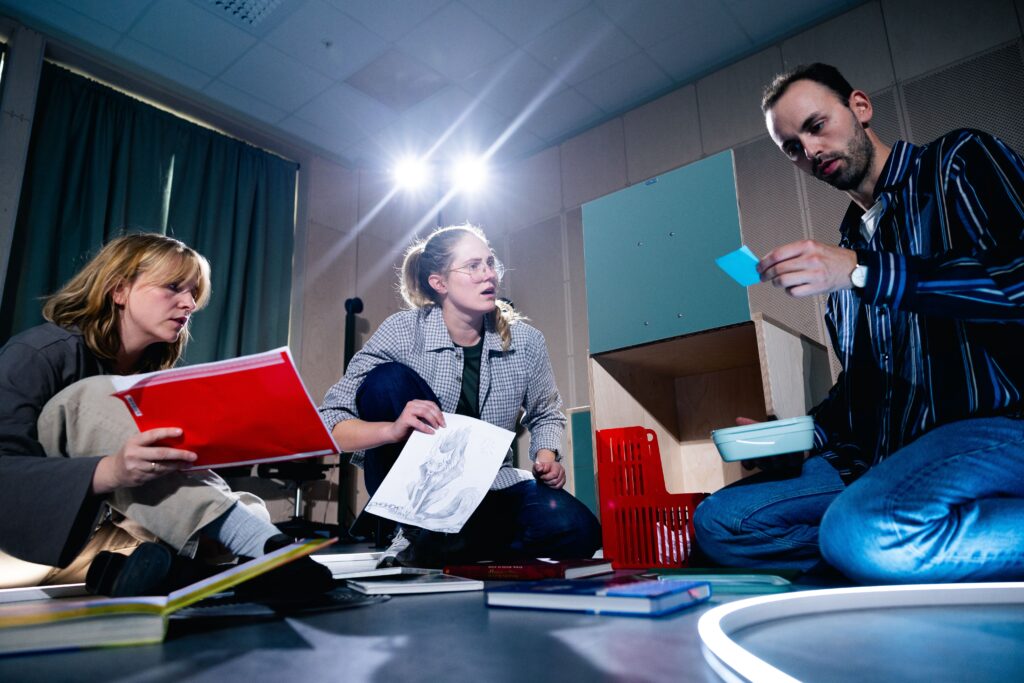
The performance is designed for young people between the ages of 14 and 18, and it shows in the way it meets the audience. It speaks to young people, not down to them. The language is direct, the rhythm is tight and the themes are from the reality that young people already know: online forums, algorithms, gaming culture and the feeling of not being enough. At the same time, the themes are so general that even adults are left with questions: How do we meet young people who are losing trust in the community? How do we prevent silence and rumors from growing?
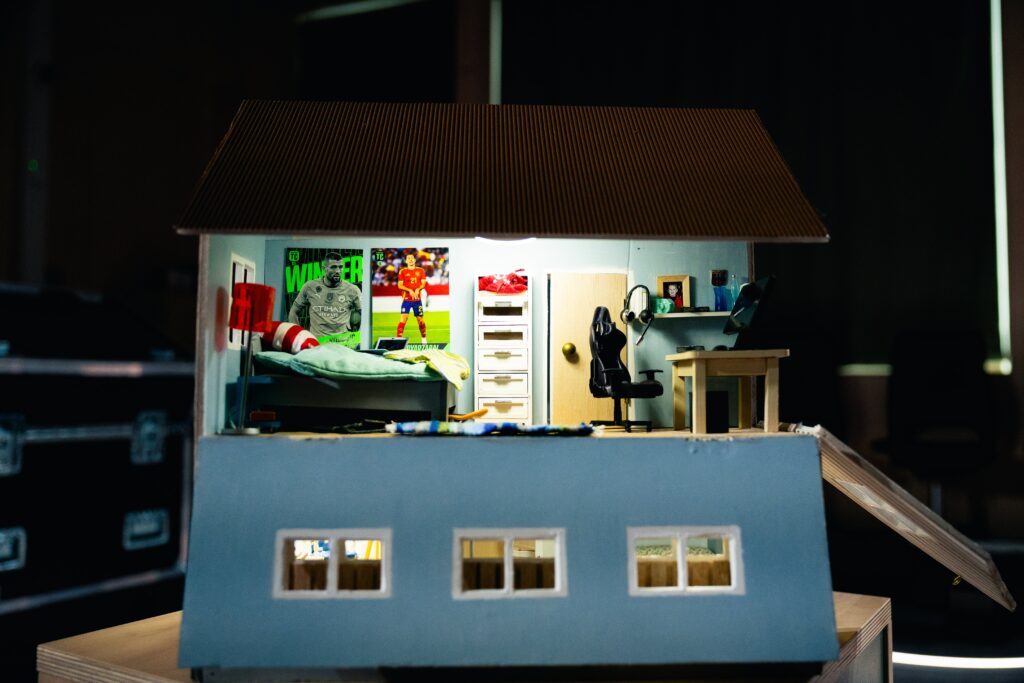
The set design is simple but effective. The audience sits in front of small screens, reminiscent of those on airplanes. On these screens we see a figure lying on the ground, visualizing Leo after he was beaten up, the message exchanges with OdinRage and live streaming from Leo's home. Leo's home is a dollhouse, which the actors film. This dollhouse is a replica of a typical Norwegian home, and Leo's bedroom is exactly like a real boy's room with a gaming chair and a football star poster. This is a creative way to convey a story. It makes it exciting, and you get more things to follow.
Light and sound are used precisely to mark the transition between the safe and the dangerous in the play. When we see the figure visualizing Leo, it is the flashing, red light and dramatic music that really make an impression. I got a nasty feeling inside me.
The actors deliver a strong collective performance. The story about Leo is conveyed from an omniscient point of view, but through good transitions the actors step into the roles of the story they are telling. An example is when the actors talk about the violence Leo is subjected to. Soon after, Johannessen slips into the role of the mother of one of the boys who beat Leo, and says "my son could never have done that." There are several such transitions in the play. They are well executed and make the play coherent.
In the play, we get to see several aspects of the story, but disappointingly, we lose Leo's perspective. We get information that he was good at school when he was in eighth grade, but ninth grade is not doing as well. He has made some outdated comments about women to his mother, but we don't hear Leo say this himself. OdinRage writes "it's almost time we're not allowed to say brown cheese anymore," as an argument against our "Woke"-centered society, and Leo just replies "true." We deduce from these depictions that Leo is a person with a radical worldview, but I think we lose a personal approach to him. I think the play would have had more depth if we had the opportunity to hear from Leo himself.
When the show is over, you're left with a lump in your stomach. It makes us wonder how many Leos there are around us, and how often we see a beginning of change without asking why. And most importantly; what are we doing to stop this?
October 9, 2025
CONCEPT, STORY, DIRECTION AND ACTORS:
Amanda Hedvig Strand, Vilde Johannessen and Sebastian Skytterud Myers
SCRIPT:
Sebastian Skytterud Myers
LIGHTING, SOUND AND VIDEO DESIGN:
Thomas Gallagher
MUSIC:
Embla Persdottir
SCENEGRAPHY:
Amanda Hedvig Strand
CARPENTER:
Anniken Shoe
REQUISITES:
Andrea Austdahl and Ella Austdahl
PRODUCTION ASSISTANT:
Karoline Hjartåker
POSTER:
Sigurd Braathen Dalen
CO-PRODUCERS:
The cultural school bag in Oslo and Kloden theatre
Voldsløkka School, September 30, 2025
All photos: Wrong theater/ Lucas Ibanez-Fæhn