
So stupid it's fun
The guys at Det Norske Teatret are so stupid that it's funny, writes Fiona Åtland (20) in this illustrated review.
Kjersti Horn's version of “Les Miserables” is completely stripped down. There are no songs or big musical numbers, just talented actors and real emotions.
I entered the hall and sat in the middle of the third row, a transparent plastic wall was in front of me, and on it was hung a screen. On the stage there were seven black plastic chairs, and several of the actors sat with the script in their hands, while others were warming up. It was like watching a rehearsal, not a finished play. All the actors walked to the chairs, sat down, and the play began.
Jean Valjean has escaped from prison, where he has been imprisoned for 19 years after stealing bread for his sister's seven children. He has walked for miles looking for a place to stay for the night, but every inn has turned him away since he has been in prison. He finally lies down on a cold stone bench. An elderly lady asks why he is sleeping there, and if he has asked the church if he can sleep there. Jean Valjean is honest about who he is to the bishop, but is still welcomed in. He is surprised by how warm and gullible the bishop is. This trust scares Jean Valjean. He has not felt any kind of trust in the last 19 years in prison, and it is now an unfamiliar feeling to him. After eating his fill and warming himself in front of the fireplace, he lies down in the warm bed with down pillows. Throughout the play, we see Jean Valjean strive to become a better person, changing his name to Monsieur Madeleine and being elected mayor of the village he moves to. But he never quite feels like he fits in, and as he takes care of others, his past comes to the fore.
Les Miserables is a novel written by Victor Hugo and published in 1862. It is considered one of the greatest novels of the 19th century. The story in the novel is set both before, after and during the French Revolution. Now the story is known as a musical, but it has also become a television series and has been released as a film. Kjersti Horn's version of the play was first shown in Denmark, where it received good reviews and won awards.
Throughout the entire performance I felt like a spy. It was as if I was seeing something I wasn't supposed to see, that I should look away. It was so stripped down and naked, and painful. You could feel Jean Valjean's pain when he told about his life, his thought that he wasn't worth as much as everyone else. He wasn't a separate person, but rather a creature defined only by his own bad actions.
For me, the story was about someone who fell out and struggled to get back in, but also about how bad the justice system can be for those who fall outside the norm. There are various reasons why someone can fall out of society, whether they are in the child welfare system and are moved away from friends and acquaintances, or those who are on the verge of being diagnosed with autism or ADHD.
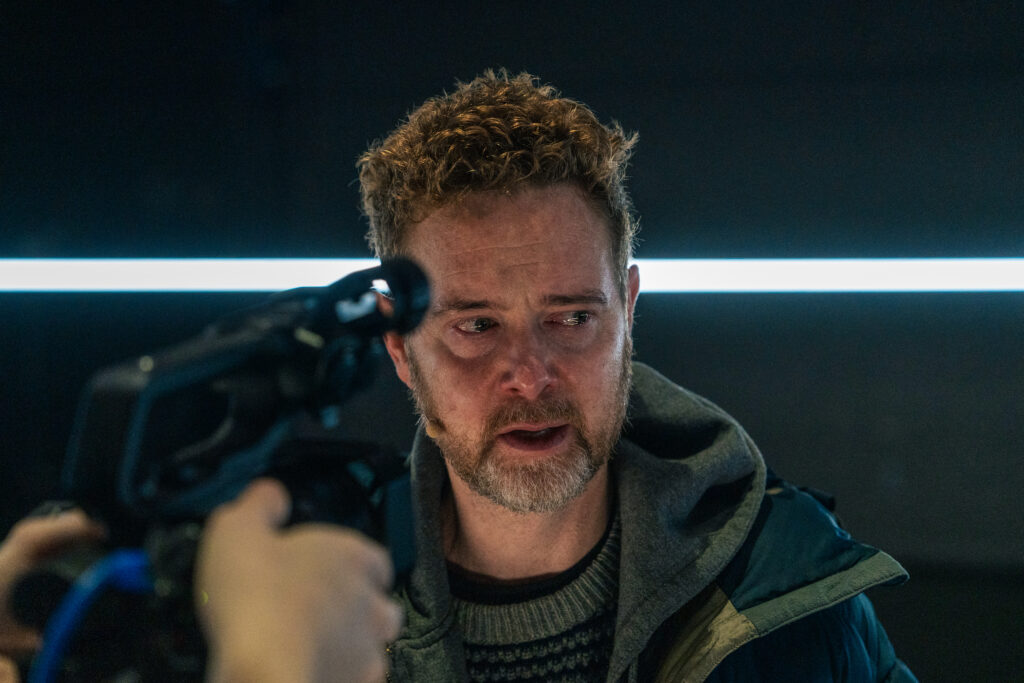
I struggled to get caught up in the play, I understood that it was a sensitive and emotionally heavy piece with skilled actors, but the feelings they expressed did not reach me. I liked the choice to take it as an exercise, without big flashy costumes or big musical numbers, and that everything was behind a screen. All of this made me feel isolated and misplaced. The feeling that I am watching something secret and shameful is greater when everything is far away, but I can still study all the expressions and grimaces of the actors. Emil Johnsen (Jean Valjean) played with real tears in his eyes and dry lips that did not get all the words out. With a bubble jacket and worn hoodie he made him look cold and exhausted. A messy hair style showed that he did not know how to look neat, and gave the character a story before the actor told it.
Sigrid Kandal Husjord was a sweet and adorable eight-year-old as Cosette, with all her body language and face. She was scared and curious with her whole being, with love for the world and her father. But I wish they had used Kjersti Dalseide as Cosette after she has grown older in the convent. Even though Husjord was a convincing eight-year-old, I was a little uncomfortable when she was supposed to flirt as a 17-year-old. This is both because Sigrid Husjord is an older lady kissing a younger co-star, but also because 17 is a difficult age to be and play believably. You are still a child who has to figure out what you want to do, but very close to being an adult. Playing a 17-year-old is being an insecure, self-confident, curious, scared and hopeful person, who does not know where you are in the world or where you are going next. When Husjord does not look like a 17-year-old either, it becomes difficult to imagine that she is a teenager.
All in all, I really enjoyed Les Misérables at the Norwegian Theatre. I wasn't as emotionally overwhelmed or exhausted as I might have hoped I would be. During the performance, I heard several people crying, sniffling or laughing, and I didn't feel enough to have such reactions, but later I understood that it had something to do with me, and not the performance. I thought about all the choices they had made throughout the performance, agreed with almost everything, and understood why they had been made.
December 16, 2025
By: Victor Hugo
Sales: Ingrid Haugen
Dramatization: Kjersti Horn and Kristian Lykkeslet Strømskag
Video instructor: Borgar Skjelstad
Directed by: Kjersti Horn
Composer: Erik Hedin
Scenographer: Sven Haraldsson
Lighting designer: Christian Alkjær
Costume designer: Sven Haraldsson
Costume coordinator: Silje Hostvedt Isaksen
Sound designer: Erik Hedin
Lighting designer: Per Willy Liholm
Technical producer: Anders Audum
Conductor: Glenn Thomas Johansen
Camera operator: Borgar Skjelstad
Production employee: Ia Marie Stavestrand
Masker: Anne Stålegård
Props: Åshild Mjelde Nordås
Stage managers: Freddy Jensen and Stefan Nilsson
Sound engineer: Jonas Vikanes Alfhei
Dramaturg: Ingrid Weme Nilsen and Tom Silkeberg
All photos: Ole Herman Andersen/Det Norske Teatret.
Produced by The Norwegian Theatre