
I wanted to dance along!
This concert is music, dance and theater all in one. Many of the dances are still in my body.
Unconventional, interactive, nerve-wracking; I find it difficult to choose the perfect word to describe “The Court” – but maybe the show wasn’t meant for me?
In a hypothetical world where the Sun King Louis XIV and other ghostly figures from the 18th century slip into today's society and live in parallel with us, The Court at Dansens Hus provides a taste of what such a world could look like. The Court premiered on May 28 at Dansens Hus and the audience could move freely in the space on the main stage during the entire performance, just like the performers, who moved freely in the hall regardless of where the audience was. The consequence of this is that the audience could never predict what was going to happen, and had to move in accordance with how the action moved within the hall.
In contrast to other performances I have seen, The Court does not have a linear plot, but is rather built as an experience. Already when the performance began, some of the performers were in their own places, doing their own thing. Those of the performers who were not on stage at the time gradually entered the action, which they had to do by walking behind the audience, and then pushing their way through the audience. A common denominator for all the performers is their body language, as they harmoniously either danced or performed other rapid movements, or moved unusually slowly.
Something I particularly noticed was the use of a live camera throughout the performance. What was filmed on the live camera was shown on a large screen in the hall, allowing the audience to get a closer look at how The Court is experienced by the actors. This was particularly used towards the end of the performance, which ends with the Sun King (Amie Mbye) both standing and dancing in front of the camera. The performers wore costumes inspired by the Baroque of the 18th century, but also costumes that represent modern society. In contrast to a classic performance presentation, the seats are placed around the stage in addition to there being a ring of seats in the middle, and these seats move with the action throughout the performance.
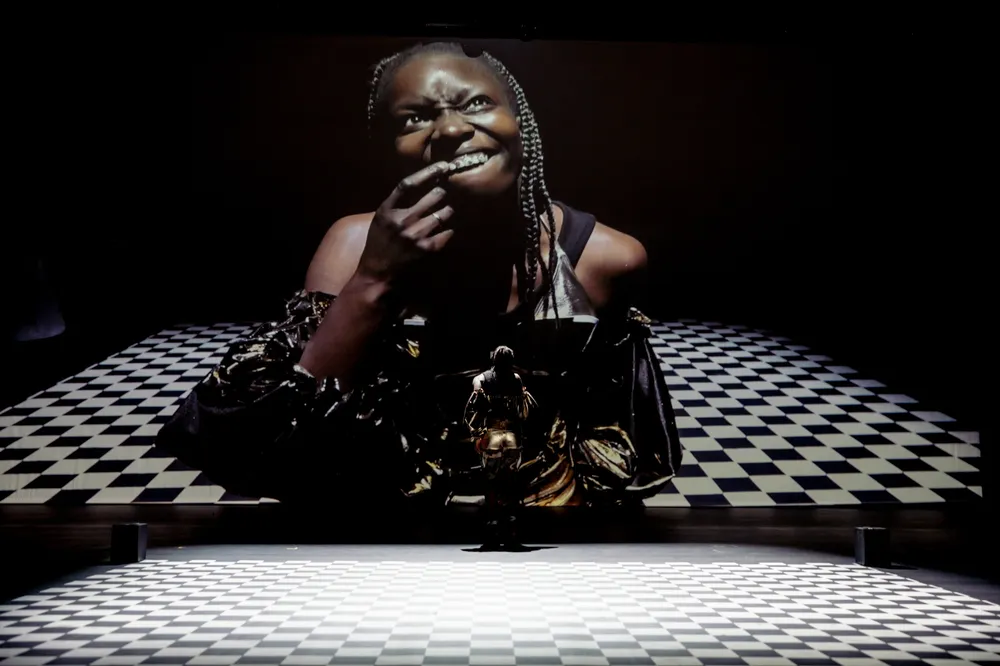
As an audience, you constantly alternated between observing the action and becoming a part of it; for example, there was an abrupt transition when the audience went from following along, to sitting at a long table among the performers, to participating in a citizens' meeting the next moment. The scenography meant that the audience could never take a passive role, but rather had to relate to the play and its unpredictable action.
Despite the great fluctuations throughout the performance, I missed dialogue during the piece. The Court is a dance performance with a strong visual and physical expression, in addition to a few scenes where the actors talk to each other and the audience. Nevertheless, the amount of verbal language was relatively limited, making the concept more difficult to grasp. A stronger focus on mono and dialogue could have made the connection between the scenes clearer, and given the audience a better understanding of the performance's themes.
The play is nevertheless a good example of postmodernism, considering how the concept pushes creative boundaries, and differs from a more classical form of performance. Postmodernism is a movement in art and culture that emerged in the post-war period, and one of the most central characteristics is that it combines high and mass culture, in addition to combining historical references with contemporary society. The Court falls under the term as it draws inspiration from the Baroque, which is visible in, among other things, the choice of costumes and the portrayal of the roles, but at the same time the performance has a more modern and experimental physical expression. In addition, the play breaks with classical performance presentations, as the audience has the freedom to move within the space, and form personal experiences with The Court .
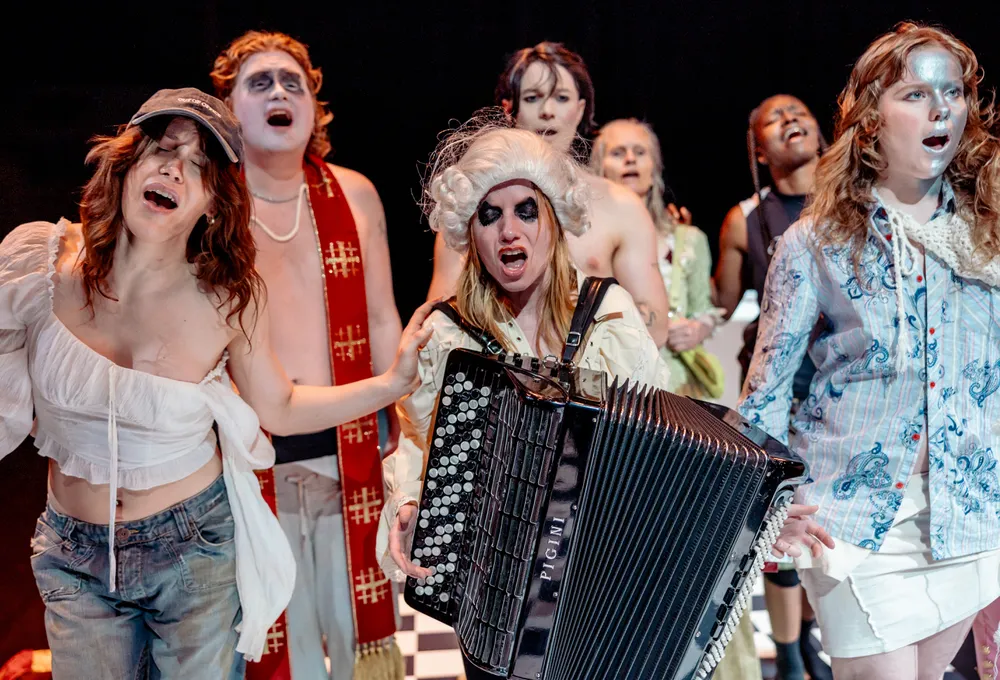
The Court draws inspiration from Louis Schou-Hansen's master's thesis, where he discusses the Sun King Louis XIV's role in the history of dance, and compares the king's role with the main character in the movie Mean Girls ; Regina George. On the website of Dansens Hus, they have posted three chapters from the master's thesis. Schou-Hansen points out how both the Sun King and Regina are in a higher social ranking, and uses this power to control those under him. In addition, The Court is also inspired by sociologist Avery Gordon, who claims that we always live side by side with the ghosts of the past. Gordon's idea shows that history is not something that disappears, but rather something that will constantly be present, regardless of whether we are aware of it or not.
The Court depicts a dystopian society where history not only remains in our society, but actively controls the people in the space. Considering how there is a blurred line between actor and audience, this creates unpredictability, but also hints at negative social control. If you ask me, the concept does not allow for society to develop into something new, but rather a thought that history will always influence us in the future.
If I had to choose one word to describe The Court, I would choose to call it interesting. Although I believe that the ideas behind the play limit how society develops, The Court has a play that tests creative boundaries, and is a unique experience.
June 25, 2026
Concept and choreography: Ingri Fiksdal, Louis Schou-Hansen
Costumes and set design: Vilde Espeland Brattekås, Louis Schou-Hansen
Music and composition: Axel Vatne Barrat-Due
Lighting design: Philip Isaksen
Cast: Tora Midtbøe, Amie Mbye, Axel Vatne Barrat-Due, Louis Schou-Hansen, Philip Isaksen, Bertine Fadnes, Ingri Fiksdal, Yamile Calderon, Heidi Steen Jensen, Nicole Schuchardt
Producer: Fiksdal Dance Foundation
International distribution: Nicole Schuhardt
Co-producer: Dansens Hus, Bergen International Theatre
House of Dance, main stage, May 28, 2026
All photos: Dansens hus / Tale Hendnes