
I wanted to dance along!
This concert is music, dance and theater all in one. Many of the dances are still in my body.
The lunch break begins, and four women enter a dark attic. You hear footsteps going up a staircase before the door opens and light shines in. The audience is taken into the atmosphere of the attic, and it is as if we are now in there with the women. It is a rather intimate and small room that we are transported into. The middle of the stage is covered by a cloth that creates an optical illusion that the room becomes narrower the further you go in. All of the scenography on the stage is actively used. It is not just static effects, but a bookshelf that can become windows or a chest of drawers that can become a box that can be closed. It is very nice to see all the thought and all the details that have been put into everything on the stage, and that it is actively used. I am never left with a question about why something was there. Everything is answered during the two 1-hour long performances.
The two performances Loftet and Kjelleren appear as two independent works, but share an underlying connection. The performances are shown one after the other, with a break in between. Although Kjelleren can be read as a sequel to Loftet , both performances stand firmly on their own two feet, each with its own mood, rhythm and narrative logic. Both are choreographed by Jo Strømgren, who has been house choreographer at the Norwegian Opera & Ballet since 2013, and his long-standing connection is noticeable in how the works both challenge and play with the institution's framework.
Strømgren is also the artistic director of Jo Strømgren Kompani, known for its distinctive expression where dance, theater and cinematic means blend into each other, and which has produced these two performances.
In Loftet og Kjelleren this is expressed through a choreography that alternates between the precise and the absurd, the down-to-earth and the dreamlike. Although the performances can be experienced independently of each other, an extra resonance arises when they are seen in context, like two floors of the same psychological building, where what is whispered above receives a darker echo from below.
The evening began on the top floor with Loftet , and we immediately get up close to the main character through a suicide attempt with a gun. The attempt is fortunately stopped by a comical scene with three women who slowly but surely emerge from behind cupboards and shelves. This is already where we understand Jo Strømgren's humor, because it seems as if all three women and the main character have romantic relationships with each other, which becomes a recurring theme in the performance for both humor, love and argument. This is especially seen when one of the three women puts her wedding ring back on after it has been insinuated that the three of them have slept together.
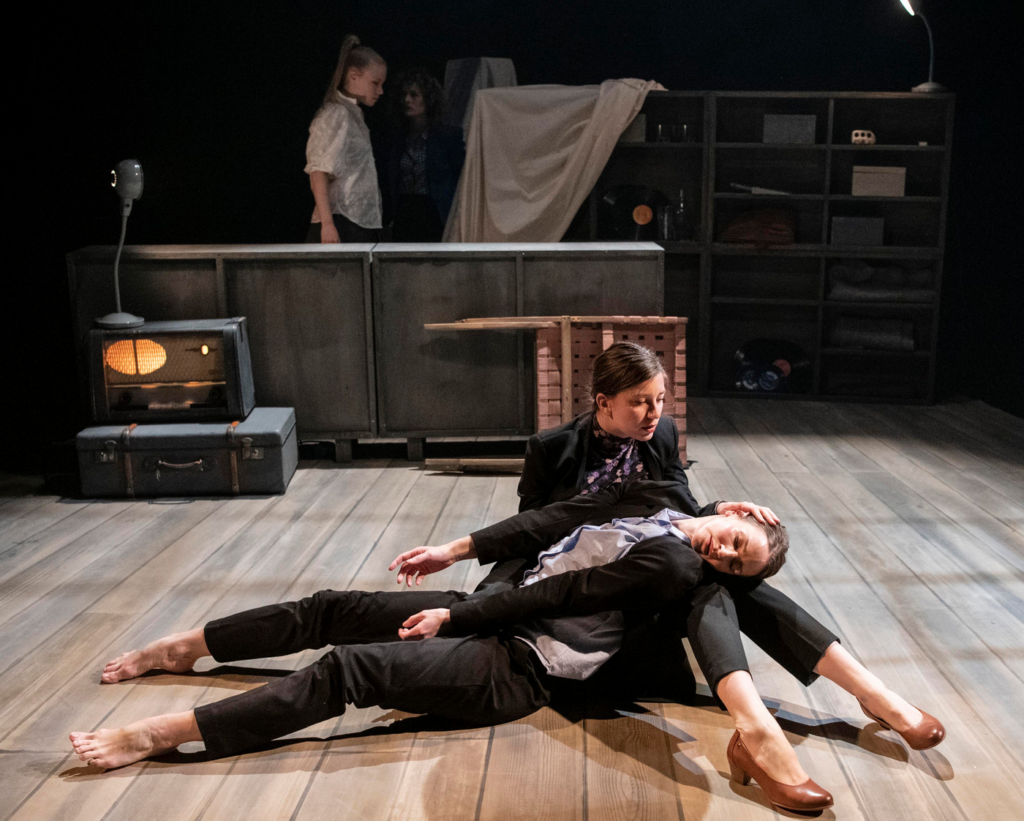
Photo: Erik Berg
The idea of pushing other women down in order to get higher up the ladder yourself is quickly presented through the incredibly intricate choreography of Jo Strømgren. There is a lot of body contact between the four women, and a common step is pushing each other down or pushing the other away to appear smarter or better yourself. These are movements with a lot of power and intention behind them, when the dancers move they have the ability to flow with soft, light movements, or show strength, especially when they push each other down. The intricate steps in both performances are incredibly impressively put together, and the dancers' ability to remember all the steps and to perform them with intense liveliness and theatrical ability is nothing short of fabulous to watch.
Another enchanting element in the performance is the use of light; there is everything from large stage lights, to small electric cube lights. The light helps to create the incredible execution of the effect that sucks the audience into both the Loftet and the Kjelleren . Like the scenography, the light is also very actively used; a lamp is not just a lamp, but it can be a spotlight for a puppet theater. And the dancers are not only artistic dancers, but they rearrange the scenography and handle light in a choreographed way that makes the changes almost imperceptible. Strømgren has a knack for choreographing in a way that means that all you see is the beautiful dance, and not the countless scene changes and not least the countless costume changes. It is only a little while into the performances that I notice that they have changed costumes 10 times already.
We leave the Loft after a final push from the four women. The same gun that the main character almost shot herself with is now aimed at the three other women who are on their knees with their hands on their heads. The gun slowly slides back and forth over their heads. The gun is not only aimed at them, but also at us. The entire session is interrupted by one of the three women who defies the threat of the gun and stands up with her hand outstretched, and the audience hears bullets slowly but surely falling, one by one. The gun was unloaded. There was never any real danger, just a challenge to see if the main character had actually shot or not. This action puts an ethical spotlight on the entire performance. Although one never has to ask oneself why something happens on stage, due to the incredible detail put into every part of the production, I was left with a more reflective question about what it means to be human, and “What do you do when no one else is watching?” is the question that buzzes in my head when the buzz of the break is heard in the hall.
The break is over. There are some returning audience members and some completely new audience members in the hall at Operaens Scene 2. When you see the two performances right after each other, you probably get a completely different experience than seeing them individually. For example, the similarities in means and dance steps are sometimes very similar, in addition to the fact that there are the same dancers and the same choreographer.
As a returning audience member, there is a delicious sense of familiarity that strikes me as I hear the sound of footsteps in The Basement , this time going down the stairs and not up. But before we even get to feel it, we hear the reason the main character is coming down: Lavish laughter and inaudible chatter from the men upstairs. It seems like the laughter stems from a woman trying to argue with the men, but that she is only being put down and ignored. Finally, we hear the footsteps coming down the stairs and see the light from the door opening.
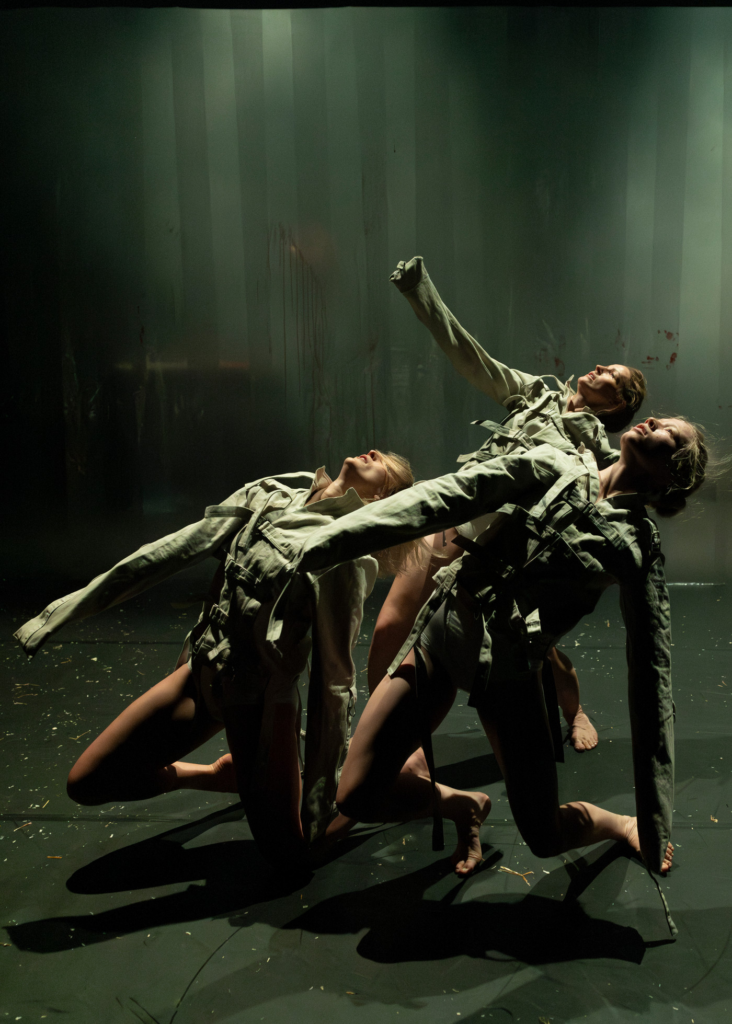
Photo: Jubal Battisti
The extraordinary use of lighting follows us into The Basement as well. As the main character enters the basement, a small ceiling light is pulled in and lit. There is an immediately different atmosphere down here than up in the attic. There is a naked corpse in the middle of the stage, lying bent over on an examination table. Behind it is a translucent plastic screen with blood spatter on it. And the audience can glimpse two more corpses. It is a rather grotesque scene. We are in a morgue, and the woman who was previously discussing with the men seems to be the only employee. The humor from the previous performance is quickly drawn in when the main character picks up the same gun that was so actively used in The Attic . Laughter at the character's similarity in action breaks out in the hall, and one must think that the new audience members were puzzled as to why a gun pointed at the ceiling is funny.
Strømgren manages to bring out humor in every situation, and it underpins his commenting choreography. Both performances seem to comment on what it means to be human, and how all people are different with different stories, reactions and emotions. It is especially centered around themes of what it is like to be women, as an audience member and as a woman, I was amazed at how a man managed to capture the diversity of the female experience. From The Loft, themes such as internalized sexism, homosexuality and female hysteria emerge through stylized scenes that are meant to make an impression. To The Basement where the journey goes from the interior of the mind, to the exterior and historical. The Basement is like a commenting journey through time and place, where the common thread is always women and their place in the world.
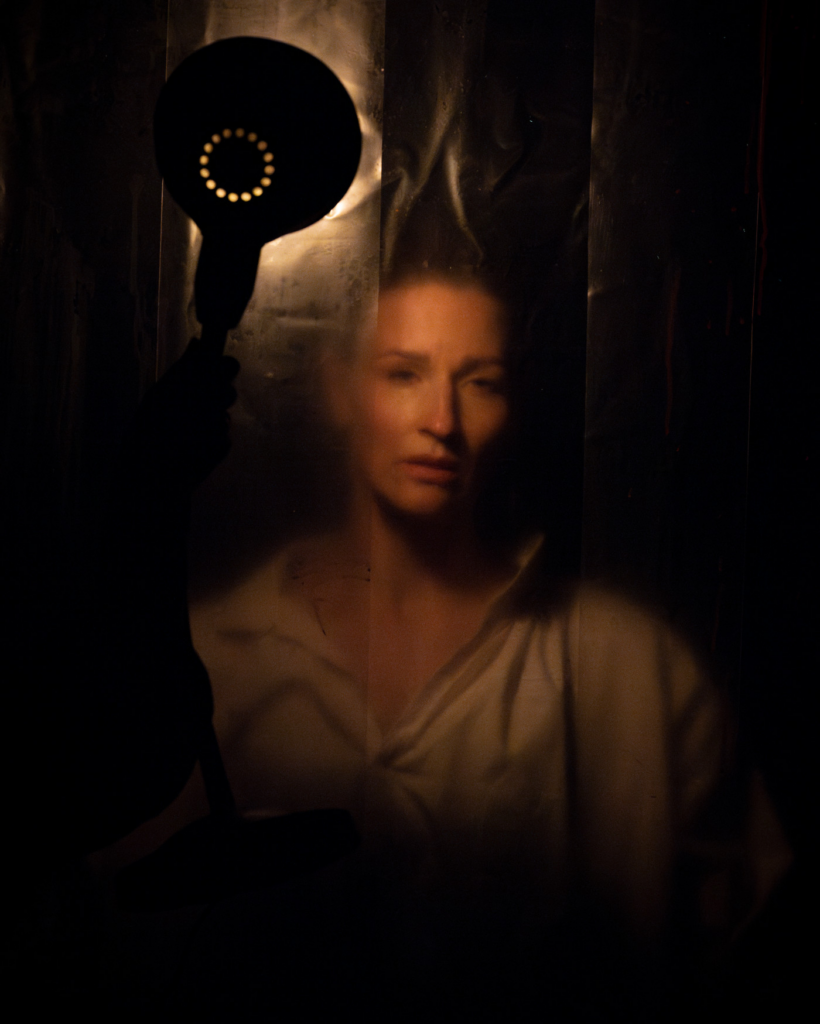
Photo: Jubal Battisti
A particularly excellent sequence occurs during The Cellar when three coffins are pushed together, and the four dancers slowly but surely portray one by one the 12 apostles. We first see a representation of Jesus with his arms outstretched, but it is only when the rest of the apostles fall into place in their stylized positions that we realize that it is Leonardo da Vinci's “Last Supper” that is being portrayed. In light of the earlier commenting action, this sequence appears as a comment on the lack of women in historical moments and especially in religion. A similar sequence occurs towards the end of The Cellar , but now the story has turned; now women are part of the picture, and instead of Jesus it is Joan of Arc who is portrayed, with sword held up to the ceiling and ready for battle.
I really have to let my thoughts and experiences sink in after seeing Loftet og Kjelleren . There is a feeling of pride that remains, pride in being a woman, and I am almost proud of how skilled the dancers on stage are. What we have seen has been so intellectually intimate that I feel that the dancers have almost become an extension of each of us in the audience. I think there are many in the audience, male or female, young or old, who can relate to something or someone in the two hours we sat in scene 2 at the opera. It was a spiritual experience that I would have gladly set aside many more hours to see again.
April 24, 2026
The attic
Direction, choreography and lighting design: Jo Strømgren
Composer: Bergmund Waal Skaslien
Costume design: Bregje van Balen
Co-design lighting: Jan Harald Ovrum
Cast: Henriette Hamli, Nora Svendsgård, Anna Benedicte Andresen and Angela Dematté
The basement
Choreography and scenography: Jo Strømgren
Composer: Bergmund Waal Skaslien
Costume design: Bregje van Balen
Lighting design: Jan Harald Ovrum & Jo Strømgren
Cast: Henriette Hamli, Nora Svendsgård, Anna Benedicte Andresen and Malika Berney
The Norwegian Opera and Ballet, Scene 2, March 26, 2026
Photo: Erik Berg and Jubal Battisti