
I wanted to dance along!
This concert is music, dance and theater all in one. Many of the dances are still in my body.
The performance Psychedelic Cave removes one of the most important senses of the audience; sight. What hides in the darkness? Destruction or creation?
Choreographer Mia Habib's Psychedelic Cave at Dansens Hus is a performance that takes place in total darkness. On Dansens Hus' website it is stated that Mia Habib wants to open the doors of the cave as a place of unity, transformation and rituals. The preparation for this performance has therefore included visiting and exploring different caves and the starting point is the murals in them and the darkness that surrounds them.
I think Habib and the artists she has worked with want to create a space where you can be yourself in the middle of a confusing and dark time. I also think they want to convey the feelings they themselves had during their stays in the caves and while they watched the cave paintings “dance” across the walls. By taking away the audience’s view, you open up the possibility for each person to create their own story of what is happening around them. Based on my own thoughts through the performance, it addresses important and current themes about war, industrialization and personal development.
Before we enter the hall, everyone gets to choose a “comfort stone” as they call it or “trygghetsstein” in Norwegian. An anchor point if you feel like you are losing yourself or for other reasons need a little support during the performance. We also get a Fisherman's Friend for the same reason. When you lose such a dominant sense as sight, it is nice to be able to find comfort in the other senses. Feel that you are present. We are also given a flashlight that we can use to signal that we want to leave the room if we need to. To say that I felt looked after is an understatement.
While we stand and wait in the hallway outside the studio stage, Habib and her team of artists also tell us a little about the process of preparing the performance and that one of the caves they were in was discovered during the war, which contributes to the associations I get later. They tell us about how the world around them was dark and destroyed, while in the middle of it all they discovered a cave full of cave paintings; creation and a completely different darkness.
When darkness envelops us, I realize how dark it actually gets. If I had held my hand in front of my face, I wouldn't be able to see it even from a millimeter away. I think it surprised me how little I'm used to total darkness, how much I rely on the light. Even in the middle of the night it doesn't get that dark; the lampposts, billboards and shop windows light our way. Sitting there in the darkness was like traveling back to prehistoric times. A time without cell phones, neon lights and busy internet lines. A time when darkness was dark and where history and murals dance around you.
The darkness removes what makes us visibly different; our appearance. In the darkness you can be anyone, but most of all it gives you space to be yourself. Not your clothes, not your hair color or your jewelry, but who you really are when you take away everything superficial and are forced to feel what it is like to be yourself. In the darkness we are all the same, it takes away one of the things we have in common; our sight. This creates a kind of unity there in the darkness. Where we are all alone, together.
Perhaps the darkness is also a symbol of the dark times the world is drowning in at the moment. A symbol of how difficult it is to navigate this world and how one can feel so alone even with others sitting around you, it's just too dark to see them.
We sit in silence for a long time and I can't help but get the feeling of sitting in a bunker waiting for an attack. Slowly but surely, sounds can be heard. It sounds like airplane propellers. Just hours earlier I had read a headline that Israel has attacked Gaza again after the peace agreement was signed on Friday, October 10, which strongly contributed with associations of war and bombing.
It falls silent again and you can hear the sound of the performers moving. I know they are there. That they are moving among us, but I still don't know if there is someone standing right in front of me or if someone is crawling on the ground at my feet. But I know them, I hear them. I don't know if someone is trying to show me something or if there is something I am missing. It is like witnessing a small community of your own, moving as they always have, while you stand blind in the middle of it all.
I would like to believe that the dancers see as little as we do and are enveloped in total darkness just like us; the blind witnesses. Often it seems as if they are moving slowly or close to the ground so as not to stumble or bump into anything or anyone. Other times it seems as if they are jumping on the spot or running around us, this contributes to the tension curves and dynamics of the performance. The performance is in a way also interactive where the audience plays an active role in the scenography. We in the audience become a kind of labyrinth that the dancers navigate through, which means that everyone will have different experiences both because we are sitting in different places and what we experience depends on how and where the dancers move, but also because we all sit with our own experiences and stories.
Suddenly someone starts screaming at the top of their lungs, I imagine it's a person who is in acute pain or finds out at that moment that their child has been killed. It doesn't take long before everyone joins in and creates a kind of chorus of screams. The speakers also play sounds that can be reminiscent of screams and I imagine that it sounds like they are burning to death. As if everything has been taken from them and they are now being shaken from the one thing they have left; life. It doesn't take long before the sound slips into a harmonious, calmer chorus that moves around the room. As if their ghosts are still around us. As if their voices will not turn to silence, even after death. The screams are also reminiscent of train brakes and I also have time to think about how the industrialization of the world has destroyed much of nature and history, including rock carvings and murals. And how much of this we will never discover because it is already too late.
It becomes quiet again. Then I see some red lights appear. At first they remind me of war drones that aim at the target before they shoot and for a moment it feels like I am the target. Then the lights remind me of surveillance cameras – staring at me. They come closer. It seems as if the dancers have the lights in their mouths and thus the light follows their movements. When they look up at their arms or down at their bodies, you can just see the outline of a person. One of the lights comes towards me, slowly, slowly, slowly. The dancer has closed his mouth and therefore it shines red through his cheeks, nose and upwards towards his eyes. It looks deformed like a small child, but also a creature that is impossible to describe. Maybe some kind of demon. It moves past me and disappears.
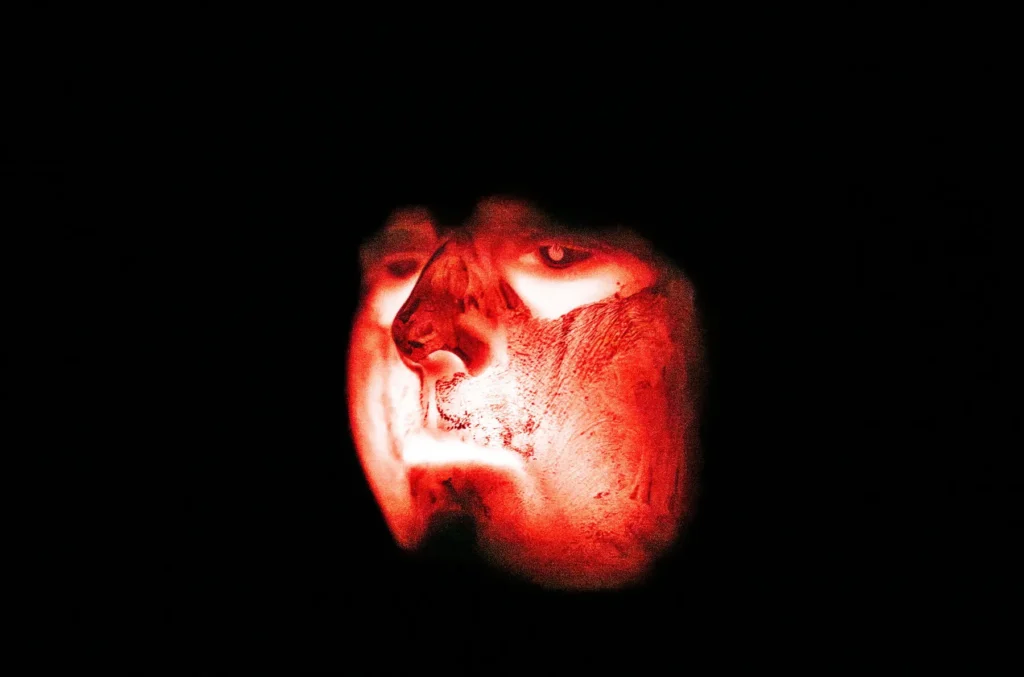
Perhaps this is exactly the highlight. The dancers have gone through a transformation and let inner demons take over, they have given themselves over to the devil. On the website of Dansens Hus, they talk about rituals and the cave as a portal to inner demons. As a kind of welcome to what we all live with, demons that twist and turn among forgotten thoughts, dusty tasks and the ideas that keep you awake at night. Like creatures that live inside us. The experience becomes an acceptance of that taboo and how one can let the inner demons free and live freely in a limited world.
Not long after, all the lights and movement around me disappear and it becomes quiet. The light slowly comes back on and the doors to the street and its Saturday walkers open. I suddenly became terribly aware that I was not alone with the creatures, that there were other people present and I would rather the lights go out again.
There was no applause and no cheering. I think that suits the performance well, it would have been strange if the whole thing had been interrupted with applause. The absence of this allows the audience to leave the “mine” with the atmosphere and feeling that was created. It leaves the audience free, but at the same time the performance traps them in their own thoughts and experiences. None of the dancers who are in the performance emerge from the shadows when it is all over, they just disappear. It is as if they are ghosts or the murals themselves. Which I also think maintains the feeling that the audience has during the experience. If the shadows had faces, I think it would take away some of the special thing about not knowing who is hiding in the darkness. You don't know who was moving around you or breathing down your neck.
This is an experience that will stay with me for a long time. For me, the performance could have lasted longer. Psychedelic Cave forces the audience to sit with themselves and their own thoughts, something I think more people need in today's digitalized society. It invites a creative darkness that does not contain fear, but unity, history, emotions and thoughts.
October 27, 2025
Choreographer and concept: Mia Habib
Co-creative performers: Natanya Helena Kjølås, Laura Spottag fog, Nina Wollny, Anja Müller
Electroacoustic composer and sound designer: Giulia Vismara
Dark designer: Ingeborg Olerud
Costume: Ida Hansen
Producer: Frida Skinner, Madeleine Fairminer
Pre-producer: Ida Frømyr Borgen
Project archaeologist: Hein Bjerck
Voice teachers: Siri Gjære, Beate Estherdatter Myrvold
Photo: Ingrid Sommerseth
Photo from the performance: Lars Opstad
CODA, Dansens Hus, studio stage, October 19, 2025.