The Turn of The Screw at the Norwegian Opera manages to bring out the disturbing atmosphere found in the over a hundred-year-old short story, as well as give it a fresh breath of topicality.
Benjamin Britten's 1954 cabinet opera The Turn of the Screw is based on Henry James' 1898 Gothic horror novella of the same name. In the novella, we meet a governess who is given responsibility for two seemingly perfect orphans, Miles and Flora. Together with a number of servants and the housekeeper Mrs. Grose, they live in the Bly house. Early in the story, things start to go wrong. The governess receives a letter stating that Miles has been expelled from school, even as "perfect" as he is; the reason for the expulsion is not stated. The governess also discovers that they are not alone in the Bly house; the ghosts of two deceased employees of the house (Peter Quint and Miss Jessel) seem to be trying to make contact with the children, their ghosts trying to involve the children in evil plans. The governess begins to doubt the children's innocence, and what role the children play in it all.
The story is vague in many areas, are the ghosts real or has the governess gone mad? What is the real relationship between Peter Quint, Miss Jessel and the children? Also what is really happening and has happened, what these former employees and the children are doing, and what the horror is that makes the governess feel she must protect the children, is uncertain.
There is much that goes unsaid that the characters feel they cannot talk about openly. Perhaps it is precisely this absence of explanation that makes the reader's or viewer's own thoughts spin, which is the scary thing about it all. That you simply do not know for sure, and much like in an audio play, it is in your own head that the horrific possibilities spin on.
Throughout the story, the children do not mention the two former employees, even though Mrs. Grose believes the four of them were very close. Nor do they mention the ghosts, despite the governess being absolutely certain that the children see them too. The children's manipulative behavior can be interpreted as a mirror of certain leaders who, with their smiles and charisma, cover up a darker truth and where one does not know who or what to trust. When one is told that one cannot trust one's own eyes and judgment, what can one really trust?
'Little, little'
The opera has a relatively small, visible ensemble with an orchestra of thirteen musicians and six singers and actors on stage, as well as five extras. Two of the main roles are Miles and Flora, supposedly two of the most difficult children's roles in opera. In the production I saw, these were played by Camilla Øfsthus (16) and Mikkel Bosrup Kvalbein Blyverket (13). The technical execution of the two singers is extraordinary and is reflected in the applause that rises when the two emerge side by side after the last scene. The soundtrack also interweaves, in addition to the opera, several English children's songs and 'Malo, malo', a song used to learn Latin, all sung by the children themselves. These tricks bring out a realistic understanding of the characters, both in that it is as if we are looking into their lives, but also reminding the audience that Miles and Flora are just children, which makes the fact that they are in a way two of the villains even more disturbing.
Britten's music is dramatic and rich, filling a nearly full hall even with a small orchestra. The music is a large part of the play and highlights the menacing atmosphere and increasing tension on stage. The orchestra plays from the moment we enter the hall until the play is over, with few breaks along the way, and thus helps to draw the audience into the story and keep them there. The singing performances of the performers are also extremely impressive. This is one of the things that, in my opinion, makes the performance very good. Something else that contributes to this impression is the set design.
A living, breathing space
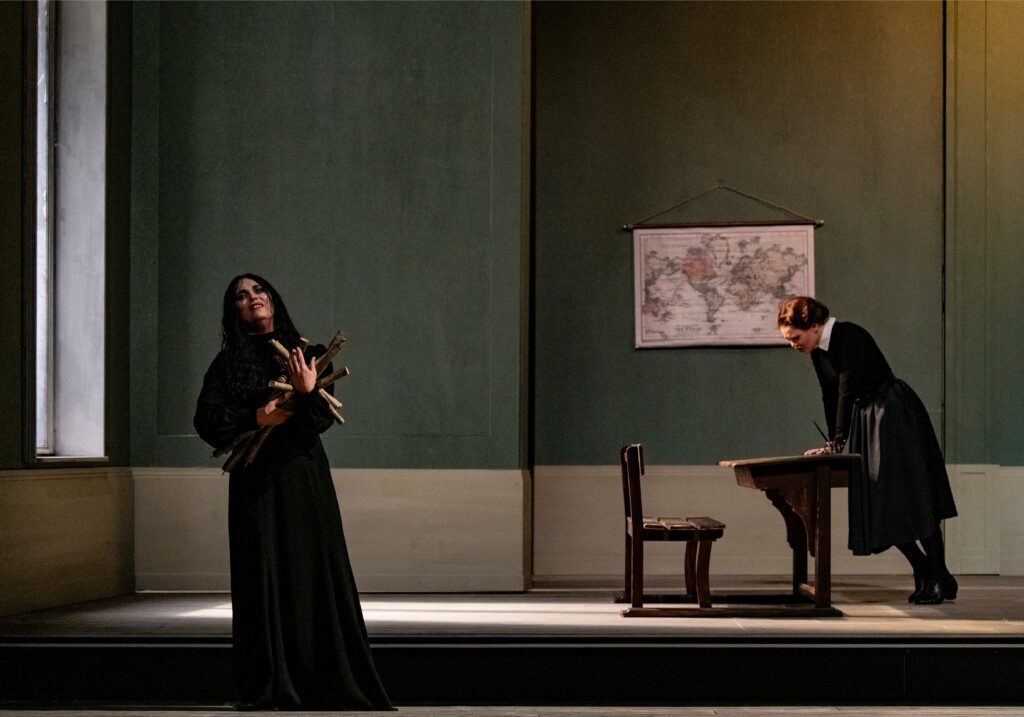
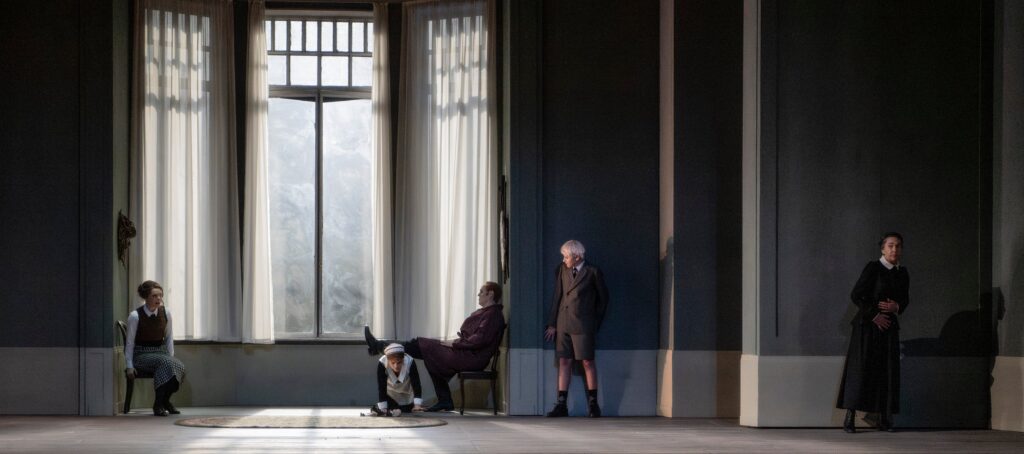
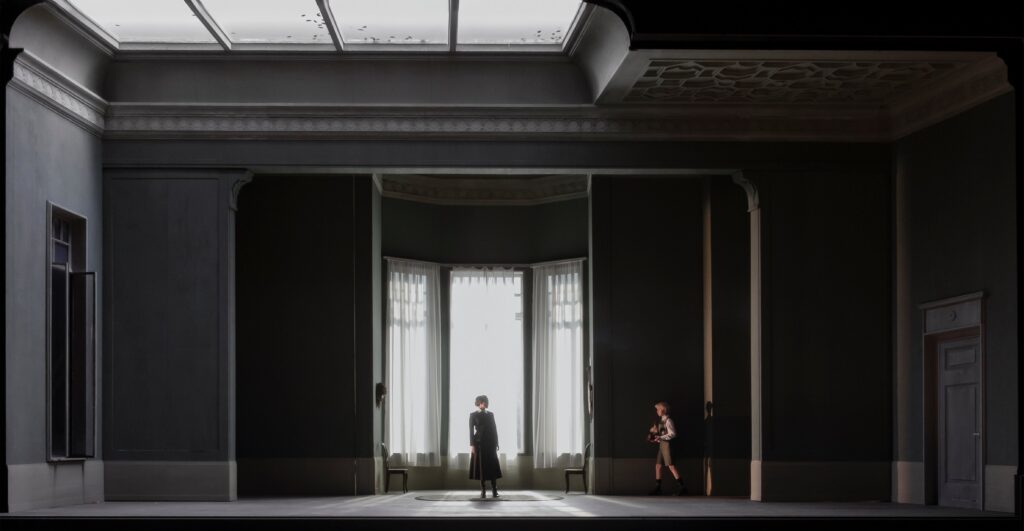
The scenography on the main stage shows a small, furnished room in an old, stately house. The room is closed in that the division between the room and the stage is covered with light panels facing the audience. These hide technical stage elements such as spotlights and rigging points, and thus contribute to a more authentic feeling of the room. As if it is there, in the house of Bly, that we are located and not on a stage that is supposed to depict Bly. The room is decorated with walls, windows, ceilings and ornate cornices. The windows are dirty, so that one cannot see clearly through them and provide a natural source of soft light. These also seem to be the only light sources, apart from the light panels around the stage, which in turn contributes to the authentic feeling that there are no stage lights, but rather sunlight and moonlight shining through the windows and into the room. There are also four windows in the ceiling that appear to have fallen leaves on them, the room looks alive where it is on stage. As if it has lived a life and is still breathing.
The incredible set design, with its light, colors, and silhouettes, also provides a great space for the great compositions in the different scenes. I simply can't stop thinking about them, daydreaming away, even long after the curtain has fallen. The slightly more minimalist costumes give more focus to the space behind them and are in keeping with the time when the story takes place, namely the 19th century.
On stage, a transparent net curtain, a bobinette, is used to separate the two rooms, outside and inside the house. But it is also used as a kind of illusion I have never seen before, where what is happening behind the curtain looks like faded memories or ghosts.
“Master of frogs”
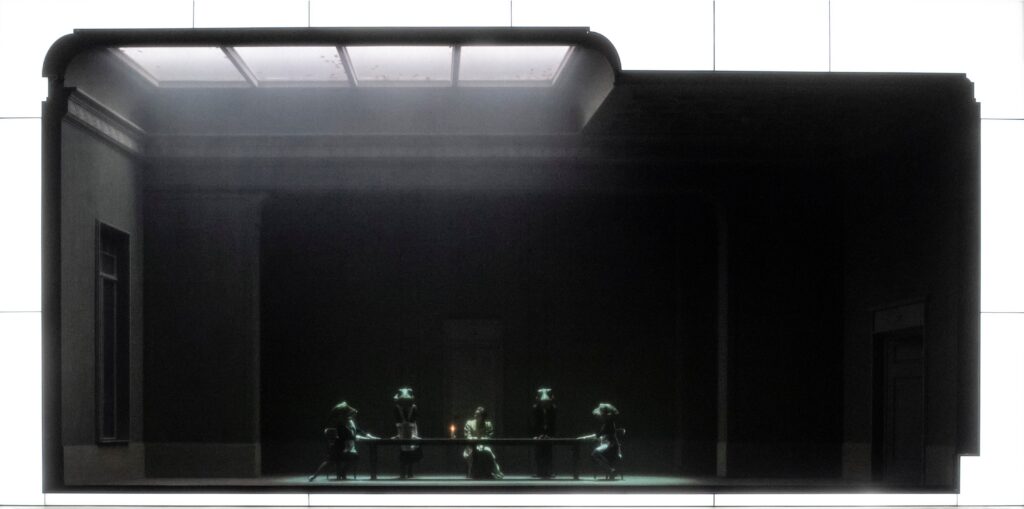
In advance of the Opera, I read Henry James's short story and discovered that there are several small changes that have been made in the adaptation from short story to opera, naturally, but one of the ones I noticed most was the use of frogs. In the short story, I didn't find frogs mentioned once, while in the opera it seems to be a symbol of how Miles spins everyone around his own little finger. In one of the first scenes, we see Miles and Flora cutting up a dead frog, while the adults behind them talk about how wonderful and perfect the little children are. Later in the second act, the governess sits alone at a table, the servants sneak in with frog masks pulled over their heads and surround her. Behind her, Miles walks past with the dead frog in his hands. This is an interesting interpretation and use of symbolism. It may also bring out the children's manipulative abilities a little more as it appears in the short story, but without the frogs.
The unsettling feeling I got while reading the novella is reflected in bleak, absurd scenes like this one. Especially in a scene where darkness envelops the masked servants – or frog creatures, depending on how you look at it – and the governess. The light from the skylights pours faintly into the room like moonlight, the frogs surround the governess while the oil lamp glows uselessly in the darkness and the governess melancholy watches the masked servants. The fear is visible on her face, but also the curiosity and disbelief can be glimpsed in her features; “how am I the only one who notices that everything is not as it should be?” The scene describes her exhaustion and temporary paralysis in doing anything and perhaps also reflects how she feels she is slowly disappearing into madness.
In my opinion, the story of Miles and Flora is about the psychological abuse that is carried out on the young children by the two deceased employees, Peter Quint and Miss Jessle. It seems as if they persuade the children to do things they really do not want to do, in a way that plays on their previous relationships, while the employees were still alive. This also comes to the fore towards the end of the play, where Miles in a confession shouts “Peter Quint, you devil!”. This is particularly effective because it is the only time he mentions the name of the deceased employee. Today's news is full of stories and images of children who have experienced more than even adults should and who are exposed to an increasingly dark world. Although both the opera and the novella were written many decades ago, it seems just as, if not more, relevant today. The Turn of The Screw is a visually and musically incredible performance that has burned itself into my eyes, just as much as the topicality.
Music: Benjamin Britten Libretto: Myfanwy Piper Musical direction: Antonio Mendez Directed by: Peer Perez Øian Scenography: Etienne Pluss Costume Design: Bianca Deigner Lighting design: Martin Flack Choreography: Magnus Myhr
Cast: The Opera Orchestra
The Prologue: Magnus Staveland The governess: Johanna Wallroth Miles: Mikkel Bosrup Kvalbein Leadworks and Ola Drevsjømoen Flora: Camilla Øfsthus and Alisandra Riber Sparre Mrs. Grose: Christine Rice Quint: Magnus Staveland Miss Jessel: Elin Kristin Hanssveen
Flute: Marie Lille Haugen Oboe: Kjersti Strøm Clarinet: Petter Langfeldt Carlsen Bassoon: Jaran Stenvik Horn: Rune Brodahl Timpani Pål Bugge Percussion: Jonas Blomqvist Harp: Ida Aubert Bang Piano/Celestia: Andreas Taklo Violin 1: Guro Kleven Hagen Violin 2: Hannah Catherine Wilder Viola: Ai Kanda Engelaug Akutsu Cello: Erlend Habbestad Double bass: Alexander Edelmann
Studio manager and soloist director: Boris Schäfer Children's choir director: Edle Stray-Pedersen Musical rehearsal: Andreas Taklo, César Cañon Musical rehearsal for children: Marianne Willumsen Lewis Assistant director: Victoria Bomann-Larsen Producer: Henrik Celius Conductor: Karen Løken, Susanne Schwarz Lindvik Dramaturg: Hedda Høgåsen-Hallesby
Norwegian subtitles: Siv Iren Misund English subtitles: Henry James
January 30, 2026
All Photo: Erik Berg /The Norwegian Opera and Ballet
Other articles
I remember/tread carefully
Josefine R. Narverud saw the performance "Treework" before the summer. "Treework" was described as an opera for the trees and the people and was performed in Østmarka outside Oslo. The performance gave a lot of room for one's own interpretations and thoughts. This text is a response to this invitation, written partly immediately after seeing “Treework” and partly a few months later.
DIY that really works, the primal child and a tribute to the imagination. Young voices have seen this year's performance at the Summer Theatre, by the second class at the Theatre Academy.
Kitchen table conversation with Young voices at Heddadagene
NewsPodcast
Consent 🍪
Cookies are used on scenekunstbruket .no for necessary functionality and traffic analysis. We process personal data in accordance with the laws and regulations in force at any time.
Functional
Always active
Data storage or access is necessary to be able to use a specific service explicitly requested by the subscriber or user, or only for electronic communication.
Preferences
Data storage or access is necessary to store preferences that are not requested by the subscriber or user.
Statistics
Data storage or access is used solely for statistical purposes.Data storage or access is used solely for anonymous statistical purposes. Without a subpoena, voluntary consent from your internet service provider or a third party, information stored or retrieved for this purpose alone cannot usually be used to identify you.
Marketing
Data storage or access is necessary to create user profiles to send advertising or to track the user on a website (or across multiple websites) for similar marketing purposes.