
Warm exploration of the imagination
DIY that really works, the primal child and a tribute to the imagination. Young voices have seen this year's performance at the Summer Theatre, by the second class at the Theatre Academy.
Sawdust Symphony creates circuses where the everyday and the absurd merge into each other, and where creativity knows no bounds.
To the sound of silence, David Eisele walks down the steps in the stands and onto the stage, a raised platform with a parquet floor, with a bucket full of wooden blocks in his hands. Michael Zandl follows soon after, and then Kolja Huneck, but his bucket is without a plank. On stage, the first two are busy nailing together the wooden blocks as fast as they can, while Huneck carefully and slowly picks up some blocks and begins to smear the contents of the bucket on the blocks to fasten them together. It is possible that they were portraying stereotypes from the lumber trade, although I have not encountered these myself. But their frantic movements in contrast to Huneck's slow ones were funny to most people in the audience, and characters I think most people can recognize both on and off the stage. In the circus world, you also find archetypes to create a perfect performance: the elegant, the skilled and the strange, something we also find in Sawdust Symphony .
A fun and practical device in the performance is how the stage is built. It is a raised platform, with a wooden floor on top. There are various hatches in this wooden floor, and considering that the space under the stage becomes a kind of “backstage”, the hatches function as entrances and exits to and from the stage. This contributes to funny moments where the performers disappear into the stage or suddenly pop up. There are also cases where only a head or a hand sticks up from the floor. In one of the scenes, nails also rise from the stage floor in time with the music flowing from the speakers, a kind of symphony of nails.
In the second scene, Eisele climbs onto the stage through one of the many hatches with a lathe. He puts on his glasses, finds equipment and begins to work on a piece of wood. The warning about the presence of sawdust quickly becomes a reality. The sawdust splatters as the wood is shaped. In an absurd interruption to the strangely normal action, Kolja Huneck throws himself out of one of the other hatches on the stage and lands face down, soaked in something that resembles wood glue. While Eisele quickly gathers his things and disappears under the stage again, Huneck struggles towards a bucket with the same contents in which he himself is soaked.
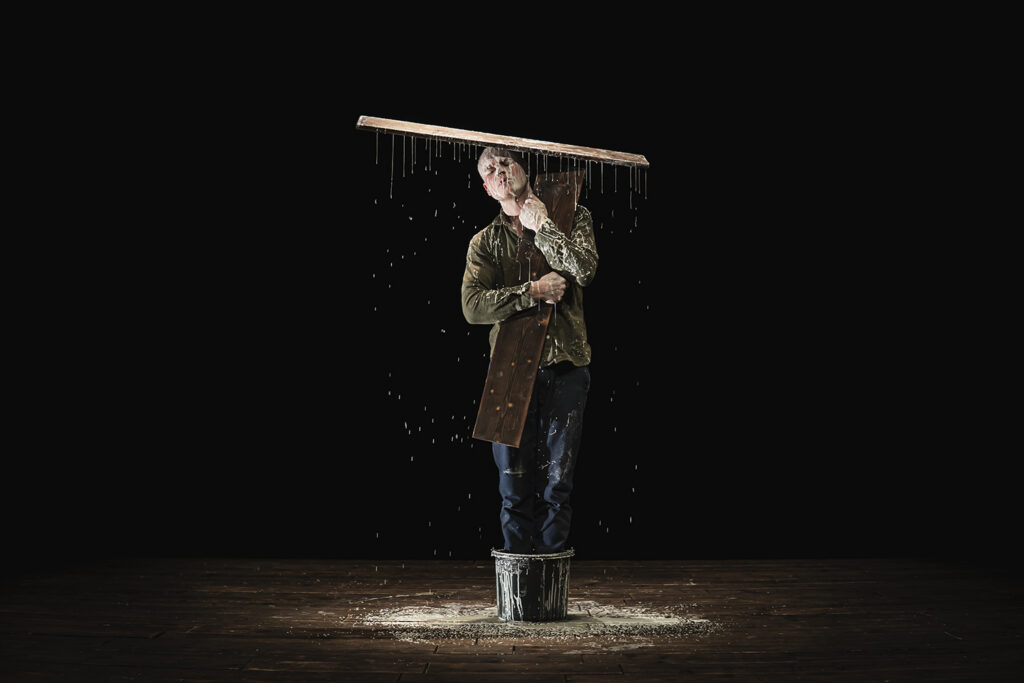
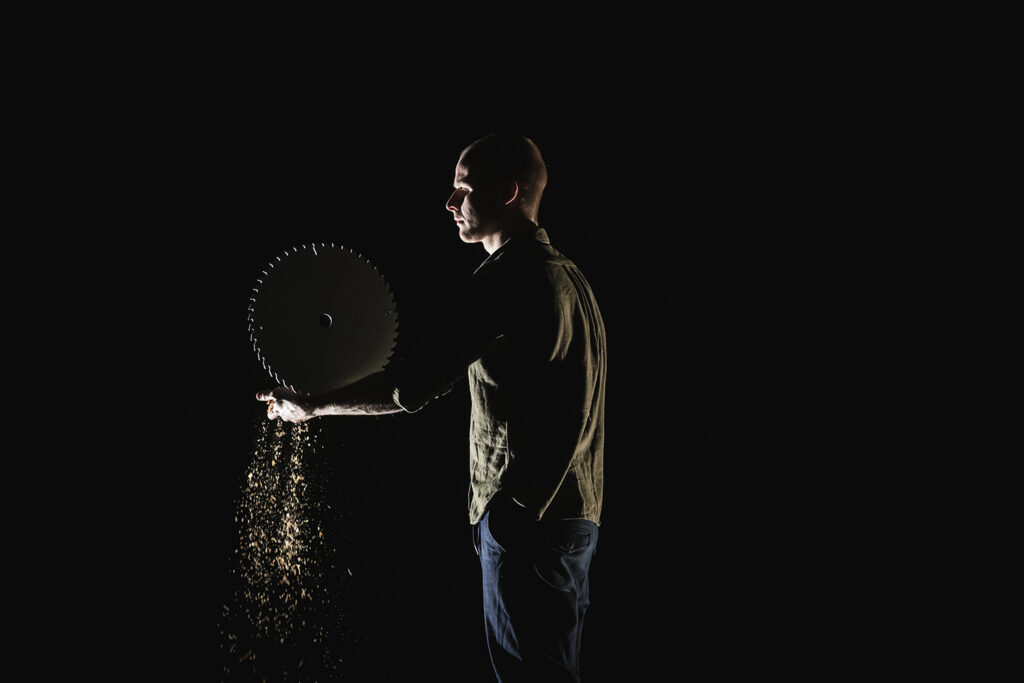
Throughout the act, he smears himself in more and more wood glue while a voice can be heard over the speakers whispering about destruction and creation. The figure moving on stage, combined with the disturbing whisper, is reminiscent of a performance art piece called Transfiguration by Olivier de Sagazan from 1998. In this piece, de Sagazan shapes, or rather deforms, himself into disturbing creatures using clay. It starts with a man in a suit and tie, who slowly begins to smear clay on his face, but it quickly develops into an almost manic obsession. Like Transfiguration, the boundaries between the creator and its creation are weakened. The creator himself becomes the creation. This is also in line with the whispering over the speakers, the balance between creation and destruction. Where is the line between creating and destroying both nature and oneself. Back on stage at Nøtterøy Kulturhus, Huneck balances a circular saw blade on his forearm, while sawdust drips from his hand, the voice over the loudspeaker whispers something along the lines of “Cutting my wrists. Pain” . The sawdust becomes like the blood of the tree, while the creator balances between sanity and madness, creation and destruction. Huneck eventually ends up with his own head stuck in the bucket containing the wood glue. While holding onto the edge, he lifts his legs slowly and controlled. He sinks further into the small bucket. Further and further. Finally, his feet disappear too.
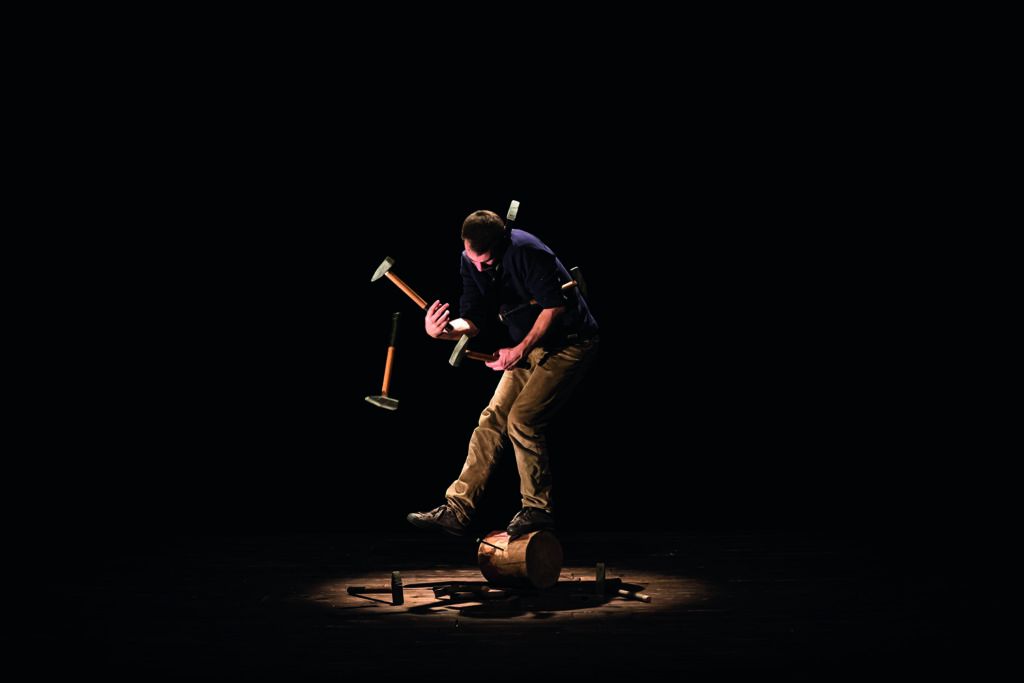
On the opposite side of the stage, a head has appeared and Zandl rises with not just one, two or three hammers, but five. It develops into a modern juggling act, which contains almost no common juggling patterns such as “Cascade” or “Shower”, where you throw the props either in a cross or in a circle and catch them again with the opposite hand, but rather a way of moving the juggling props that is almost hypnotic.
In my world, this is what new circus is all about. Seeing circus in what at first glance seems as little circus as it gets, or simply mundane and boring. Using objects we have all seen before, but which we might not think about, for example, being used for juggling. The creativity that spreads from the everyday and seeps into the absurd, seeing circus where others don't see it, proving that everything can be circus. These are elements I often see in new circus performances, and some of what also makes it precisely new circus. Another example is The Yelling Kitchen Prince , who through juggling, music, pig, mess and flame blowing makes a pancake for someone in the audience, where all the props are taken from his small travel kitchen, which also functions as a kind of stage. Although finding creative solutions to old circus disciplines has become a relatively common angle within new circus, I think that Sawdust Symphony does this in a way that seems unique. Especially considering how they each have their own character based on elements and characters from both circus and the lumber trade.
In the last scene, sawdust is raining from the ceiling, Eisele is buzzing around in the background, Huneck has rolled himself into all the piles of sawdust that have appeared on stage and is filling both his shirt and his pockets full, while Zandl is crawling around on the floor with a tree stump with a nail stuck in it above his head. He tries to find a hammer to hammer it down, but can't find any that aren't broken. Finally, Huneck tries to disappear into the stage floor, but his shirt is so full of sawdust that he can't fit in and ends up stuck; greed in real life. Zandl finally finds a mini hammer and sits next to Huneck, while he hammers the nail on top of his head down with the small hammer. Standing applause resounds in the hall when the lights have dimmed and Huneck has been helped up off the floor again. Truly an absurd and beautiful performing arts experience, which I hope to experience again.
March 5, 2026
Occasionally: Michael Zandl, David Eisele, Kolja Huneck
Artistic Advisors: Lucho Smit, Darragh McLoughlin
Sound design: Juliano Abramovay, Lasse Munk
Lighting design: Sanne Rosbag
Scenography/special effects: Philipp Dünnwald, Michael Zandl
Technicians: Roland Kumpl, Stephan Kalod, Casper van Overschee, Batist Van Baekel, Cecilia Rosso
Produced by: Korzo (Mirjam Zwanenburg)
Supported by : Federal Chancellery Republic of Austria, Dutch Ministry of Culture, Municipality of The Hague (NL)
co-producers: Provinciaal Domein Dommelhof – Theater op de Markt, Le Palc – Pôle national cirque – Châlons-en-Champagne
Partners/residencies: Latitude 50 – Pôle des arts du cirque et de la rue, Werkplaats Diepenheim, Dynamo – Workspace for circus and performing arts , La Transverse – Scène Ouverte aux Arts Publics, Gutsverwaltung Fischhorn, TENT
All photos: Jona Harnischmacher
Nøtterøy Cultural Center, February 24, 2026