
The world's best circus, failing theater
What can I, a young man at the beginning of my adult life, get out of Pippi at the circus? Asks Aksel August Ruud Raustøl.
Before the lights above the stage at Nøtterøy Cultural Center are turned on, the sound of waves crashing in the darkness is heard. The two performers, Riia Kivimäki and Saku Mäkelä, stand on one side of the stage facing the audience and sway to the music, which slowly comes on in time with the lights. The performance GLG addresses important themes on a personal and global level, about the climate crisis and hope with graceful and acrobatic movements that slide into each other and merge together.
The name of the show, GLG , is an abbreviation for Go, Let Go or Go, Let's Go and can be interpreted in both directions, either as saying that one must let go of something or someone, or that one must stick together, or as I interpreted it; as a combination. The show is at the crossroads between the strong unity of park acrobatics and more somber solo sequences, and about halfway through the show an event occurs that divides the show in two.
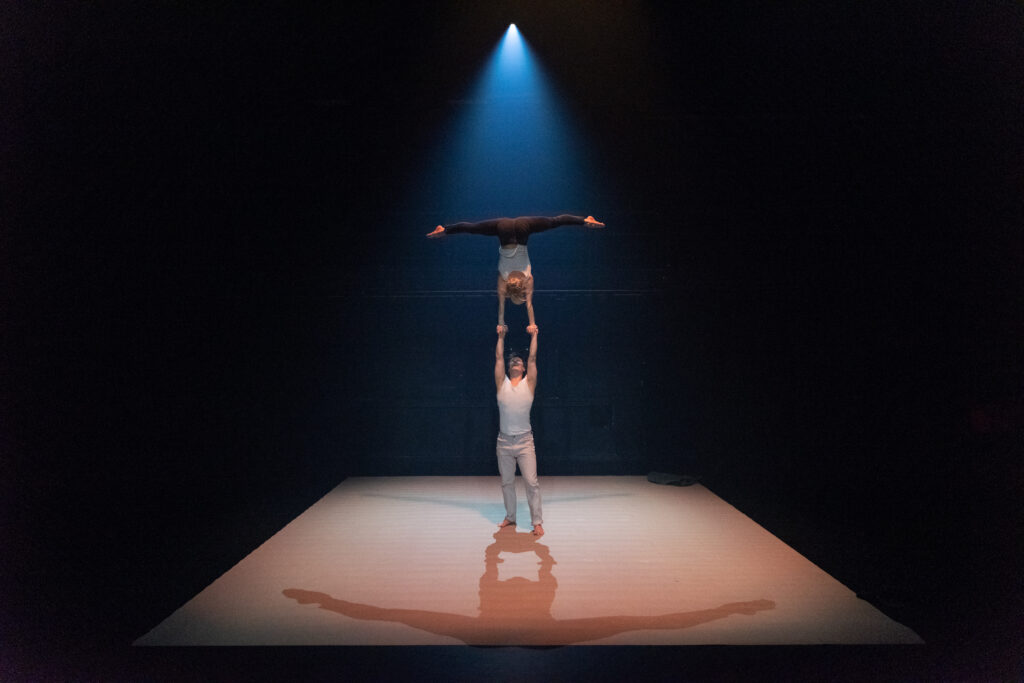
In the first part of the performance, the two performers move in an acrobatic dance across the stage. They climb and throw each other around as easily as if they were nothing more than a sack of feathers, but most of all, they trust each other. It is clear that both know the other's movements like the back of their hand. They represent a world of balance, cooperation and trust. Their acrobatic movements show how soft Riia Kivimäki is, and her movements are therefore often “bridge-based”. Her flexibility can be compared to a contortionist, but the performance is packaged in a completely different way than a regular contortionist act. A traditional contortionist act often contains stylized poses that emphasize their mobility. Such as standing on their hands and stretching their legs over their head or lying on their stomach and bending their legs so that their feet can be placed on either side of their face. Instead of these stylized poses, in GLG they are packaged in continuous movements that slide into each other.
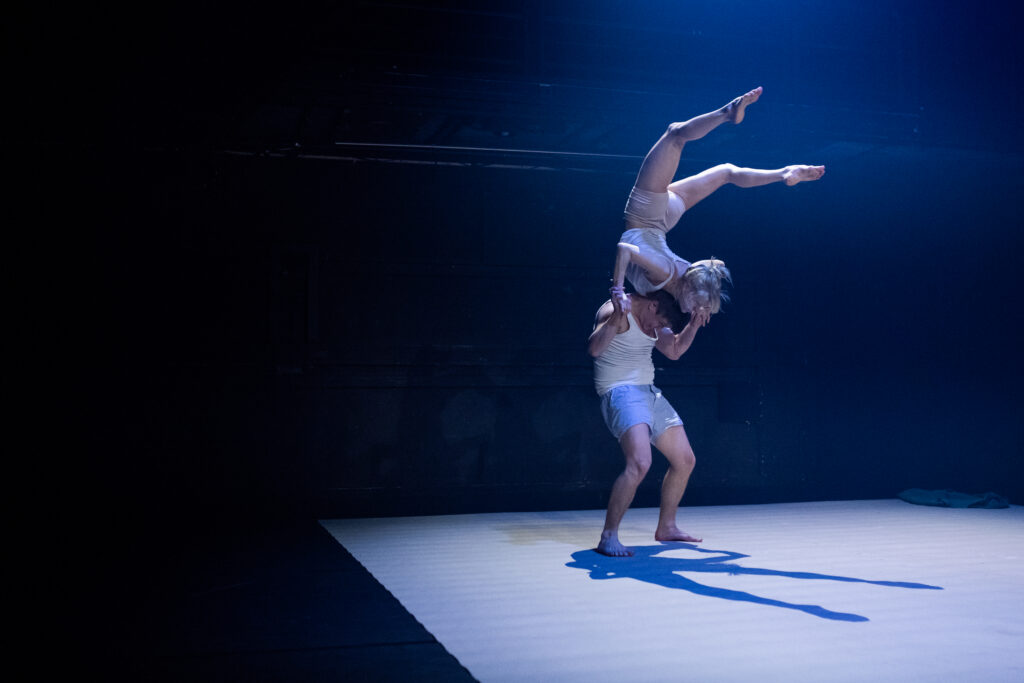
Kivimäki is bent and tossed around in an eternal dance, while Mäkelä becomes a steady base. Then suddenly, as Mäkelä spins Kivimäki around from one hand, he misses. The balance is broken, Kivimäki slips off the mat and into the darkness, while Mäkelä is left alone on stage.
After a brief blackout, the second part of the performance begins with Mäkelä sitting in a beach chair under a parasol. He is listless, leaning wearily and clumsily against a Coke bottle that he puts to his lips. A black liquid runs like oil down his chin and down his chest, before he collapses and half-slips off the chair. When he bends back into a sitting position, this time on the floor, the chair has collapsed around him and the light dims again to a faint darkness.
When the lights come back on, we see only Kivimäki on the stage floor. The sound of the waves crashing can be heard again as she lies motionless on the white stage floor. When the movements pull at her muscles, they are desperate, as if her body feels unfamiliar to her, as if she is trying to get to know it again. The movements are a big contrast from the beginning when there were two of them and the movements were controlled and smooth, while now they are feverish.
The world around us is chaotic and incomprehensible. War crimes without consequences, genocide, political leaders who act on impulse and poor judgment or do not dare to speak out, people who are not heard but are instead shot, plans that are changed or not made at all, threats, attacks and no regrets, no remorse. It can seem as if freedom of expression has no more value than the paper it is written on and it can be easy to lose yourself in it all, to feel cut off from your own body, especially when you are alone. What do you do then, when your body does not feel like your own, when you do not recognize the face staring back in the mirror? When I watch Kivimäki's movements on stage, they are uncontrolled and asynchronous, which paradoxically require a tremendous amount of body control. She grabs one of her feet and brings it behind her own head, the other foot she still has planted on the floor. Impressive gasps go through the hall as the audience stares speechless before them; Circus magic has truly taken the stage.
Her movements take her off the illuminated mat and into a sea of clothes thrown across the floor. She throws herself around in the piles of clothes – as if she is looking for something, or that depression has blown her life out of proportion lately, and at this moment she cannot believe how all her clothes have turned upside down all over the place. A sea of clothes is not an unknown sight in the newspapers either, after years of war and refugee crises in both Europe, the Middle East and Africa, even when it comes to the climate crisis it has become a “normal” sight. Piles of clothes that have been collected for a people who have lost everything, clothes floating from flooded houses, or garbage heaps full of yesterday’s fashion. Kivimäki moves towards a larger pile further into the stage, from which she digs out two legs. Before you can think about where they come from or who they belong to, they seem to be stuck to her, like the famous circus figure Josephine Myrtle Corbin. Corbin was born with two sets of legs and from the age of 13 to 18 she was part of the sideshow culture under the name “The Four-Legged Girl From Texas”. She quickly became a household name and also traveled as an attraction with PT Barnum in the late 1800s. The four-legged girl on stage in Nøtterøy seems to have lost control of her now four legs. They move out of sync and cross each other. She holds them around as if trying to get them to stop moving in uncontrolled jerks, but to no avail.
The four legs are torn apart and disappear into the pile of clothes again, leaving Kivimäki standing alone on stage on two legs. She slowly walks towards a pink bag lying among the clothes, bends and folds until she can fit her entire body into the small bag, and hides away.
Mäkelä has returned from behind the curtain and in a final scene the two performers step off the bright mat and in silence they begin to fold it. They continue to fold, and fold until they unfold a large boat. Perhaps they had to let go in order to find themselves and perhaps they had to find themselves in order to stay together again, to create new hope. On stage stands an oversized paper boat, the sound of waves crashing can once again be heard over the speakers, while the two artists walk off the stage and darkness engulfs the hall to the sound of applause.
In the post-performance discussion, the artists talked about the process and thoughts behind the 45-minute performance. They explain that it was made against a backdrop of environmental disasters and a world in crisis. Frustration, hopelessness and resistance have been sources of inspiration. These are also the feelings I am left with as I write this. The frustration and hopelessness in their facial expressions reflect my own when new headlines appear in the newspapers. But also the resistance of having hope, without hope we might as well have given up. There is resistance in the hope that washes over our feet in jerks and tugs on the beach at the end of the world and there is resistance in the unity in the same water. It is this sea of hope and unity that connects us together, whether it is to enjoy the sun on a beach or to be washed ashore by large waves. The boat on stage stands as a new hope that can sail on the waves and towards the horizon. GLG masterfully shows how new circus, unlike more traditional circus acts, can be so much more than just a series of tricks.
April 14, 2026
Concept, choreography and performers: Riia Kivimäki & Saku Mäkelä
Lighting design: Jukka Huitila
Sound design: Sami Tammela
Costumes and scenography: Riia Kivimäki & Saku Mäkelä
Dramaturg: Jarkko Lehmus
Tour technician: Jere Mönkkönen
GLG in Co-production with Cirko – Center for New Circus.
Photos: Kai Kuusisto
Nøtterøy Cultural Center, March 5, 2026