
The musical Ingvar – it's typically Norwegian to be good
On Thursday, September 10, IKEA came to Østfold in two formats. One as a physical store, and the other as a musical. Unfortunately, I made the trip to the wrong IKEA.
Oslo Nye Teater's version of “The Young One” is exciting, funny and moving. But after the play, you are left with the feeling that the message disappeared behind the scenes.
“The Young One” at Oslo Nye is an adaptation of Oskar Braaten’s play of the same name from 1911, but now set in modern times. The play was also made into a musical, and then a film in 1974.
In the play we meet Milja, a young woman in her 20s who has just become a mother. After she discovers that her boyfriend Julius has been unfaithful, she breaks up with him and chooses to raise her child on her own. Although she gets help from her local daycare, Hønse-Lovisa, raising a child is harder than she thought. After a while, the attending physician comes to visit and gives Milja the choice of adopting the child to a rich family on the west coast. Milja takes the chance, but it quickly becomes one of the worst choices she has ever made.
As an adaptation of the 1974 film, the play falls flat. The biggest example of this is how the theater performance handles the adoption versus the film. In the film, Milja gives up the child because she is overworked, underpaid, lonely and alone. In other words: societal pressure. The society they live in at the end of the 19th century is set up so that it is almost impossible to raise children and earn enough money. When Milja hears about the superior, it is natural that she wants to give the child a “better life” because the chance of social mobility and wealth is almost zero on the east coast.

In the play, it seems more like Milja gives the child away because the child became a great emotional burden. Milja in the play was also overworked, underpaid, lonely and alone, and it is clear from the dialogue that she cannot afford to raise the child. But the play is set in the present. With the welfare state, and all the schemes to provide support to poor parents, the argument against poverty is weakened. I can imagine that Milja and the child cannot go on holiday once a year, but that is a much milder poverty than not being able to afford food, clothes or a roof over their heads, which is something that the film Milja is in danger of.
In addition, the character development of Hønse-Lovisa was much weaker in the performance than in the film.
Hønse-Lovisa is a nanny who runs a nanny business from the house she inherited from her brother. It is implied that most of the young adults in the play were raised by her.
In the film, she represents steadfastness against the system that tries to oppress and exploit them (the poorest). That is why she is so mean to the supervising physician and so rude to Milja when she reveals that she is going to give her child away. For Lovisa, who has spent all her resources raising the East Coast, every child that is adopted away feels like proof that the Hen's Nest is not enough. Even though the Chief is not wrong in that on the West Coast there are more opportunities and better resources, he does not want to take these children to save them, he only wants to give cute, little children to the rich. If the Chief cared about the poor, he would have taken Petra's child (the one who was sick), but a sick child does not sell as well as a healthy one. Lovisa notices how their bodies only have value when they produce profit or cute, healthy children. The Hen's Nest stands in direct opposition to this system and exists so that unmarried, poor mothers can also be allowed to raise their children while they work.
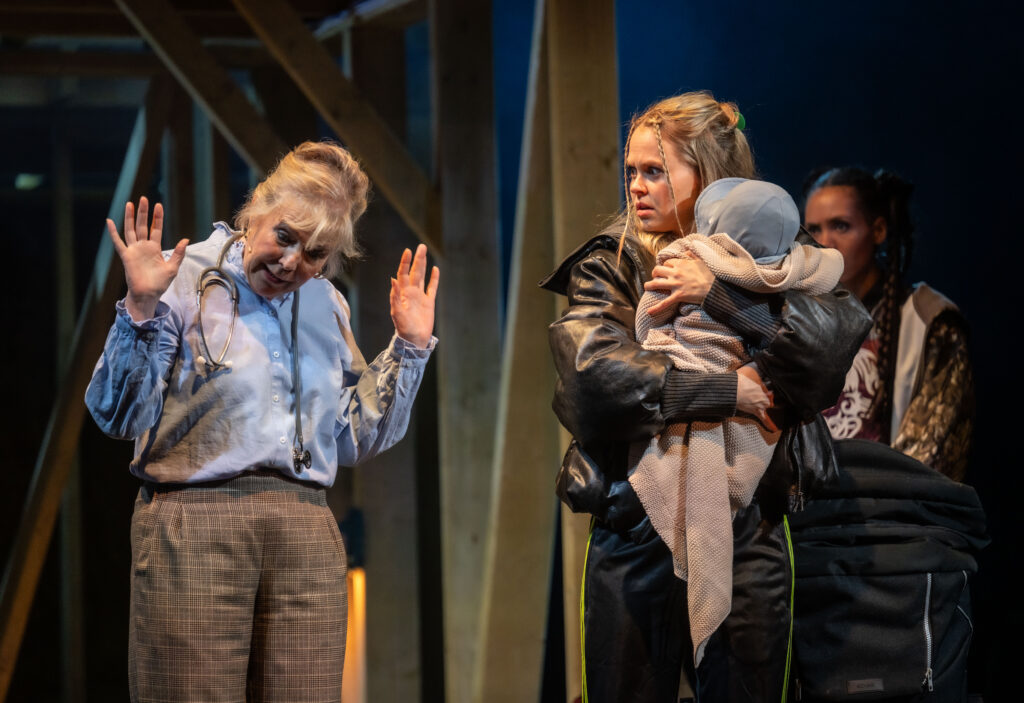
Unlike the film, Milja's choice is taken as a personal attack in the play. Theatre-Lovisa cannot believe that Milja will give up her child, it is as if she is completely blind to the reality they live in. There was a moment during the performance where Lovisa stood in the dark and rolled up the shirt, which she had been wearing around her waist, into a burrito and held it like one would a baby. Can't Lovisa have children on her own? Is she taking her anger out on Milja? It seems that way. In the film, it became clearer that she sees all the young adults as her own children, and that she is most likely past menopause. Whether film-Lovisa can have biological children or not is irrelevant because they are all her children. In the play, it seems as if she is taking care of these children because she loves children and cannot have them herself. In the film, she is doing society a service, in the play, she is using the chicken nest to satisfy her own emotions.
The play the film is based on (“The Young One” by Oskar Braaten from 1911) is a contemporary drama written in a neorealist style. It is supposed to be about society, but instead it became more melodrama than social criticism. I think the adaptation would work better as a continuation of the original text, where they used features from the original play like the hen’s nest, but replaced the original main plot with a more current social problem. For example, if Milja was a single mother who had just enough money to not be able to get support from NAV, or maybe something about abortion. Another alternative could have been to have more scenes that give a little more context to Milja’s choices. For example, having to choose between heating the apartment in the winter or dinner for both herself and the child.
March 11, 2026
Cast :
Mile: Cathrina Vu
Julius: Gunnar Eriksson
Hønse-Lovisa: Sanne Kvitnes (Later taken over by Silje Lundblad)
Petrina: Karoline PU Schau
Gurina: Trine Wenberg Svensen
Olina: Maria Agwumaro
Kristoffer: Sindre Postholm
Supervising physician: Brigitte Victoria Svendsen
Jacob: Ferdinand Falsen Hiis
Petra: June Elisabeth Baltzersen
Erik: Alexander Karlsen El Younoussi
Understudy Julius: Fabian Christensen
Understudy Petrina/Olina: June Baltzersen
Understudy Hønse-Lovisa: Caroline Glomnes
Understudy Jakob/Erik: Andreas Stoltenberg Granerud
Understudy Kristoffer: Ferdinand Falsen Hiis
Understudy Supervisor: Sindre Postholm
Musical director: Lars Bleiklie Devik
Music arrangement: Lars Bleiklie Devik, Eyolf Dale and Helge Sunde
Orchestra:
Bandmaster/keyboards: Eyolf Dale/Lars Andreas Aspesæter
Bass: Marius Reksjø
Cello: Sophia Cabo/Katrine Pedersen
Violin: Karl Espegard/Bjarne Magnus Jensen
Big band: Helge Sunde, Børge-Are Halvorsen, Erik Smith
Underscoring: Eyolf Dale
Repetitors: Tove Kragset/Trond Lindheim
Director: Runar Hodne
Set design and costumes: Christina Lovery
Choreography: Kristin Ryg Helgebostad
Lighting design: Clement Irbil
Sound design: Tore Gustavsen
Mask manager: Wibke Schuler
Props: Ingrid Usta and Stine Bergo
Dramaturg: Marianne Sævig
Director: Emilie Hallem
Production staff: Frida Nordholen / Amund Sigurdssønn Karlsen
Technical coordinator: Christer Berg / Arne Lindberget
THE YOUNG
by Oskar Braaten
Dramatized by Harald Tusberg, music by Egil Monn-Iversen
Edited by Marianne Sævig and Runar Hodne
February 18, 2026. Oslo New Theatre
All photos: Lars Opstad / Oslo New Theatre