
The musical Ingvar – it's typically Norwegian to be good
On Thursday, September 10, IKEA came to Østfold in two formats. One as a physical store, and the other as a musical. Unfortunately, I made the trip to the wrong IKEA.
Thank You for Life is a piece, a life, and a hero that I got to know in about two hours. A piece that was as moving as it was confusing. Thank You for Life!
My first encounter with Håkon Banken was a podcast on NRK , which had been recommended to me as I was going to see this play. In the podcast, journalist Joachim Førsund traveled around Norway to learn about Håkon and to hear stories about him from his friends and family. Håkon Banken grew up in a Pentecostal church in Hof in Solør, and his father was a pastor in the church, so he and his sister were always at the ceremonies. Håkon was never fond of church services, he learned guitar early in life and sang and played guitar on all appropriate occasions. Håkon was also not a believer, unlike the rest of his family. In my opinion, he felt trapped and forced into a faith that did not suit him, and this may have also affected him later in life. He never really liked being on stage, not as an adult either. There were several times when he did not perform at his own concert. From the podcast, I see Håkon as a man who stood up for those around him who needed it, an insecure man with a big heart. A man so destroyed by his own thoughts that he dares not be alone with them. I asked several people around me who had grown up in the 80s if any of them knew Håkon Banken and his music, but most said no.
I felt quite young when I entered the hall, most of the people around me were older than 55, with the exception of the three sitting next to me who were in their 20s. A man walked into the hall wearing a Stetson hat and a checked flannel shirt. Several others followed him in the same attire. The spotlights were directed at the audience, so the stage was completely dark. This was enough to completely hide the stage in darkness, so that we would not see what was on stage. It was approaching 7 pm and the people in the hall were excited, the lights went out and the play started.
On stage, an old, yellow American car drives in, with five passengers squeezed inside. They are dressed in flannel, denim or leather. Everyone has a hat or cap of some kind, some with Stetson hats, others with caps. They drive into a place where a concert is going to be played, but they are the only ones there. It is dark and they only have each other to play with. They decide to listen to some cassettes with Håkon Banken, one of them finds a guitar and there is a good atmosphere around the car with singing and playing. We see Håkon's life on stage through the songs he composed, from the time of singing and hymns in the Pentecostal church to the day he meets Annlis at Klara bridge. Håkon has written about his own experiences in his songs. Between the songs, they act out a scene that I am not sure if is meant to remind us of something that happened in Håkon's life, or is pure fantasy inspired by the songs. In one scene, two of the actors are under the car with wrenches and fixing the car. On the stage, walls with car lights are set up, making it resemble a car repair shop. The two actors talked about how it's hard to get up once you've laid down. After they've been lying there for a while, the other actors start tapping the car and the walls rhythmically, and the two actors under the car get up and start singing. One of the things I learned about Håkon Banken through the podcast was that he liked to tinker with cars and often helped others fix their cars for them. Throughout the play, they took the car apart and used the parts as props.
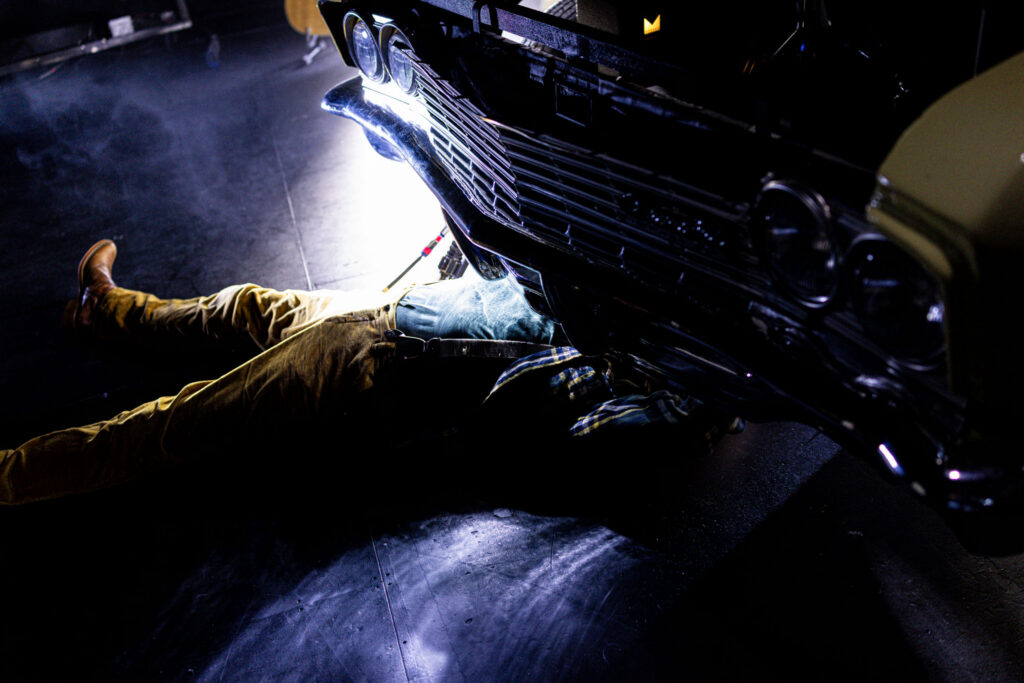
I liked the atmosphere that came into the hall during the play. It felt like I was part of something bigger, a kind of family. A family created by Håkon's music. Even though I don't necessarily like the music, I liked the group of people he gathered through the music. I liked the effect the spotlights gave before the play started, I couldn't see the car in the complete darkness, so it looked like it was driving onto the stage even though it was there the whole time. I got the impression that when they took the car apart, they became more and more Håkon Banken. When they put it back together, they were someone else.
As I mentioned earlier, I didn’t know Håkon Banken before I went to see this play. I liked the title and thought that the play must be good with a title like “Takk for livet”. Håkon Banken’s music itself doesn’t really move me, but it’s the stories he tells and the life he has lived that are moving. He wrote songs in a genre I don’t listen to often, namely a kind of troubadour/country. The music is like a diary, he tells about things he has experienced as they were, without sugarcoating the truth.
If I hadn't listened to the podcast, I wouldn't have understood the plot. Yes, the songs have stories, but it's hard to take it all in the first time you hear a song. They played some of the scenes from the songs at the same time, but it wasn't clear enough for me to understand what was happening.
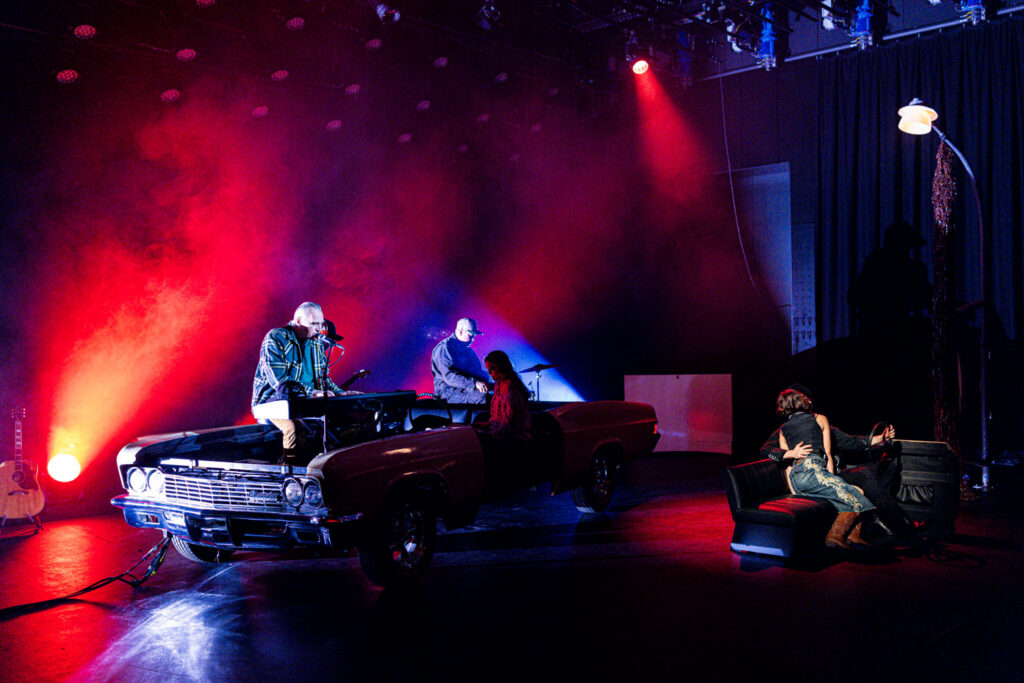
A song I remember well from the play was Finnskogens drönning . It's about Annlis, the girl Håkon met at Klara bridge. They acted out the scene from the song when he met her for the first time. With a slightly infatuated Håkon asking if he would drive Annlis home. We see Annlis becoming more comfortable with Håkon throughout the song, from sitting on separate seats in the car to her leaning on his shoulder and singing along. This was a scene I recognized from the podcast. I listened to Håkon's songs after I had seen the play, to get a better idea of who he was. I liked the play, and learning about someone I had never heard of, but who meant a lot to others is fun! I still don't have a big relationship with him, but it was nice to get to know his story. The play was truly a tribute to Håkon Banken. A tribute to the music, the life he lived and the lives he touched.
March 16, 2026
By: Sigmund Løvåsen and Håkon Banken
Playwright: Sigmund Løvåsen
Director: Erik Ulfsby
Scenographer: Even Børsum
Lighting designer: Mathias Lundgren
Lighting technician: Adrian Sveløkken Ødegård
Choreographic assistance: Belinda Braza
Costume designer: Ingrid Nylander
Sound engineer: Michael Dahlen
Technician: Jan Harald Ovrum
Technical Manager: Jan Terje Molstad
Producer: Kari Dæhlin
Director: Ida Marie Vik
Mask manager: Marjan Waaijenberg
Props manager: Britt Elin Østby
Costume designer: Irén Godtfredsen
Dramaturg: Anders Hasmo
Musical arranger: Kjetil Bjerkestrand
Produced by Teater Innlandet
February 27, 2026, Vega Scene
All photos: Photo: Lars Martin Bøe