
Axel's little criticism crisis
What is the role of critics in the world of theatre? Aksel August has pondered this throughout the Hedda Festival – and life in general.
The new circus performance “The Shedding” paints a macabre picture of today’s society and explores how far one is willing to go for others. How far are you willing to bend and fold yourself, to be loved?
During the Circus Village in Torshovparken, where I myself worked in the cafe, The Shedding played earlier this fall and will play again in connection with the MERGE new circus festival on November 15. The performance is by and with Elise Bjerkelund Reine, a Norwegian new circus artist living in Denmark, and takes issue with today's view of women.
For much of my childhood, the few weekends in Circus Village have been the ones I look forward to most during the year. They have been the ones that have made the rest of the year a breeze to get through – even in later years, when they have also been the most tiring. It started with me just being with my dad at work, but since then Circus Village has become my own workplace and sanctuary. A place where I am surrounded by good friends even though it may be the first and last time we meet. Although for many Circus Village ends when the curtain goes down, for me it is when it begins. It is the evenings around the campfire, breakfast around the kitchen table or outside the caravan and the short conversations between beats that I remember best. In a way, it is between the tents, together with the circus artists and in the smell of the popcorn that I grew up. This is where “home” is.
During the years I have been at Circus Village, I have had the opportunity to meet people from all over the world and see countless fantastic performances. Everything from more theatrical new circus like La Sagrada Familia , to performances mainly rooted in one discipline like Une partie de Soi and not least the annual cabaret with a mix of everything possible and the highlight every year.
One performance I remember particularly well is As a Tiger in the Jungle , which played at Circus Village in 2018 and 2022. The performance is about the experiences of two of the artists, Renu Ghalan Tamang and Aman Tamang, who were sold to a circus when they were children. I think I remember this one particularly well because until then, circus had only meant freedom to me, I hadn't thought about the fact that it wasn't necessarily always like that. I was impressed that Renu and Aman, despite their backgrounds, chose to continue with circus and create a safe environment for young and old in Nepal's first new circus, Circus Kathmandu . In As a Tiger in the Jungle, they mix circus and theater and create a strong performance, with a tragic story, but which fortunately ends well for Renu and Aman.
New circus can be described as a meeting between dance and theater, but with circus as the basic discipline. I think one of the things that interests me most about new circus is that it is a meeting place that gives room for freedom and creativity. A place where everything is allowed. Where you can both defy the forces of nature and where there seem to be no physical limitations. You can bend, stretch and stretch your body to the most incredible lengths, but how far is too far? How far are you willing to bend and fold yourself for others?
For decades, women have bent and folded to fit into the template of the “ideal female body,” which seems to change every week. They have stretched and twisted to satisfy men’s fantasies without thinking about their own bodies or health. Men have exploited women’s fears of not fitting in or not being liked, and when they no longer meet their demands and desires, there are no limits to what men are willing to do.
According to VG , there were 8 partner murders in 2024, all of whom were women. In addition, at the time of writing, 3 have been killed so far this year in the same category. Is this where we have come to? Has this become the norm? Is this the world I am supposed to live in?
Women have been treated throughout history as subhumans, not worthy enough to have a job, vote, or simply live, it turns out. Many women become living punching bags for male aggression, taking every punch, kick, and stab with a smile, because isn't that what you're supposed to do? Isn't that what women are for?
Women bend to men's needs. Twist and turn. Do what they are told.
This lays the foundation for the new circus performance The Shedding , in which Elise Reine plays the lead role.
The first thing that meets me when I enter the tent opening to see The Shedding is a half-naked woman partially buried in the ground. The stage is dark and you can barely make out her, but she is unavoidable. She looks abandoned, as if she has been thrown like trash into a ditch. Or tried to be buried, but the perpetrators have been in a hurry and not bothered to finish the job. This is the beginning of a performance that paralyzed me from start to finish, that still gnaws at the inside of my head and that has not yet released its claws from my body.
A woman crawls up from the ground, as if she wants to tell her own story after death. The story she refuses to let die with her.
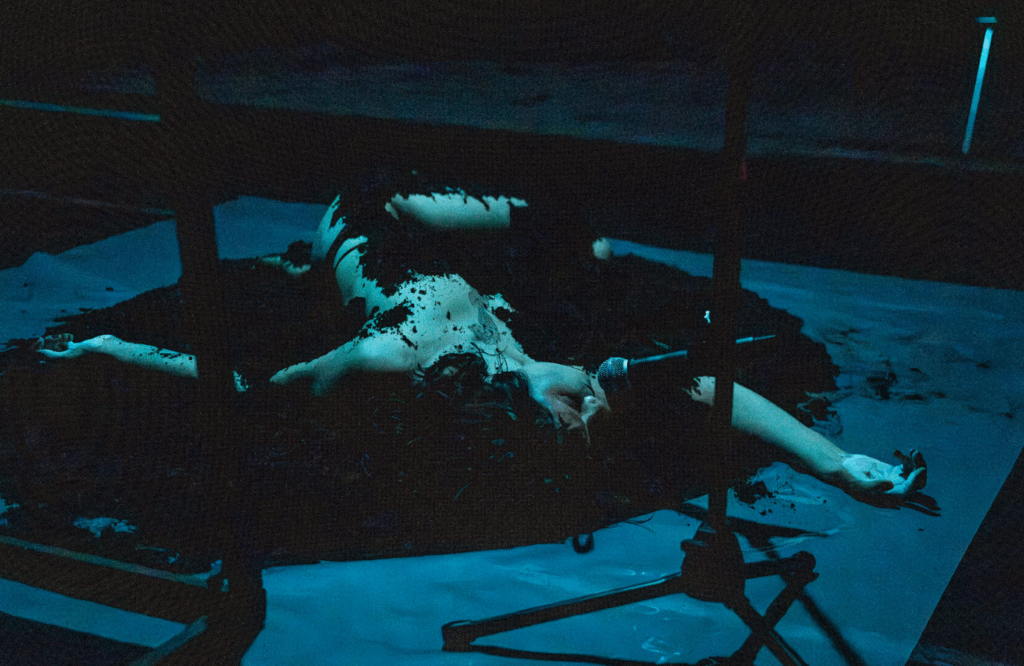
The performance deals with a view of women in which women are nothing more than objects that can be used as one wishes and then thrown away when one is done with it or if it does not live up to expectations or do what one wants.
After Reine has crawled out of the earth that buried her, she grabs the trapeze that hangs like an anchor point in the middle of the stage. Her movements are slow, and the rumble from the speakers has stopped. All that can be heard is Reine's movements and the drumming of the rain on the tent canvas. This sets the trapeze sequence apart from most other trapeze acts. Where others have loud music, here it is completely silent, except for the rhythm of the rain. Where others make rapid movements and lean on applause, Reine's movements are calm, controlled and have no applause to hide behind. Self-confidence shines from every movement. Elise Reine has been in the circus environment for many years and is too veteran to be considered today, which this performance shows. She bends, squirms and twists and both the ground and the air are hers.
It's not just women who are used to bowing down to others. Circus artists depend on work to survive, and may feel compelled to take jobs that stretch their own boundaries.
The Shedding is also about the sexualization of the circus performer and especially the contortionist, which Reine herself is. The performers are expected to wear clothes that barely cover their bodies, and it is in a way their job to bend, fold and stretch themselves for the audience's great pleasure. How Reine squirms and twists becomes a representation of how women and contortionists are portrayed and sexualized in the media, on stage and on the street. How they never get any peace, but exist only for the pleasure of the audience and men.
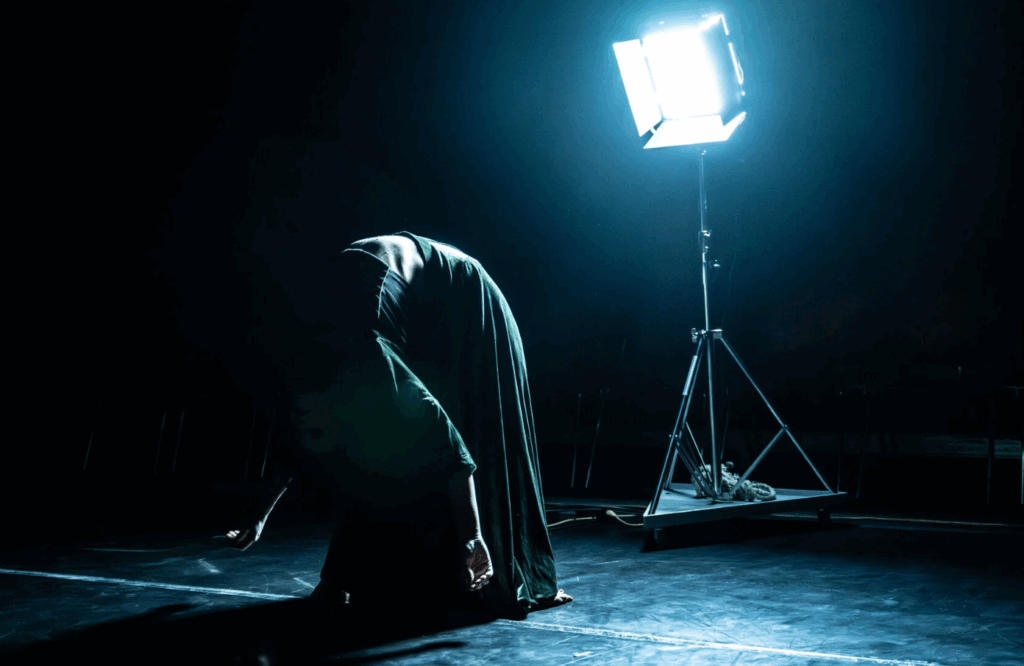
An example is in a sequence where she does the same routine three times. The first time she is wearing a green skirt, with a matching blouse. The second time she is only in her panties. The third time she is completely naked in the middle of the stage. She does the same movements as the first two times. The same routine. I interpreted this as an image of how women are undressed, either involuntarily by others or by the feeling that they have to.
Several of the movements performed in the performance I have never seen before. For example, when she hangs from the trapeze with her entire body weight in her own fingertips. She twists herself until her arms can no longer go. Then, as the audience watches, her shoulders slide back into place and she twists herself again in a similar way to the last time. The technical execution in this piece is absolutely extraordinary. Every movement she makes could have been the highlight of any other performance, but in this one, highlight after highlight comes and ends in a bloodbath that drowns the audience in their own thoughts and emotions revolving around a dangerous world and a current performance.
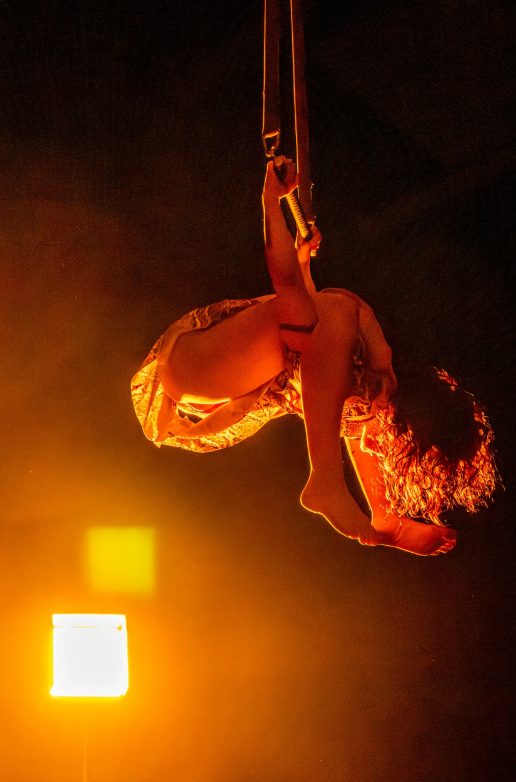
The Shedding ends with Elise Reine smearing herself in blood as music blares from the speakers. The performance explores how far some women may be willing to go to achieve a form of closeness and love. As if pain is a cheap price to pay to feel loved. As if it is an inevitable outcome.
The light goes out. When it comes back on, it flashes and the audience can see a bloody Reine wrapped in plastic. She bent and folded for all of our amusement, until she broke.
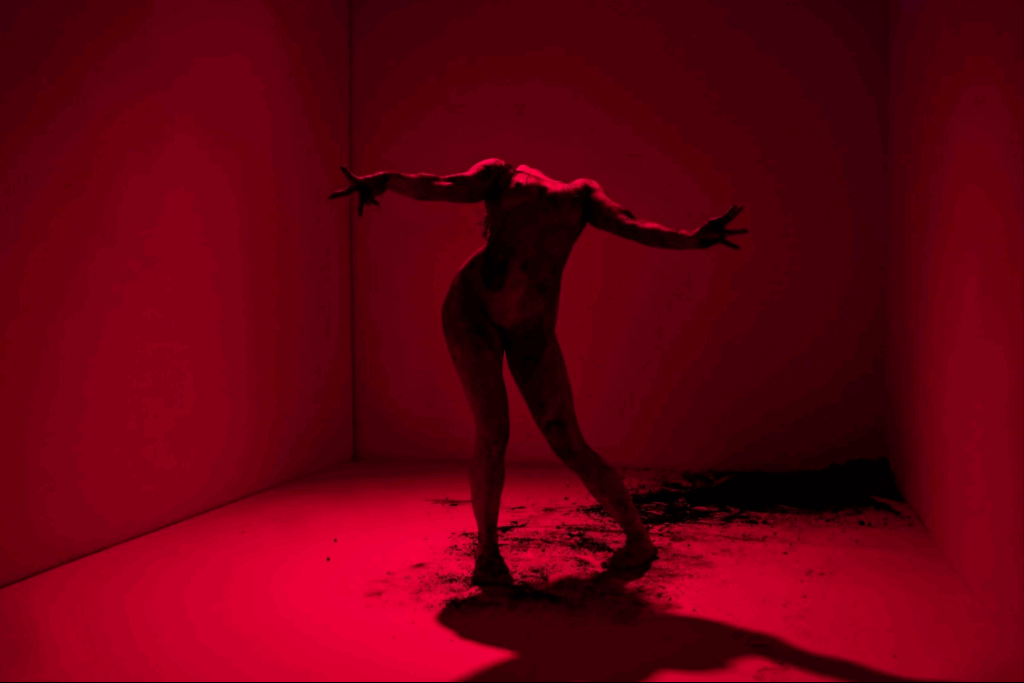
Elise Bjerkelund Reine forces the audience to look at one of the many problems we face today. An outdated and worn-out view of women that should not be relevant today, but which is unfortunately more relevant than one would think. In the UN's statistics for gender equality , which do not address violence against women, Norway is in 2nd place behind Denmark because we are one of the most equal countries in the world. I had therefore hoped and expected that this would also be reflected in the partner homicide statistics. Norwegian society is unfairly balanced and will continue to be so as long as we do not acknowledge that it is not equal in all areas. As long as we continue to live in our little Norwegian bubble, where everything appears nice and great and equal, changes will not be made. The Shedding confronts the audience with the blood dripping from the gender equality statistics and forces a dangerous mentality among some men into the spotlight and onto the stage, where women's own interests are exchanged for men's needs and desires .
November 14, 2025
Sirkuslandsbyen is a new circus festival that has been held every year in Torshovparken in Oslo since 2008 and is still ongoing. Previously, they have also spent 1-2 weeks in Sandvika first, but after reduced support this is no longer possible and its future is becoming increasingly unstable.
Concept and performer: Elise Bjerkelund Reine
text: Kajsa Bohlin
Scenography, lighting, sound design: Hjalmar Nilsson
Outside view: Marcelo Nunes, Kajsa Bohlin
Makeup: John Hanna
Costume: Helle Karlsson
Concept photo: Klara G
Performance photo: Andreas Bergmann Steen
In collaboration with: Östgötateatern/X-scenen
Co-production for tunre: AFUK scene(DK), Glimt Amager(DK)
Josefine R. Narverud saw the performance on Friday 5 September.