
So stupid it's fun
The guys at Det Norske Teatret are so stupid that it's funny, writes Fiona Åtland (20) in this illustrated review.
What seemed to be a couple's journey to a happy life in Lithuania was more about a dysfunctional family.
“I have to go home.” The words circle like a wave through Mari Qviller’s play Blue Men . A nighttime mood of restlessness, love and earth. It’s about Darius, who longs to return to the abandoned family farm in Lithuania. Lucas, Darius’s girlfriend, is with him. They are about to embark on a journey, the background of which I didn’t quite understand. There are also several other questions raised in the play that we don’t get answers to. Why is there so much tension between Darius and his parents, why does Darius suddenly push Lucas away, and what’s the deal with this farm in Lithuania? I would have liked to have had answers to several of the questions the play raises, and overall the lack of answers weakens the play’s credibility.
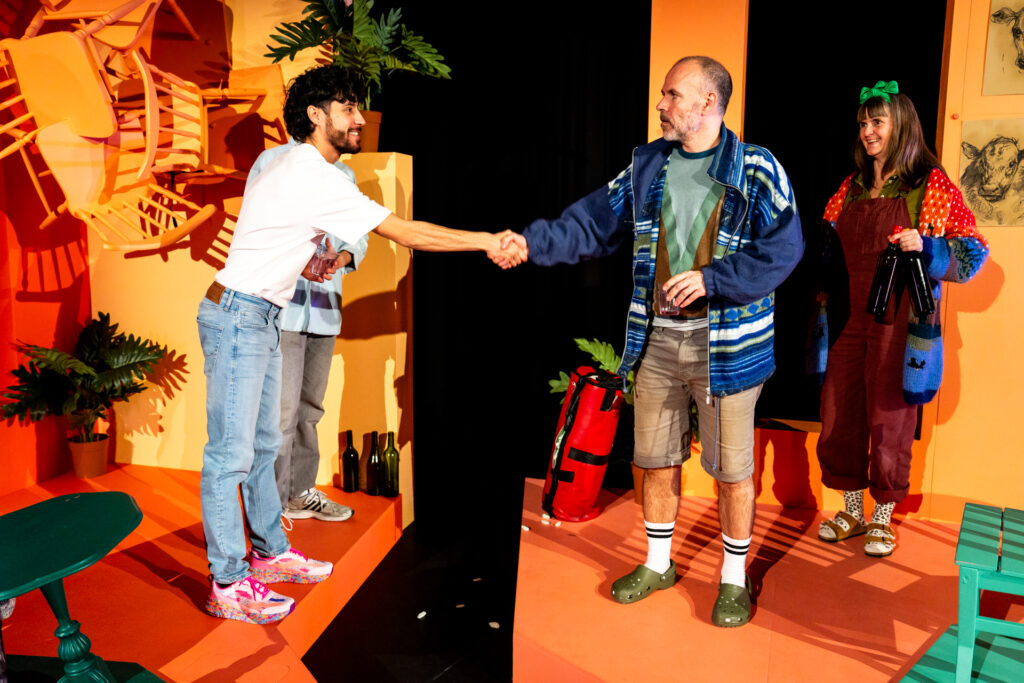
The performance begins almost like a miniature road movie, with a romantic escape. Darius and Lucas just have to pick up the keys to the farm, at Darius's parents' house. But the way home turns out to be a path into the shadows of their childhood. Home is a place Darius refuses to return to, and neither Lucas nor Darius escape completely when they arrive. Several things stand between them and the keys to the farm in Lithuania: their mother's beetroot, an angry, unemployed father who paints cows, and a darkness that constantly seeps in between the laughter. Because here there is both humor and sadness, tenderness and cruelty.
Qviller has written an original play. She wrote Blå menn when she was 19 years old, and the script was developed through Ung tekst at Unge Viken Teater. The play has never been performed before its premiere on October 24th during “Stjernenatt” in Lillestrøm. The text is full of nerve, which is evident in how it is written without filter or attempt to embellish reality. Qviller has created a play about human vulnerability. About the desperate will to belong, and the fear of being seen as weak.
The actors balance the intimate and the absurd with precision. Ulrik Græsli and Aleksander Varadian make Darius and Lucas a believable couple. Everything from the little glances, the nervous pace, the tender irritation that you often see in couples in love. One of the things that made the acting believable is that I was a little embarrassed by the ear biting that Darius did to Lukas. I don't like seeing couples in love doing PDA (Public Display of Affection), so it was uncomfortable to see the cuddling and tickling the characters did to each other. Still, this worked very well.
Tiril Pharo and Espen Løvås play a convincing married couple, who move between comedy and seriousness. Precisely because they play a married couple who have lost their spark, we also see the darkness that lies over them. A darkness of longing for everything they were and had together.
It was fun to watch the language barrier play out between Lucas – and Darius’s parents. When Lucas meets Darius’s parents for the first time, Darius translates between his girlfriend and his mother. Nothing is directly translated, because he tries to shield his world with Lucas from his family. They don’t speak Lithuanian on stage, but instead act like they don’t understand each other. This created humorous breaks from the seriousness of the play.
We meet two men seeking peace, but it is unclear what they are actually fleeing from. This is not the only question that arises in the play, but also questions about Darius's upbringing, and why he has not been home for a year. Of course, one can draw one's own conclusions from everything that is unanswered in the play, and that is not all that can be squeezed into a one-hour play. Still, there is too little that one is told, which means that the play lacks a foundation or pegs that we can hold on to. The play lacks too much information.
“I have to go home”, says Darius, but where is it really? The play makes itself relevant with this very sentence, “I have to go home”. I think many people can identify with feeling like they don’t belong. Whether it’s in Oslo, in Norway, or in their home country. It could also be that you long for a home, where home is a version of yourself. Maybe you don’t feel like yourself, and long for your true self, your best self, that is, “home?”
It's hard to understand Darius' character, and that's largely because we don't know enough about him. One thing is for sure; Darius is insecure, but we don't know what he's insecure about. I interpret Darius as insecure because his personality around Lucas doesn't connect with the one he has around his parents. Around Lucas, Darius is a small and clingy man, while when he's with his parents, it seems like he has nothing left for them. He gives them short answers and little love. It could be because he no longer feels Lithuanian, and when his parents tease him for not knowing the language, it doesn't help the relationship. Even though you change your personality a little when you're with friends, family or a partner, it was hard to see a connection between Darius as a boyfriend and Darius as a son. It was almost like seeing two completely different characters.
Blue Men is not a perfect performance, but it carries a sincerity that makes it rare. There is a lot I missed in the play, but it was still a nice theatrical experience.
October 27, 2025
By Mari Qviller
Young Viken Theater
With: Ulrik Græsli, Aleksander Varadian, Tiril Pharo and Espen Løvås
Directed by: Kjell Moberg
Scenography and costumes: Katja Ebbel
Composer: Anna Moberg
Lighting design: Håkon Karlsen
Dramaturg: Lina Killingdalen
Producer: Sandra Sandbye. Stage manager: Rebecca Røsand. Technical manager: Håkon Karlsen. Production employee: Hans Jørgen Thoresen. Technicians: Espen Mortensen, Hanna Kittelsen Pettersen. Communications manager: Anika Mackenroth. Mediator: Sofie Anna Røger. Content producer and photographer: Erlend Dalhaug Daae. Tour manager: Thomas Møller. Intern: Vilde Aaslund Moen.
Poster photo and illustration: Morten Bendiksen
Premiere October 24th at Stjernenatt in Lillestrøm