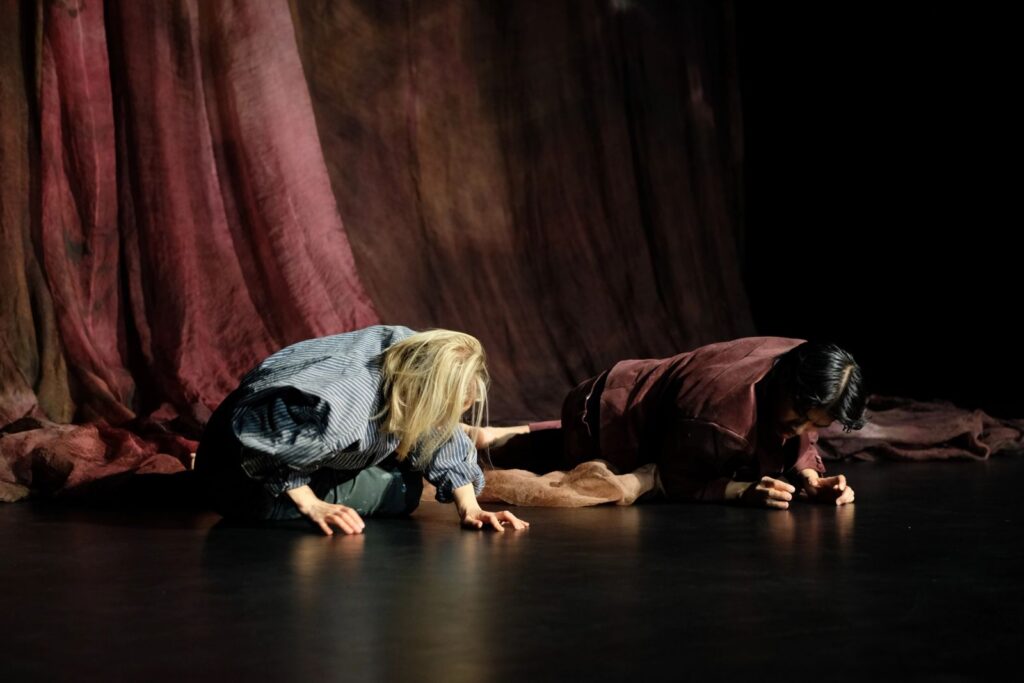
Morten Espeland makesMelancholia IIan almost unbearably strong experience. But when the form is repeated inMelancholia I, the performance loses some of its mystery.
"First Lars, now also Sivert. First Lars ... now also Sivert". With a soulful look, flowing movements and a vulnerable voice, actor Morten Espeland takes the audience through Jon Fosse's Melancholia II . A story about the painter Lars Hertervig, told through his sister Oline who, with dementia and sore feet, is going to visit her other brother Sivert on his deathbed. Hertervig has passed away before the action takes place, but old Oline constantly remembers him and gets lost in the memories she has of her brother. With Jon Fosse's repetitive language and an acrobatically impressive and at times karate-like choreography, the story of Oline becomes a strong depiction of the frailest and most helpless sides of humanity. Espeland's voice and Fosse's form go hand in hand. Had the performance been stripped down to a radio play or an audiobook, the interpretation of the work would still have been master class. Seeing the actress take on the role of the poor old lady who tries to go to the bathroom with countless failed attempts while you as an audience know that her brother is about to die, something she has long forgotten, is one of the strongest things I have ever seen on stage. Melancholia II premiered in 2020 while Melancholia I is from this year. The theater company Ymist is behind the two performances. In other words, the company has reversed the order of Fosse's two novels.
When Espeland is helped by two other actors after the break to retell the novel's volume one, Melancholia I , the form is somewhat revealed. The choreography no longer feels like inner impulses, but like a repetitive and contentless means of action. It is not destructive, but it becomes shallow. The performances of all three actors are solid, but I wished for more interaction between them. They each tell their own story: Ine Marie Wilmann plays Hertervig as a painting student in Düsseldorf; Huy Le Vo when he is admitted to Gaustad and Espeland plays the author Vidme who wants to write a novel about a Hertervig painting. The actors ignore each other completely throughout most of the performance, other than performing the repetitive choreography that quickly feels less like a response to the others, but like idle movements.
In Melancholia I, we also get to know Hertervig better, who the entire project is about. Here, like the story of Oline, we are served leaden depictions of the most painful aspects of a human being. About a man with an enormous talent that he cannot use due to great difficulties with most other things that surround him in life.
Both the soundscape and the visuals are impressive in both performances. The scenography has clearly taken inspiration from Hertervig's color palettes and the lighting changes in a subtle way while managing to change the entire expression. Although I would not like to see the production as a competition between the two acts, the point must probably go to Melancholia II here as well. The way the spotlights manage to bring out new nuances in the painting behind Espeland could stand as an installation at an art exhibition. The soundscape that alternates between atmospheric violins and electronic crackling creates a sense of mystery that is beautifully baked into the whole. After the break, scenographer Kjersti Alm Eriksen has taken over for Maja Nilsen, who is responsible for Melancholia II . The painting has been replaced with a transparent carpet that opens up for interaction between the performers and the visuals. Here too, the light brings out different expressions in the scenography. Again, the problem is that the expression from the first performance is recycled and the aesthetics go from being something visually unique to becoming a pattern of means that one quickly gets tired of.
At the same time, I in no way believe that Melancholia I is an unnecessary production that ruins the precursor. Not only was I looking forward to it, I had a need to see how Ymist would continue as I waited for the curtain to fall after the break. Perhaps because the first act from Jon Fosse's side is the precursor and that the plot therefore did not feel complete, but primarily because the theater company had given me a hunger for an expression so unique, painful and beautiful that I just had to have more. And even though I left Black Box Theater with a somewhat rumbling stomach, I had in no way ingested anything bad. Melancholia I is a devouring story about Lars Hertervig's life, but both the set design, the sound image and the general dynamics are more powerful in the second performance. Melancholia I is a good performance, but I still sit and long for Oline and Melancholia II's stripped-down atmosphere.
Melancholia II: Original text: Jon Fosse Performer: Morten Espeland Choreographer: Erlend Samnøen Dramatization, dramaturg: Oda Radoor Set designer, costume designer: Maja Nilsen Composer: Gaute Storsve Lighting designer: Ingeborg Staxrud Olerud
Publisher: Colombine Teaterforlag Co-producer: Tou Scene.
Melancholia I: Original text: Jon Fosse Performers: Huy Le Vo, Ine Marie Wilmann, Morten Espeland Choreographer: Erlend Samnøen Dramatization, dramaturg: Oda Radoor Scenography, costumes: Kjersti Alm Eriksen Composer: Nils Jakob Langvik Lighting designer: Ingeborg Staxrud Olerud Producer: Billie Barker Technician: Daria Zarbeeva
Publisher: Colombine Teaterforlag Co-producer: Black Box Theatre
Black Box Theatre, Main Stage 26 April 2026
Photo:Inge Schreuder-Lindløv and Kjersti Alm Eriksen
Other articles
I remember/tread carefully
Josefine R. Narverud saw the performance "Treework" before the summer. "Treework" was described as an opera for the trees and the people and was performed in Østmarka outside Oslo. The performance gave a lot of room for one's own interpretations and thoughts. This text is a response to this invitation, written partly immediately after seeing “Treework” and partly a few months later.
Katona József Theatre from Budapest has created an emotionally intense modernization of Ibsen's classic, which shows Hedda's feeling of emptiness and loss of control.
Cookies are used on scenekunstbruket .no for necessary functionality and traffic analysis. We process personal data in accordance with the laws and regulations in force at any time.
Functional
Always active
Data storage or access is necessary to be able to use a specific service explicitly requested by the subscriber or user, or only for electronic communication.
Preferences
Data storage or access is necessary to store preferences that are not requested by the subscriber or user.
Statistics
Data storage or access is used solely for statistical purposes.Data storage or access is used solely for anonymous statistical purposes. Without a subpoena, voluntary consent from your internet service provider or a third party, information stored or retrieved for this purpose alone cannot usually be used to identify you.
Marketing
Data storage or access is necessary to create user profiles to send advertising or to track the user on a website (or across multiple websites) for similar marketing purposes.