
So stupid it's fun
The guys at Det Norske Teatret are so stupid that it's funny, writes Fiona Åtland (20) in this illustrated review.
"The best you know" is a warm theater performance about belonging to a family, whether you want to or not. The play aims broadly, but it's the music that ends up hitting the mark.
The premiere is set at the Brageteateret premises in Drammen. Playwright and director Toril Solvang-Kayiambaki's newly written stage text will be shown on stage for the first time, for an audience that excitedly finds its seats in the intimate hall. The most excited are perhaps the members of the popular band Hellbillies, who are behind the songs that have inspired tonight's performance. Their music seems to be wearing its new costume as musical theater, for the audience claps enthusiastically to the beat of the first song. It is just as captivating for me, who does not know the band before, as it is for loyal fans in the hall.
"Den finast' e veit" takes place in a small community center in a village in Buskerud. The set design is both believable and recognizable, with yellow wooden walls and a green linoleum floor. A band takes place on stage, under a large moose head. It is Stine's band, which is to be confirmed in the venue. Her mother and father quickly start preparing for the party, but Stine would rather sing than be confirmed. She certainly doesn't want to wear her grandmother's bunad.
There are five actors on stage, in addition to the three musicians who make up the band. They are the father (Mads Skar-Jørgensen), the mother (Silje Breivik), Stine (Catharina Vu) and her best friend (Jakob Stabell), and the father's little brother, Ulf-Magnus (Iver Innset). They have all made choices that hurt the others, and are struggling to find balance in the family dynamic. Ulf-Magnus is home in the village for the first time in 14 years, and is brushing off the dust of old secrets.
The play follows the five characters through a celebration that doesn't quite go as they had imagined, until the inevitable cleanup afterward. The family is left with far more than napkins to clean up, because they've all messed up their lives.
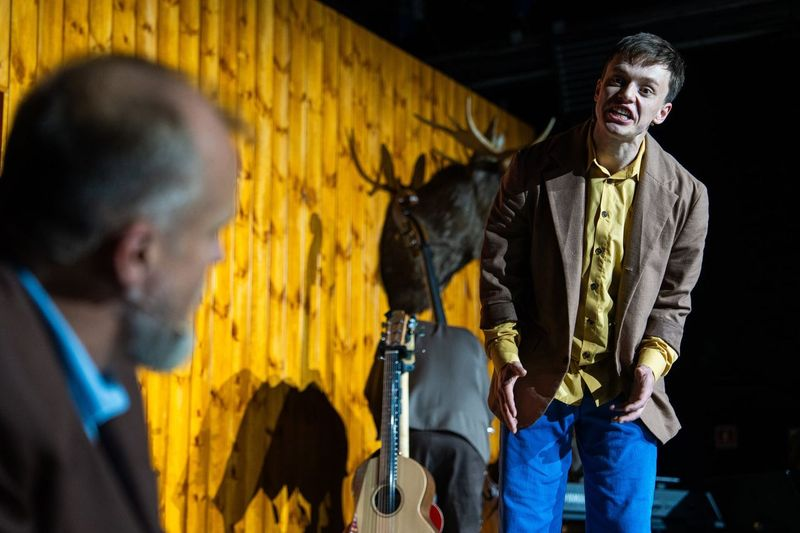
"Den finast' e veit" is Brageteateret's anniversary performance, to celebrate 25 years as Buskerud's regional theatre. The play's title is taken from a famous love song by Hellbillies, and the plot stems from lyrics from the band's extensive repertoire. It is no coincidence that it is precisely Hellbillies' songs that have been the inspiration for the performance. Hellbillies is a rock band from Hallingdal, in the north of Buskerud. The band has become known and loved throughout the county, after 30 years of music, records and concerts. "Den finast' eg veit" will represent all of Buskerud when it soon sets off on tour. It is therefore fitting that it is the entire county's favorite band that brings the performance to life.
The anniversary performance makes a valiant attempt to accommodate an entire family's personal experiences, challenges and contradictions, but gets lost in far too big ambitions. The play does not have enough space or time to follow each individual family member. Playwright and director Solvang-Kayiambakis therefore resorts to a kind of emergency solution to make room for as much as possible, namely clichés and stereotypes: an angry teenager, an unfaithful mother, a father who wants to be the main character, and rural boys who want to travel far away from home. These are stories that have been told before, and they do not gain any new depth in Brageteateret's production. The performance loses the honest and vulnerable sides of Hellbillie's song lyrics, in favor of seemingly unfounded and undetailed short stories about mother, father and daughter. I simply perceive the stage text as simple and superficial.
The musicians in Stine's band play Hellbillies music that elevates the performance and gives the characters new credibility. The song material is not only used as a basis for the stage text, the music is also a central tool in the production. This is a wise choice, because the atmospheric songs give a lot of meat to the bone to the somewhat meager interpretation that the stage text offers.
The performance's line-heavy script features songs throughout the evening, as the actors take on Hellbillie's melodies and verses. The song numbers serve as long-awaited breaks in a performance that rushes to get everything done. The music is a chance to tell each story on a deeper level, and allows the characters to step out of the clichéd storyline for a while. The actors are good singers, and the songs give them the opportunity to show the emotions surrounding the challenges the characters face. This gives the performance a dynamic feel, and allows for more abstract breaks from the confirmation celebration.
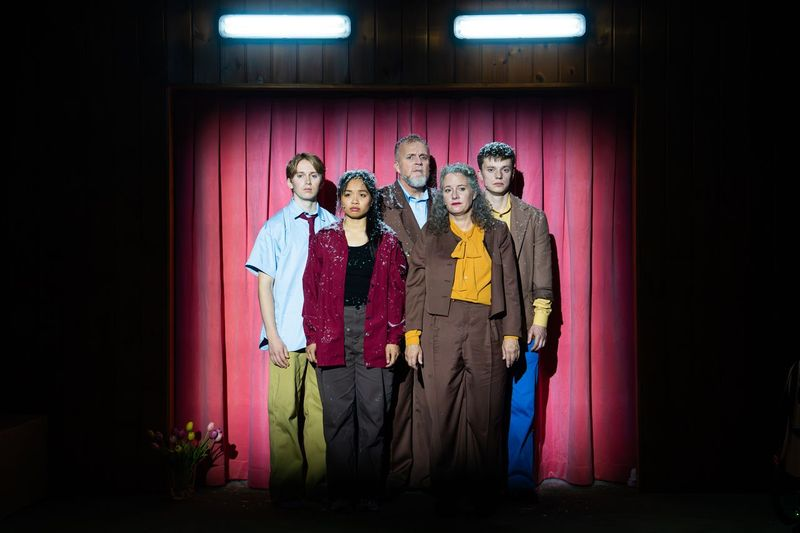
The director waits until the very end to put the crowning touch on the piece, with the closing song "Den finast' e veit". As Hellbillies' most famous song, and the title of the play, the audience probably has high expectations for this particular number. Towards the end of the performance, the mother, father, Stine, Ulf Magnus and their best friend realize that they need each other, and sing the love song together.
The ending is a harmonious and sensitive celebration of togetherness, directed at the audience. In the number, the story's many loose threads are unraveled, and the little family has finally found each other again. This happens when the actors stand together on stage, all of them, side by side, for the first time. The moment is not showered with text, like the rest of the play, but quiet. Finally, the performance feels heartfelt and real, with music in the background that helps the actors convey the atmosphere without words. During the break from the text, a long-awaited calm descends over the hall, creating a natural conclusion. The family has given each other a second chance, the noise is over. The confirmation is over.
Ultimately, I am left with a good feeling when I leave the theater, and send a thought to my own family who are waiting at home. Brageteatret's "Den finast' e veit" tries to accommodate more than it can handle, and loses depth due to the clichés that characterize the story. The songs of Hellbillies are the show's salvation. The music gives the story a new dimension, where the actors can express the depth that is missing in the stage text, and finally hit the audience right in the heart in the closing number.
October 15, 2025
Actors: Silje Breivik, Iver Innset, Mads Skar-Jørgensen, Jakob Stabell, Catharina Vu
Musicians: Trove Kragset, Peder Varkøy, Sindre Tronrud, Johanne Flottorp, Alse Bråthen
Playwright and director: Toril Solvang-Kayambakis
Music: Hellbillies
Scenography and costume: Daniel Åkerström Steen
Musically responsible: Simon Revholt
Lighting design: Markus Tarasenko Fadum
Choreographer: Kristin Ryd Helgebostad
Props: Marthe Brandt
Dramaturg: Ingrid Wene Nilsen
Language consultant: Kjersti Dalseide
Dialect consultant: Eldbjørg Lognvik
Producer: Brageteateret, Teater Ibsen
Union Scene, October 9, 2025
All photos: Ørjan Aslaksen