
So stupid it's fun
The guys at Det Norske Teatret are so stupid that it's funny, writes Fiona Åtland (20) in this illustrated review.
The performance HEKS shows the prejudices that all women faced during the Reformation, regardless of who they were.
The society before the Reformation in the 15th-17th centuries was characterized by strong gender roles, where a woman was only supposed to be subordinate to a man. In 1617, King Christian IV introduced the Witchcraft Act, which criminalized magic and sorcery. The law divided witchcraft into two categories: black and white magic. If the magic was considered black, it meant that the person had been in contact with the devil and was punishable by death. In contrast, white magic was about healing, which was only punishable by exile. Although the Witchcraft Act was universal, there was a clear preponderance of women being punished more as a result of this law. HEKS tells the story of Christence Krukow (Ragnhild Arnestad Mønness), Maren Kneppis (Malene Wadel), Dorte Kjærulf (Malin Landa), Apelone Ibsdatter (Matias Kuoppala) and Elisabeth Klyne (Marianne Holter) – five women who experienced the Reformation and King Christian IV's harsh power as a reality.
The action began with the five women slowly walking along the edge of the stage. Here the audience was introduced to Christence Krukow, a noblewoman who had made a baby out of beeswax for a woman who had 15 unborn children. This, in addition to other things Krukow did that were seen as witchcraft, resulted in her having to leave her hometown to avoid being imprisoned by the king's men. On this journey she meets Maren Kneppis, and Maren takes her to a gathering of other women who were also accused of witchcraft. The woman who stood out from the others was Elisabeth Klyne, she was the only one in the gathering who was obedient to her husband, and tried to stay out of trouble. This is evident from the way she explains her relationship with her husband, and how she convicted the other women of practicing magic. The king's sheriff (Matias Kuoppala) finds out that these women are in the same place, and goes out to arrest them. This is due to a lack of trust in women who are only among themselves, and is evident in the line of King Christian IV (played by Malin Landa): “When many women gather, it is to create devilry!” The women are found and meet the same fate – to be “condemned to the stake and burning.” All except Klyne, who escaped conviction when she admitted that the women she was with practiced witchcraft, and that she claimed to be a victim of their magic.
Something I particularly noticed during the performance was the costume selection of set and costume designer Katja Ebbel. Despite the fact that the action takes place in the 17th century, the main costumes for the roles consist of a mixture of period and modern clothing. Apelone Ibsdatter, for example, is wearing a corset and a longer skirt, and at the same time has a rocket shirt underneath, in addition to mint green sneakers. The mixture of eras in the costumes made me wonder one thing: could HEKS be relevant today?
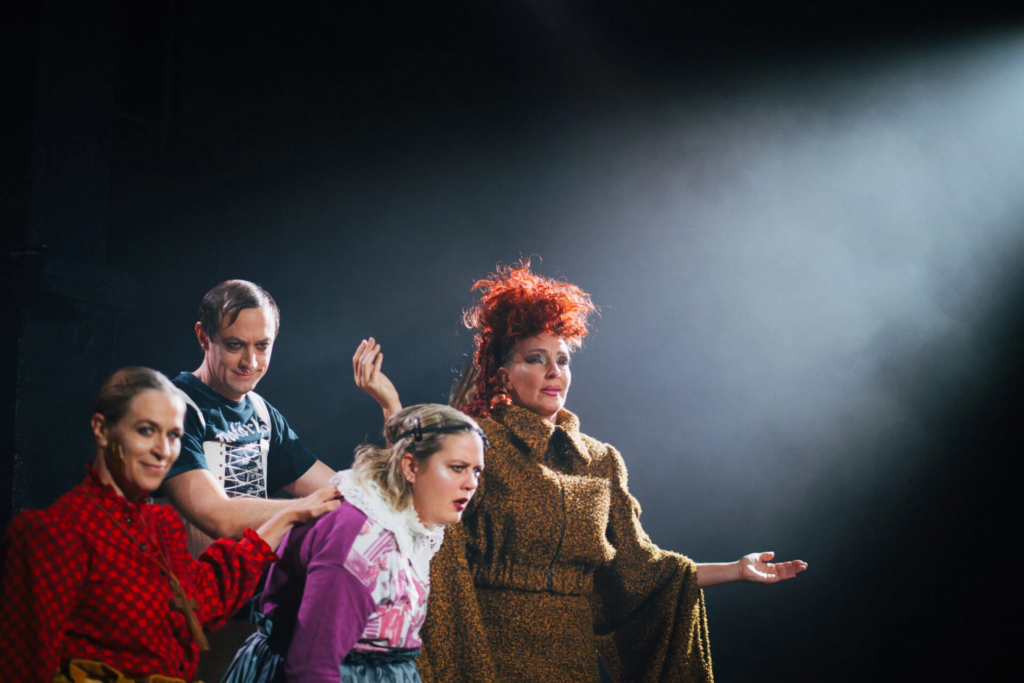
Society's relationship with women has undergone major development since the witch hunts during the Reformation.
Women have been given greater freedom to live independently of a man, whether it's voting rights or making medical decisions on their own. Yet there is a common denominator, as negative prejudices directed at women are something that have never disappeared over time, despite a 400-year gap.
In recent times, conservative values have been on the rise, as seen in the “trad wife” trend on social media. The idealization of being a stay-at-home wife often carries with it the same negative prejudices that “housewives” in the past had to experience.
The trend that has been going on on social media reminds me of Elisabeth Klyne’s story. Throughout the play, Elisabeth says several times that her husband has been abusive to her, but that she can’t do anything about it. This is because she is a stay-at-home wife who doesn’t have the opportunity to live a normal life for fear of being accused of being a witch. Women during the Reformation were told that their purpose in life was to live a traditional life so as not to suffer the same fate as those who dared to deviate from the norm – namely death.
Although the view of women has improved over time, I still believe that it is not optimal. Trends like “trad wives” not only neglect the traumas of Elisabeth Klyne, but also allow attitudes similar to what women in the Reformation faced.
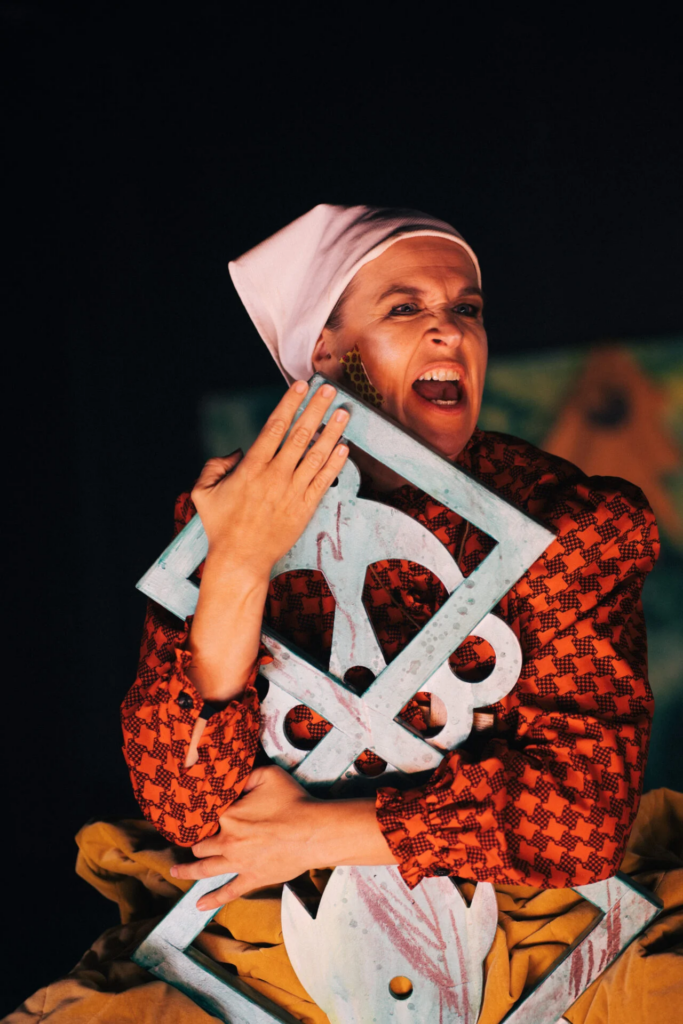
I had previously learned about the witch hunts in history classes at school, but it was a completely different experience to see the history through HEKS . The performance was particularly good at bringing out the experiences of these women, and not least showing how society has treated them, and even whether one can draw a thread to society today.
With trends that still allow negative prejudices against women, it shows that some elements have not changed much over time.
September 15, 2026
Director: Maria Drangeid
Cast: Ragnhild Arnestad Mønness, Malene Wadel, Malin Landa, Marianna Holter, Matias Kuoppala
Set designer and costume design: Katja Ebbel
Composer and sound design: Fredrik Almstedt Storsveen
Lighting design: Mathias Langholm Lundgren
Singing teacher: Nils Erik Steinsbo
Masker: Jill Tonje Holter
Dramaturg: Carl Jørn Johansen
All photos: Stig Håvard Dirdal
Rogaland Theatre, Intimscenen, 27.08.26