
I wanted to dance along!
This concert is music, dance and theater all in one. Many of the dances are still in my body.
Stepping into choreographer Hooman Sharifi's living room is like opening a secret door in the middle of Oslo. With To be means to resist what you are not (home version), Sharifi opened his home to 14 guests, and I was one of them. He welcomed us at the front door, and helped us with jackets and shoes. As we walked further into the apartment, we suddenly found ourselves in a room that was both homely and open like a small stage. We were told early on what the evening would entail. First, we would enjoy a meal while Sharifi told us some stories. Arash Moradi would then play traditional Iranian music on the tamboor. After the music, there was a dance performance by Hooman Sharifi, and then the whole evening would end with tea and dates being served. The entire living room and kitchen had been cleared for the occasion, and only a few chairs stood along the walls. Carpets were laid on the floor for us to sit on when we were going to eat, and it was clear that this was not an ordinary dance experience – but more of an intimate journey that surprised.
Hooman Sharifi, with roots in Iran, took us into the evening with warmth, stories and food that led into his project, To be means to resist what you are not . This is a so-called "home version" of a performance that originally premiered at the Black Box Theater in Oslo in 2023. Before the choreography was shown, Sharifi offered the audience a homemade dish. While we ate, Sharifi talked about how we humans have the ability to change our memories, and about sadness and melancholy. After the meal, the Iranian musician Arash Moradi played music on his tamboor. The tamboor was an unfamiliar instrument to me, and looked and sounded like a guitar in terms of the strings, but was much narrower, and it did not have a hole like a guitar has. The music that was played was about two people who loved each other until and in death, a story about love and togetherness. Not everything Sharifi told us was connected, and the confusion grew stronger when he told us about the story behind the music Moradi was going to play. I must honestly say that I lost focus here, and instead I started reminiscing back to my own trip to Egypt in 2018. During this, my family and I had dinner with a tour guide, along with many other strangers, where many tales and stories were told while the guide played the drums. When Moradi started playing the tambourine, I felt like I was suddenly with this Egyptian tour guide again. The whole evening almost felt like being invited into Sharifi's private life, and that also included an invitation into his culture.
When the dance performance began, the room was completely cleared; rugs and cushions were gone, and the floor was empty to make room for the movement of Sharifi and Moradi's music. Sharifi's background in hip-hop, classical and modern ballet, his education as a choreographer from the Oslo National Academy of the Arts, gives him a unique expression on stage. Together with Moradi, he created a meeting point for empathetic memories and personal history. Although this was an intimate setting, his artistic vision became clear! Magically, they manage to connect the past, folk culture and their own history in a way that feels both personal and universal.
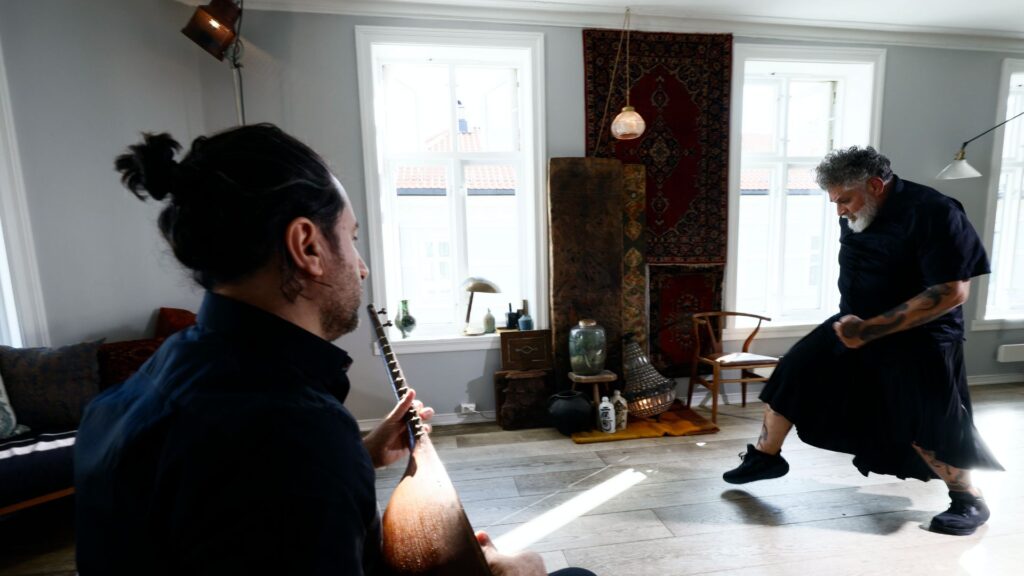
Hooman Sharifi's dance expression is physically challenging, intense and precise. The choreography had great moments, and it was clear that each movement was well thought out. He made deep movements along the floor wearing a black skirt that swayed with every step he took. He started with small movements in front of a window, and expressed himself in larger and wider movements in time with the music. Still, it must be said that the performance was not as convincing as the food, music and intimate atmosphere that had built up. Some transitions felt slow, and the energy in the room decreased a little along the way. I think this happened because the dance felt out of place in relation to the food, music and stories that were being told. The dance performance was suddenly not in the same atmosphere that was created by the other elements this evening – there was a certain established consensus that the dance expression disagreed with. Although traditional Iranian music was played for the performance, the dance became too modern, which made the performance a little uneven in my opinion. The performance had power and aesthetics, but lacked the immediate magic and warmth that had made the food dish and storytelling so memorable.
After the dance performance, tea and dates were served, and the evening landed very softly. From the intimate meal, through stories and music, to the dancing and the closing, the entire experience felt like a beautifully crafted journey through taste and emotion. There were no distractions, no superfluous decor – just Sharifi, his living room, and us taking part in a unique experience.
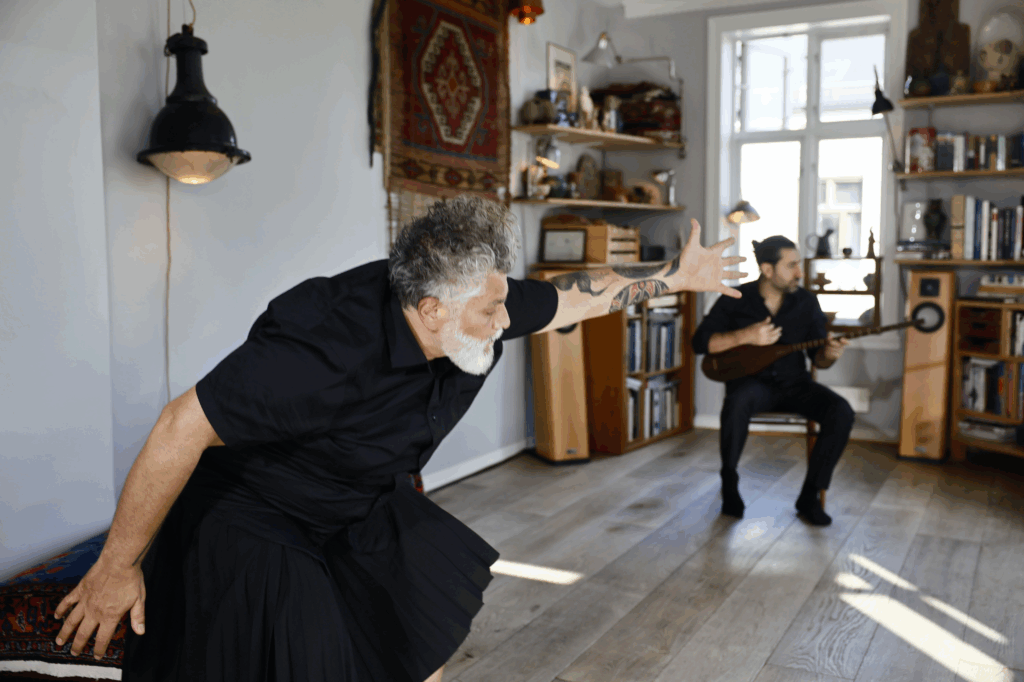
For me, the food, music and warm atmosphere were definitely the highlight of the evening, while the dance performance felt a bit like a powerful but slightly uneven addition. The food we were served before the performance was carefully composed and tasted of care, time and precision. The musical performance that followed our meal was exciting but effective, providing an elegant transition to the upcoming performance. The atmosphere Hooman created, this combination of warmth, stories and music, made you feel both seen and invited into a kind of personal core, something that is rarely experienced in traditional stage rooms or restaurants.
September 3, 2025
Choreography and dance: Hooman Sharifi/impure company
Music: Arash Moradi
Producer: Rikke Baewert
Production assistant and sparring partner: Loan Ha
Production Assistant: Samira Shaterian
Sound engineer: Terje Wessel Øverland
Photo: Arash A Nejad/New Photos
A production by Impure Company.
Impure company is supported by the Norwegian Arts Council