
So stupid it's fun
The guys at Det Norske Teatret are so stupid that it's funny, writes Fiona Åtland (20) in this illustrated review.
15 years is a very engaging piece about an ever-current topic; youth participation in society.
When I first entered the Rommen stage, it was a completely empty room with four young actors. There were no chairs to sit on, or any kind of props. The four actors asked us to gather in a cluster in the middle of the floor, and they stood with us in this cluster. They started by introducing themselves in their character(s) and how they had worked with 15 years . They said that they had based the play on interviews with people who were part of AUF, and who were all 15 years old when Utøya happened.
The actors didn't stick to just one person or character, but played different roles and spoke from different perspectives. They walked around shouting from all sides, some of them walking around the room, while others walked among the audience. We never knew who was going to say what, and this resulted in us walking around in circles as we stood trying to figure out who was saying something, and where the voice was coming from this time, a bit like being inside a thought bubble.
The play began with what the various young people's "political awakening" was, and built up to them becoming more and more politically active in different ways. An example was at school via the student council. There was a student who had become deputy leader of the school's student council, and was later invited to discuss in the Storting with 600 other young people. Another talked about how they thought it should be allowed to use snus in upper secondary school, even though they themselves were not interested in snus. In the end, these young people ended up joining the Labour Party's youth wing (AUF), and later joined a summer camp on Utøya.
They talked about the pleasant days at the summer camp before July 22. They told about the different activities they did and the community they felt. On Utøya, the young people were doing volunteer work, and soon we in the audience were also going to participate in the volunteer work. They asked us for help to set up blankets and chairs around the room, took out a kind of painting of a sunset and turned down the brightness. It was now evening. In front of me was a fan with orange fabric attached, this was supposed to imitate a campfire, and we were given logs of wood to put around. This scene was probably my favorite part of the play. I got a kind of feeling of nostalgia, even though I had never been there before.
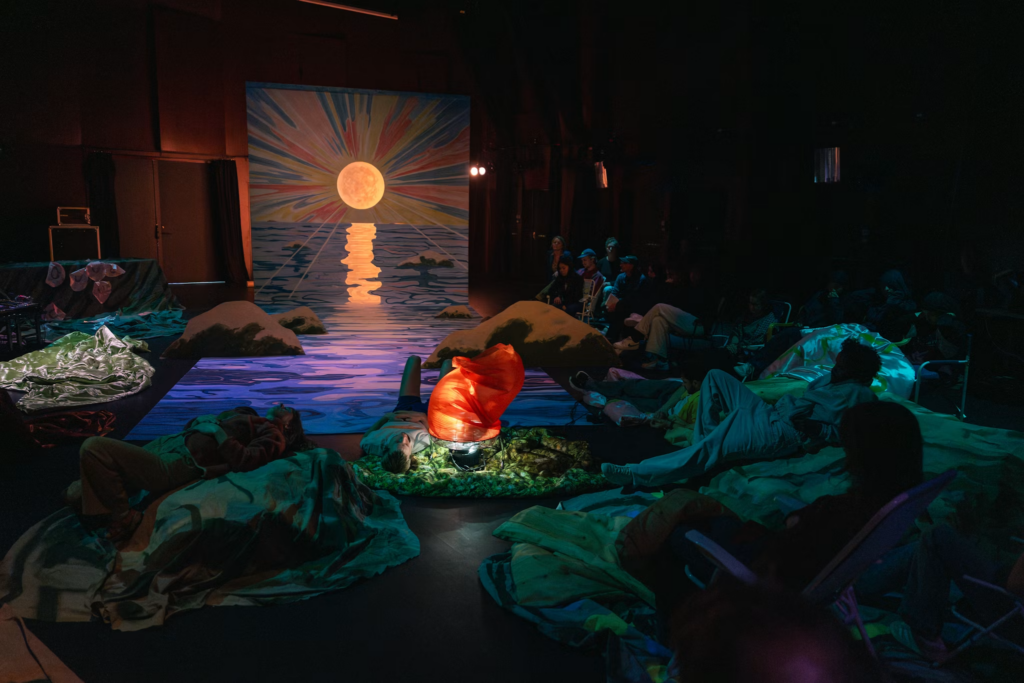
In addition, the sound effects were absolutely phenomenal. I liked the music from the start, but in the middle I noticed that on the left side of the room there was a musician (Natali Abrahamsen Garner) who sang and played live music and created incredible atmospheres with various percussion instruments and her guitar. She played almost dreamlike music, and her voice was absolutely heavenly. I think it was a bit of an alternative type of music, and sometimes I feel like it can be a bit small, or that it doesn't fit in very well, but I think it was perfect for this piece.
What really impressed me about the performance was the storytelling. The way these actors were able to capture the emotions and mood swings from a teenage perspective was so good, and made it easy for me as a sixteen-year-old to imagine what it was like to experience what they were telling us. The emotions the actors played out were so raw and real, and the mood swings were sudden, but still natural. I felt like their behavior rubbed off on me. When they were happy, I got happy, and when they were sad, I got sad. When they were passionate about a cause, I noticed that my subconscious was looking for a cause that I was passionate about. I think the same could be said for many others in the audience. Especially in the transition from the evening to the cozy campfire, to the very day before the attack. We all knew what was going to happen, but it still hit hard.
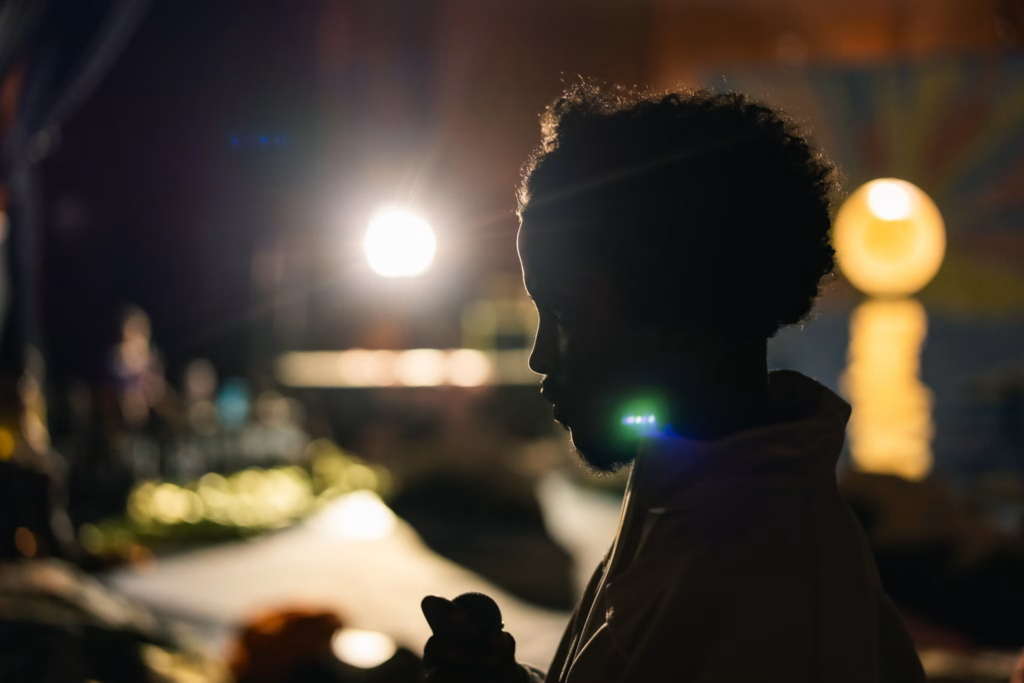
The mood went from happy but tired teenagers to panicked empty children. All the lights were off, except for a bright light facing me on the wall. The actors and musician were sitting in five different places in the room, and from where I was, I could only see dark silhouettes. Later, the light in front of me changed to one behind me, revealing their faces. They looked into the air with a distant gaze as they recounted the terrible events they had witnessed. Looking around the room, I could see how the others in the audience were also looking into the air, but with a sadder and more empathetic gaze.
What I didn't expect was that the audience would be such a big part of this experience. Everyone who was there helped to build the atmosphere in the room by putting up the scenery and “participating in the effort”. The actors made this part natural in an unnatural setting, it's a very good job. This is one of the most engaging plays I've seen. From start to finish there's not a dull moment and it made me want to follow along and be a part of the play.
Something I felt really hit home was the end when they told about the different reactions they had after the attack. Some cried when they heard their parents' voices, while others didn't feel anything. Some couldn't wait to see their family, while others wished their parents hadn't brought their siblings to pick them up. All the reactions were different, and none of them were right or wrong. The way everything was said, played out, and the different reactions, felt like they were coming from teenagers.
Finally, five young people sat in a circle in the middle of the audience and had a conversation about their political interests. These were representatives from youth organizations on the right and left of the political landscape. It seems that the director (Tatu Hämäläinen) aimed to arouse interest in what is happening in the world among young people. I think that many young people today can be very concerned with themselves and the little things that happen around them. This play can provide an awakening for many.
June 16, 2026
Actors: Mohammed Aden Ali, Serhat Yildirim, Thea Lambrechts Vaulen and Vetle Bergan
By : Kathrine Nedrejord
Director : Tatu Hämäläinen
Dramaturg : Ingrid Weme Nilsen
Set and costume designer : Tove Dreimen
Sound designer : Martin Myrvold
Composer : Natali Abrahamsen Garner and Magnus Skavhaug Nergaard
Choreographer : Siri Jøntvedt
Concept : Tatu Hämäläinen, Kathrine Nedrejord and Ingrid Weme Nilsen
Extras : Eira Ystrøm, Apollo Xavier Adriana Villanueva Storsve, Viola Tetlie Stangenes, Live Dransfeld Mortensen and Kasra N. Mahani
Substitute extra: Vida Kærnæ-Wilhelmsen
Director: Linn-Agnete Olsen
Costume coordinator: Silje Hostvedt Isaksen
Props: Juliana Solvang Danielsen
Stage manager: Mari Lysgaard
Technical producer: Anders Audum
The Norwegian Theatre, Rommen stage June 12, 2026
15 years old won the Young Voices Festival Prize during the Heddadagene 2026. Zunairah Kausar was not part of the jury.