I had high expectations for ghost theater in Østre Aker Church. Unfortunately, Croquemort was a static and slow performance, which did not live up to the church and the autumn evening.
I always get excited when a performance moves me out of the comforts of theaters and into unknown territory. This time it was up to Østre Aker Church to participate in Croquemort by DeWangen Produksjoner. DeWangen established itself 25 years ago and is known for immersive site-specific performances. Cold night, dark church; it was the perfect setting for an atmospheric performance among the ghosts in the cemetery. Unfortunately, Croquemort does not live up to the quality the surroundings suggest.
Failed extras
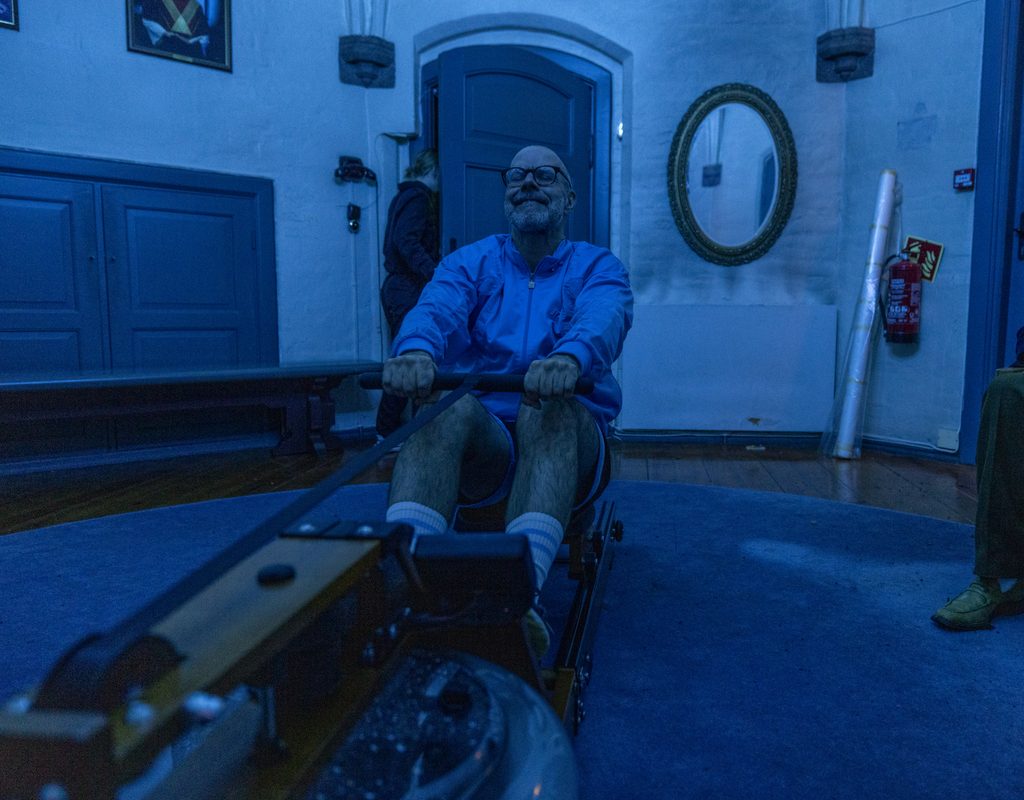
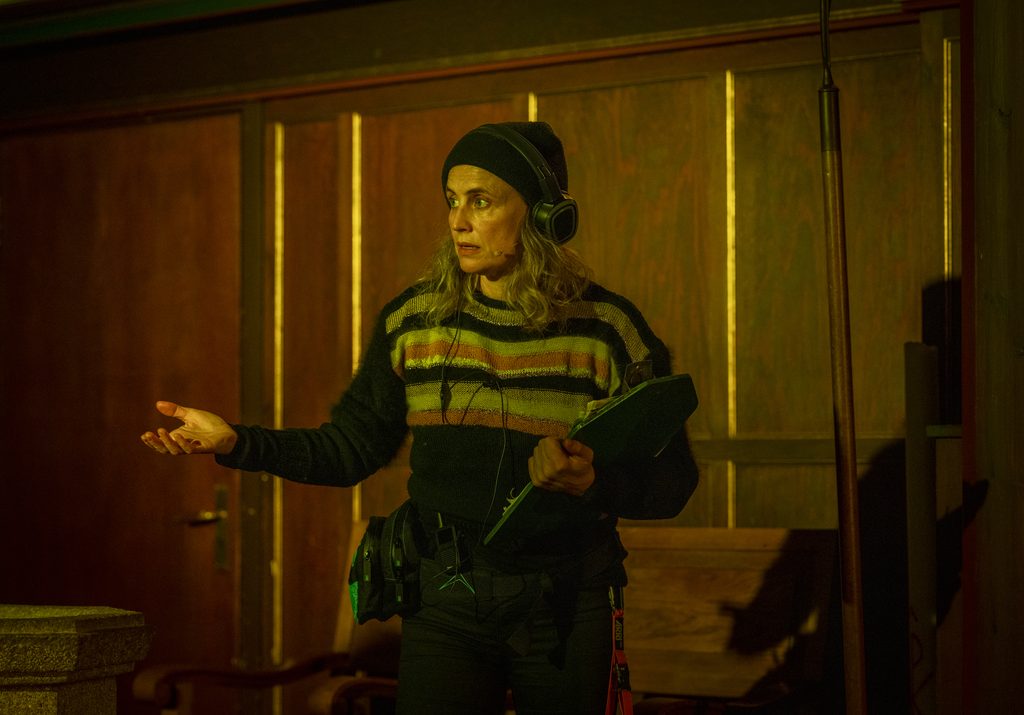
The audience in Croquemort are also extras for a film shoot that takes place in the church. At the start, we were divided into three extra groups, each signaled by a different color on the headset. I myself was in the red group. The extras approach is something I had not seen before, and with my own experience as an extra, I could easily imagine the possibilities this could give the performance. Unfortunately, the approach became a rather cumbersome tool for moving the audience between the different scenes inside and outside the church building.
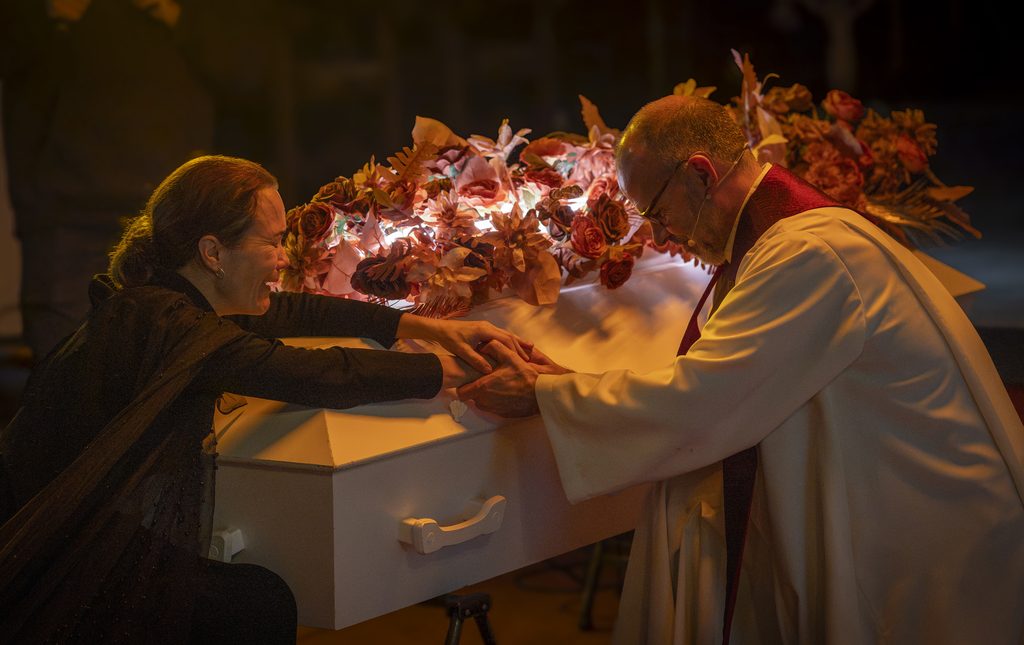
The first sign of this was in a meeting with the church's priest, who also starred in the fictional film. He immediately began to share his doubts about renting out the church, and how unsure he is about whether there is any need for the church anymore. He said this directly to the film's extras. The extra role of us in the audience was very loose; some characters used us as psychologists, others treated the audience as extras. I did not experience that the performance was either behind it or working within the framework it set for itself, and that made it much more difficult to get into the extra role.
Ironically, I didn't find the script for Croquemort to be participatory enough. A good script allows the audience to make up their own minds and come to their own conclusions, but in Croquemort all the character details and plot were fed to me with a silver spoon. I already didn't get into the story, because of how weak the audience role was, and always having to hear so directly what the characters felt, thought and wanted didn't help the engagement much. The play explores a fear that you are no longer needed. This fear is shared by the ghost, the priest and the film director. The reason I know this is the theme is because all three characters conveyed it directly to the audience. It's as if the play avoids the little depth that could have been. They choose instead to dig the subtext up to the surface.
Difficult to keep up with
Despite everything being conveyed directly, the plot was still extremely demanding to follow. The connection was thin, and I never quite understood what the scenes contributed to the whole. At one point we were taken down to a crypt, where the main actor had a monologue. The monologue is then interrupted by an undertaker. The actress asks him to drive her to the airport, he replies that he can do it if she finishes her scene, she is too good to give up now. The impression was that this is meant to be an emotional moment, but it fell extremely flat for me. This man is not a character I have had any relationship with before or since, because in my group he is only in this scene. Therefore, I experienced the uplifting "pep talk" as false and forced.
This wasn't the only example in the play of moments without context, or details that lead nowhere. Often I heard characters talking through the headset, whom I hadn't met or cared about. At one point we learn that the body in the coffin lying by the altar is someone other than what the priest thinks. This is not elaborated on any further. It felt like I was missing large parts of the story at all times, and I would guess that is a result of the audience being divided into three groups. I got the impression that all three groups experienced different parts of the play, and such divisions can work well. In Croquemort's case, it added very little to the experience. It hindered my engagement, and I think the performance would have been stronger if we had been together the whole time.
The choir that never came
Weak content is not necessarily a death sentence for a theatrical performance. Theater is a visual medium, and the scenic elements can always lift weak material. Unfortunately, Croquemort also disappoints on this front. Most of the scenes consisted of listening to a character narrate, whether over a headset or physically. There was rarely any special movement or play between the characters. The interactive parts that we were asked to do also had very little purpose. At one point, my group was told that we would sing in chorus later during the recording, but it never came up again. So why include it?
Østre Aker Church is a fantastic location, especially for a show marketed as a meeting between the dead and the living. Although the church was magnificent and added to the atmosphere, I thought it was poorly utilized. The climax naturally takes place in the church room. It is the most important moment during the filming of the film, but unfortunately this also falls flat. Because I had so little involvement in the characters' conflict, the only thing I saw was a poorly directed film scene that was trodden through again and again. I would say that the use of lighting was generally very strong throughout the show, especially down in the crypt where only candles were used. However, it often happens that there is a change in lighting, without any change on stage. There was no scenic connection.
By the end of Croquemort, I was extremely unsatisfied. The performance is a soup of choices that actively work against each other. It seems uninterested in the audience understanding what is happening. Yet it expects us to participate fully. I was disappointed, because I thought the performance had an extremely strong starting point, but almost all of its potential must have evaporated in the dark autumn evening.
With: Line Heie Hallem Espen Løvås Lilou de Wangen Oddrun Valestrand Faheel Saud Neki Pesi Reany Mecca Mankirat Singh Maya Pretzmann Bhanu Waidyanatha
Artistic director Claire de Wangen and Morten Bendiksen Lighting and sound design: Morten Bendiksen Screenplay and direction: Claire de Wangen Sound design and technique: Hjalmar Littauer Production assistant: Alva de Wangen
Played at Østre Aker Church in Oslo.
Set: November 3, 2026
Other articles
Podcast: Does it work as a parody of fascism?
Is The Boys at the Norwegian Theatre a good portrayal of fascism, or are they just kidding? Hear Young Voices Lasse, Fiona, Aksel and Heidi talk about just that and much more in this rather chatty podcast! 😅
Særp Tropez's interactive theater style, creativity and acting performances continue to blow me away, writes Hanna Amundsen (16) about the performance in the neighboring town.
Cookies are used on scenekunstbruket .no for necessary functionality and traffic analysis. We process personal data in accordance with the laws and regulations in force at any time.
Functional
Always active
Data storage or access is necessary to be able to use a specific service explicitly requested by the subscriber or user, or only for electronic communication.
Preferences
Data storage or access is necessary to store preferences that are not requested by the subscriber or user.
Statistics
Data storage or access is used solely for statistical purposes.Data storage or access is used solely for anonymous statistical purposes. Without a subpoena, voluntary consent from your internet service provider or a third party, information stored or retrieved for this purpose alone cannot usually be used to identify you.
Marketing
Data storage or access is necessary to create user profiles to send advertising or to track the user on a website (or across multiple websites) for similar marketing purposes.