Before I Wake shows the invisible struggles of youth through dreams.
Before I Wake is a puppet theater performance about a girl named Ayla (Maria Lingfors). She is in ninth grade with her best friend Miriam, and has a boyfriend (Sindre Strand Offerdal) who is in tenth grade. At home, she has a slightly awkward, but still loving father (Janne Starup Bønes).
The play begins with Ayla climbing a wall, and behind her is a monster following her. The monster attacks Ayla, and she jumps away just in time. From the jump, it looks like she is falling through the air in slow motion before finally hitting an ocean and suddenly waking up from her dream. This monster continues to torment her the following nights and makes it difficult for Ayla to sleep, but she cannot stay awake forever and so the hectic nights and tiring days continue.
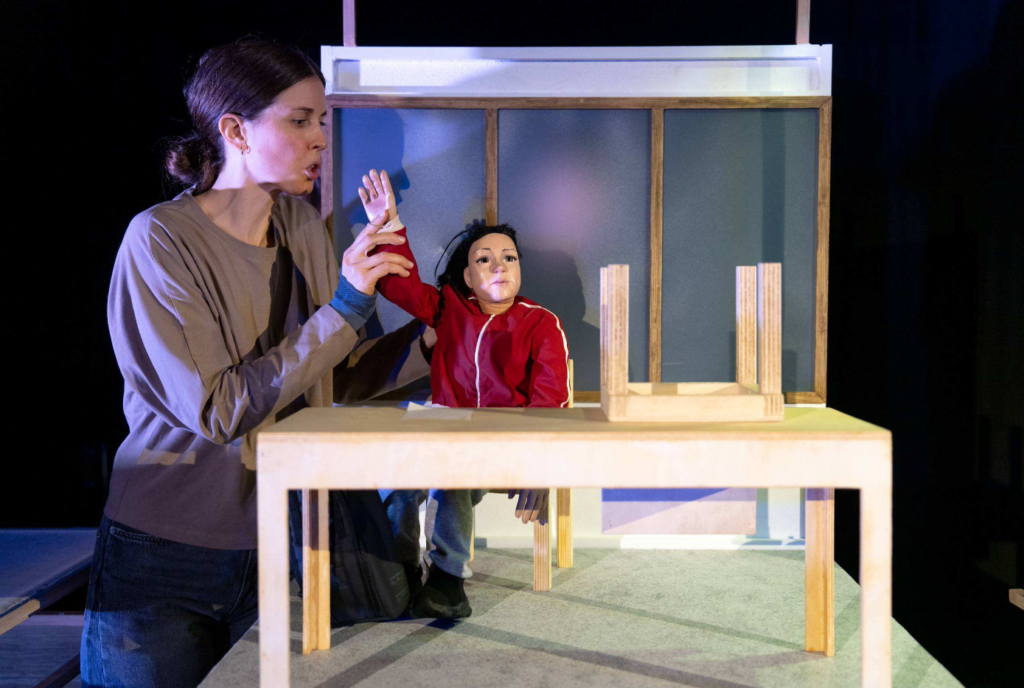
The performance was performed at Lillestrøm Cultural Center. All the props and actors were on stage the whole time. The props were mainly some boxes on wheels, which made it easy and often very seamless to change where we were in the story. Apart from these boxes, there was not much else on the stage. The boxes had different “places” on the surface. They were pushed back and forth depending on which scene it was. One box had a bed with a night lamp on it that was to be Ayla’s room, another had two chairs, a desk and a wall that was to be Ayla and Miriam’s classroom at school, a third had a small lawn with a lamppost, and many other boxes with many other “places”. The boxes with the current scene on top were pushed forward in the room, while the others were further back.
When Ayla was in a dream, she and other people in the dream could jump from one box to another. I think this was a pretty good way to recreate how in dreams you think you just have to get somewhere, and the next second you're there. What made the transitions from place to place so seamless was the way Ayla would jump from one box to another while she was having a dialogue with another character. Then the actors would push the first box away and replace it with the next one. It was a really simple way to do it, but a lot of the time I didn't even notice that the other people on stage had replaced the box until Ayla jumped back on it and we were in a new place.
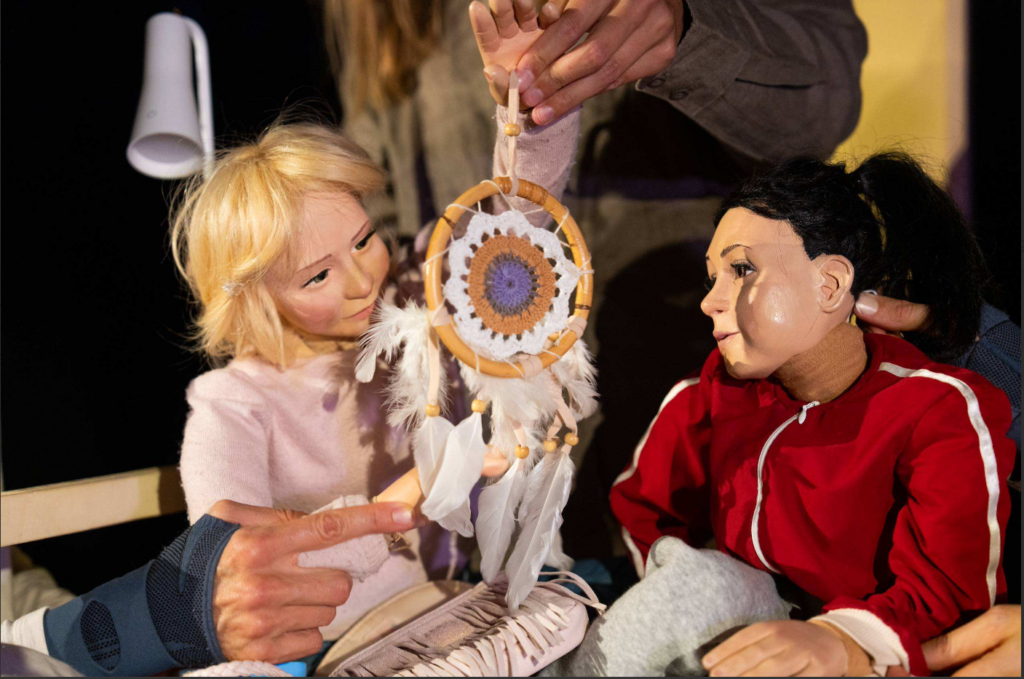
When I first walked into the theater, I was quite excited because this was my first time seeing puppet theater and I was looking forward to seeing how it would turn out. What was perhaps most surprising was how easy it was to get into the play. I wasn't sure beforehand whether I would be able to ignore the fact that there were puppets controlled by people on stage, instead of just regular people, but I was pleasantly surprised. Not long after the play had started, I had almost forgotten the fact that there were puppets. What I think contributed most to this was how they moved. I didn't expect the people controlling the puppets to be able to make them move in such a human way. It felt like watching a smooth stop-motion film where every movement had been calculated.
Another thing that made it easy to get into the story, and especially get into the characters, was the voice acting. At first it was a bit strange to hear the words being spoken by the actors who were leading the puppets, while the puppets' faces remained the same, but eventually I didn't think anything of it. Again, it comes down to human movements. The body language of people often says more than words do, and throughout the play the puppets moved with as much emotion as the actors' voices.
As a teenager myself, I thought it was really cool to see how Before I Wake captured the perspective and problems of youth, and how it was resolved. We in the audience could see what Ayla was going through in her dreams and could therefore more easily understand her actions and see that her anger was really coming from a place of fear, but others couldn't see or understand it as well. Ayla's father didn't know what was happening to her, or what to do, but that didn't stop him from trying to support his daughter. When Ayla got mad at him, he didn't respond with more anger, but rather with understanding and help. This was perhaps what I think was the best thing about the show. It's not always easy to see what others are going through, or to see that those around you are in a process that is in over their heads, but it's still trying to understand and help that is the most important thing in such situations. It was a similar situation with her best friend Miriam. When Ayla had told Miriam about her dreams, she offered to sleep over so that they could fight the monster together.
During the play, I thought there were a couple of details that were missing or poorly conveyed. One was when Dad called a psychologist who used to talk to Ayla. He wanted to set up another appointment after the dreams started. This gave me the impression that Ayla had been through something similar before. Since an appointment with the psychologist was set up, I thought she would show up so that we could possibly get some of Ayla's backstory, but that didn't happen. Instead, it was the monster who had disguised himself as the psychologist in a dream. Then I felt like the psychologist was only introduced so that the monster could pretend to be her in Ayla's dream.
Another thing was that I didn't think it was that obvious that Ayla's mother had passed away. I feel like her mother's passing had an invisible impact on the story that I didn't see until near the end of the play. That could have explained some of the father's role and behavior in the play. Often I felt like he was treading very carefully around Ayla and that they had a slightly strained relationship. At first I thought it might just be a typical relationship between a father and his teenage daughter, but now I think it could be that her mother's death was very difficult for both of them and made the relationship that way. Towards the end of the play, her mother appeared in the last dream and gave Ayla the last little push she needed to face her fears. I think that last little meeting they had was exactly the closure Ayla needed before she woke up.
Before I Wake sends the message "to dare to be brave, even if you are afraid". Throughout the play, Ayla builds more and more self-confidence. When the nightmares start, Ayla is scared and surrounded by a lot of fear, but as she gets help and support from those around her, she manages to confront her fears. This had a particularly strong impression on me. I think it was a great way to show that it is okay to be scared, but it is also okay to accept help and support from those around you, and that in the end, you can be brave enough to confront your fears.
Screenplay and directionOskar Thunberg WithJanne Starup Bønes, Maria Agwumaro, Sindre Strand Offerdal and Maria Lingfors ScenographyChristine Lohre ComposerErik Hedin Figuredesign and figure makerJenny Bjärkstedt Lighting designHåkon Oxaas Karlsen Dramaturge and translatorLina Killingdalen
Photo : Erlend Dalhaug Daae
Unge Viken Theatre, Saturday September 5th
Other articles
A dream world of a performance
"When Everyone Sleeps" is a nice show that tells young children that not all scary things are scary. At the same time, it is too short, the story disappears, and that makes it difficult to understand.
Christmas with Prøysen and Carpenter Andersen combines playful acting, impressive puppetry and audience involvement in an hour of Christmas joy that engages both children and "slightly older children".
Cookies are used on scenekunstbruket.no for necessary functionality and traffic analysis. We process personal data in accordance with the laws and regulations in force at any given time.
Functional
Always active
The storage of data or access is necessary in order to use a specific service explicitly requested by the subscriber or user, or for electronic communication only.
Preferences
Storage of data or access is necessary to store preferences that are not requested by the subscriber or user.
Statistics
Storage of data or access is only used for statistical purposes.Data retention or access is used solely for anonymous statistical purposes. Without a subpoena, the voluntary consent of your internet service provider or a third party, information stored or retrieved for this purpose alone cannot usually be used to identify you.
Marketing and sales
Storage of data or access is necessary to create user profiles in order to send advertising or to track the user on a website (or across multiple websites) for similar marketing purposes.